
The Island That Learned to Listen: How a Small Community Beat Suicide with a Question
On the Swedish island of Gotland, men were dying in silence. Doctors couldn't save them because they never came to the hospital. So the community decided to turn shopkeepers, barbers, and neighbors into the frontline defense, proving that the cure for despair isn't always a prescription—sometimes, it's just being seen

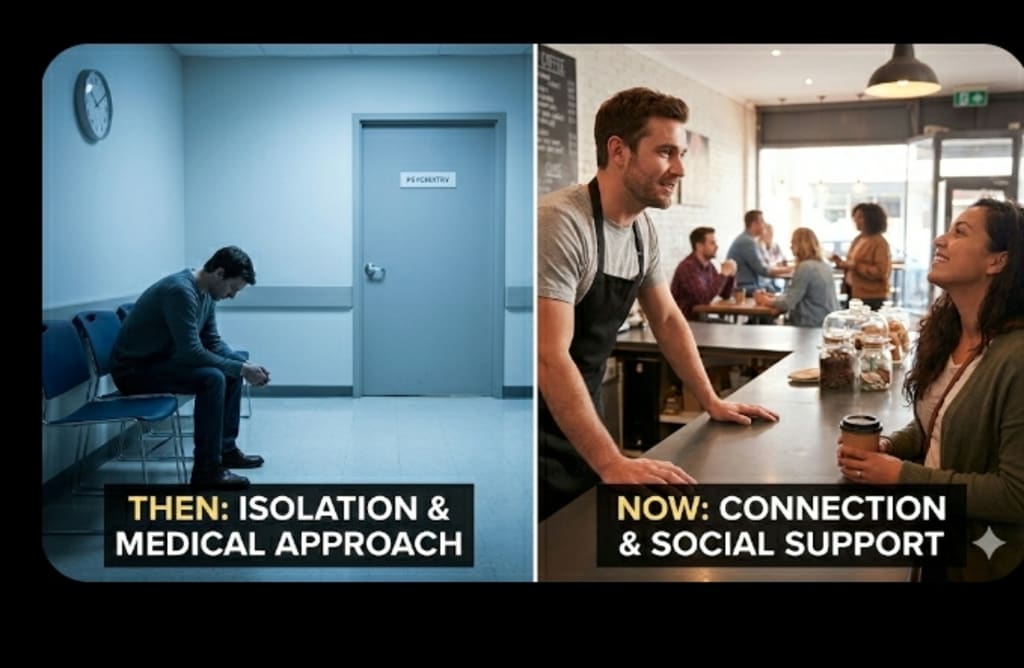
The inspiring story of the Gotland suicide prevention model, where a community lowered suicide rates not with more hospitals, but by training everyday people to break the silence of isolation.
Gotland is an island of stark, melancholic beauty. Sitting in the middle of the Baltic Sea, off the coast of Sweden, it is a landscape of limestone cliffs, wind-swept beaches, and medieval ruins. In the summer, it is a tourist paradise. But in the long, dark Scandinavian winters, when the tourists leave and the ferries run less frequently, the island contracts. The silence settles in.
For a long time, that silence was deadly.
Gotland, like many rural communities across Northern Europe, had a shadow hanging over it. While Sweden is often cited as a model of social welfare and happiness, it has also battled historically high rates of suicide. The statistics were particularly grim for a specific demographic: middle-aged men. Farmers. Fishermen. Laborers.
These were men built of stoicism. They were raised in a culture where feelings were private, where weakness was shameful, and where you solved your own problems. If the tractor broke, you fixed it. If your mind broke, you kept your mouth shut.
The healthcare system was failing them. Not because the doctors weren't good—Sweden has some of the best medical care in the world—but because the patients were invisible.
A man planning to end his life rarely books an appointment with a psychiatrist to discuss it. He doesn't call a hotline. He doesn't walk into an emergency room and say, "I am in pain."
He simply withdraws. He stops laughing at the pub. He stops returning calls. He goes to work, he comes home, and he slowly, quietly, fades away until the day he decides to leave for good.
The traditional safety nets—hospitals, clinics, therapists—were waiting for patients who never arrived. They were fishing with nets that were too small, in waters where the fish had stopped swimming.
In the late 20th and early 21st centuries, health officials and community leaders in Gotland realized they were fighting the wrong war. They were treating suicide as a purely medical problem, waiting for the "symptoms" to walk through the door. But suicide, they realized, is often a social problem. It is a disease of disconnection.
If the men wouldn't come to the doctors, the help had to go to the men.
Part I: The Invisible Army
The inspiration for the change came from a simple observation. These isolated men might not see a therapist, but they still lived in the world. They still bought milk. They still needed haircuts. They still picked up their mail. They still bought nails at the hardware store.
The health officials realized that there was an army of people interacting with these at-risk men every single day. They weren't doctors. They were shop assistants, taxi drivers, bartenders, pharmacists, and postal workers.
They were the "gatekeepers" of the community. They saw the changes that the doctors missed.
The barber knew that Lars used to talk about football, but now sat in the chair in silence, staring at the floor.
The cashier at the grocery store knew that Sven used to buy fresh food, but now only bought frozen dinners and vodka.
The postal worker noticed that the curtains in the farmhouse hadn't been opened in three days.
These people saw the signs, but they didn't know what to do with them. They felt it wasn't their place to interfere. They were afraid of offending. They were afraid of being wrong. They were afraid that if they asked, "Are you okay?", the answer might be too heavy for them to carry.
So, the silence continued.
The initiative (which drew inspiration from the earlier "Gotland Study" on GP training and expanded into community awareness) decided to arm this invisible army. But not with medication. They armed them with permission.
They began a series of trainings. It wasn't a complex psychology degree. It was human training. It was designed to break the "social contract of silence"—the polite agreement that we don't ask about each other's pain.
They taught the shopkeepers and the neighbors three simple things:
* Notice the change: Look for the withdrawal, not just the tears. Silence is often louder than screaming.
* Ask the question: Don't be afraid to ask. Asking about suicide does not plant the idea in someone's head; it relieves the pressure.
* Listen without fixing: You don't need to be a doctor. You don't need to solve the problem. You just need to hold the space.
Part II: The Question That Changes Everything
The training was about removing the "social friction" of intervention.
Usually, when we see someone struggling, we say the standard, empty phrase: "How are you?"
And the person gives the standard, empty answer: "I'm fine."
And the interaction ends. Both parties are relieved to have avoided the awkwardness.
The Gotland approach taught people to disrupt that script.
Imagine a hardware store in a small village. A regular customer comes in. He looks tired. He’s lost weight. He’s buying rope. In the old world, the clerk rings him up, says "Have a nice day," and the man walks out.
In the new world, the clerk pauses. He looks the man in the eye. He doesn't say, "How are you?"
He says: "Hey, Anders. I've noticed you haven't been yourself lately. You seem really down. Is everything okay?"
It seems like a small difference. But in the psychology of a suicidal person, it is an earthquake.
Depression tells you two lies:
* You are a burden.
* You are invisible.
When the clerk asks that specific, observational question, he shatters the second lie. He proves, in that moment, You are not invisible. I see you.
The training emphasized that you don't need to save the person right there. You just need to interrupt the spiral. You need to be a speed bump.
If the man breaks down, you listen. If he admits he's struggling, you have a card ready with a number. You say, "I know a guy at the clinic who is really good. Can I call him for you?"
It wasn't about therapy. It was about "warm handoffs." It was about building a bridge from the isolation of the hardware store to the safety of professional help.
Part III: The Social Safety Net
The results of this shift in thinking—combined with better training for General Practitioners to recognize depression—were profound.
Suicide rates on the island, particularly among women and later men, saw significant declines during the active phases of these interventions. The use of antidepressants went up, not because more people were sick, but because more people were finally accepting help.
But the numbers only tell half the story. The real story is what happened to the culture of the island.
The stigma began to crack.
When a bartender feels empowered to ask a regular, "You drinking to forget something tonight?", the pub changes from a place of escape to a place of community. When a postal worker knocks on a door because the mail is piling up, the route changes from a logistical task to a welfare check.
The community realized that mental health wasn't something that happened in a hospital. It was something that happened in the space between people.
They learned that "suicide prevention" isn't just for psychiatrists. It is for everyone. It is a civic duty, like voting or recycling.
The Gotland model showed that the most effective tool against despair isn't always a pharmaceutical. It is human connection. It is the simple, terrifying act of caring enough to be awkward.
Part IV: The Fear of Intrusion
One of the biggest barriers the training had to overcome was the Swedish cultural trait of non-intrusion. In many Western cultures, we are taught to mind our own business. We view asking personal questions as rude or aggressive.
The project flipped this. It reframed "minding your own business" as a form of neglect.
They taught people that the risk of offending someone is infinitely smaller than the risk of burying them.
If you ask someone, "Are you thinking about hurting yourself?" and they aren't, they might be confused. They might be a little annoyed.
But if you don't ask, and they are, they might die.
The math is simple. The awkwardness is worth the life.
This shifted the definition of a "good neighbor." A good neighbor wasn't someone who kept their fence painted and their music down. A good neighbor was someone who noticed when your lights stayed off.
Part V: The Universal Lesson
The story of Gotland is not just about a Swedish island. It is a mirror for every community in the modern world.
We live in an era of unprecedented connectivity, yet unprecedented isolation. We have a thousand Facebook friends, but no one who knows when we are crying. We have "likes," but we don't have "looks"—the kind of deep, noticing look that says, I see your pain.
The suicide crisis is growing globally, particularly among men, and particularly in places where the "stiff upper lip" mentality prevails.
We often look to governments to solve this. We want more funding, more hotlines, more apps. And those things are vital.
But Gotland proves that the first line of defense is us.
The "Gatekeeper" model is now used around the world, from the US Air Force to construction sites in Australia. It all stems from the same realization: The people best positioned to save a life are the people already in it.
Conclusion: The Power of "Hello"
The next time you are buying coffee, or getting your hair cut, or chatting with a colleague, look at them. Really look at them.
If you see a shadow, don't look away. Don't assume someone else will handle it. Don't assume they have a therapist.
Remember the shopkeepers of Gotland. Remember that you have the power to break the seal of silence.
It takes courage. Your heart will beat faster. You will worry about saying the wrong thing.
But you don't need the perfect words. You just need the right intention.
"You haven't seemed yourself lately."
That sentence is a key. It unlocks the door that depression has bolted shut. It lets a little bit of light into a very dark room.
And sometimes, that little bit of light is all someone needs to find their way back to the world.
The town didn't beat suicide because they found a magic pill. They beat it because they realized that the opposite of death isn't just life. The opposite of death is love. And love, at its simplest, is just paying attention.
About the Creator
Frank Massey
Tech, AI, and social media writer with a passion for storytelling. I turn complex trends into engaging, relatable content. Exploring the future, one story at a time
Keep reading
More stories from Frank Massey and writers in Motivation and other communities.
What I do to not lose my creative spark
The origin of creativity is in the mind, what you can imagine, you can bring to life. You can’t create something you’ve never imagined or envisioned (unless by accident), so this goes to show you that a lot of the creative process takes place in our mind and what else is in the mind? Memories.
By real Jema7 days ago in Motivation
How to Succeed at the Benson Directory®
Congratulations and welcome to the Benson Directory® employee #22391! As our newest call handler, you will have the privilege of speaking with dozens of unique and interesting people on a daily basis as well as the opportunity to earn bonuses for high performance. Contained within this handbook you will find a set of ease to follow instructions designed to help you settle in to your new role and begin paving the way to success.
By S. A. Crawforda day ago in Fiction



Comments
There are no comments for this story
Be the first to respond and start the conversation.