
The Last Voice in the Room: The Man Who Caught a Civilization on a Cassette Tape
In the remote outback of Australia, a linguist realized that an entire universe was about to vanish because an old woman was dying. To save it, he didn't write a textbook. He just asked her to tell a joke.

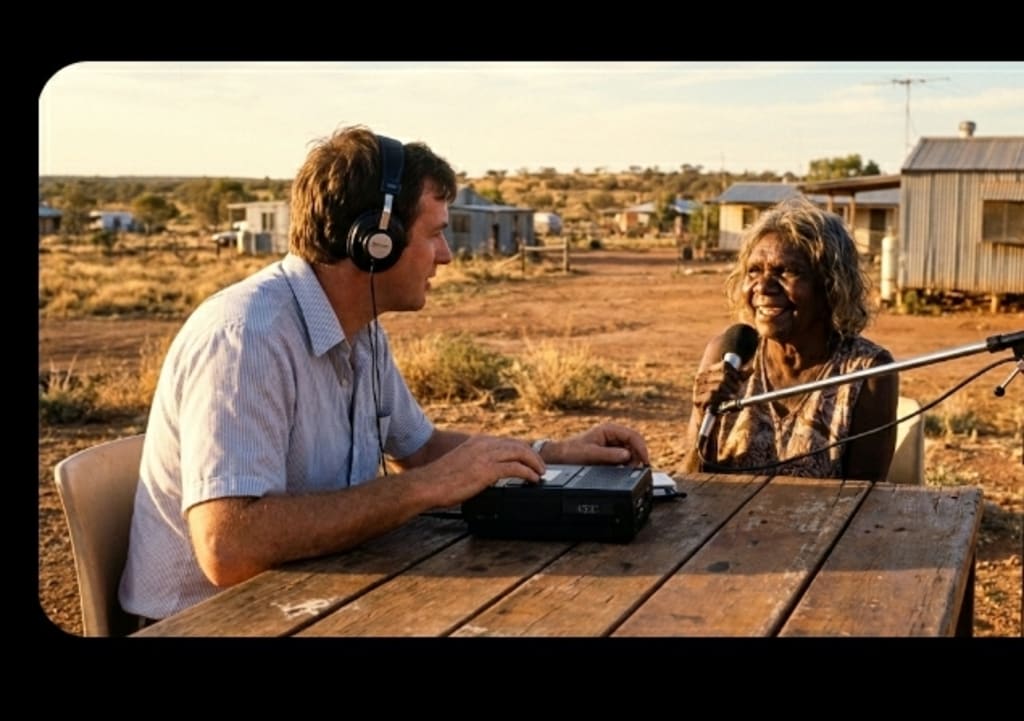
The poignant true story of how linguists and Indigenous elders in Australia raced against time to record dying languages, proving that preserving a voice is preserving a world.
The most terrifying sound in the world is not an explosion. It is not a scream. It is a silence that happens when the last person on earth who speaks a language takes their final breath.
We are living in the middle of a mass extinction event, but it isn't happening to pandas or rhinos. It is happening to human thought. Of the roughly 7,000 languages spoken on Earth today, experts predict that half will vanish by the end of this century. Every two weeks, somewhere on the planet, an elder dies, and a library burns down.
In the late 20th century, the front line of this silent war was Northern Australia.
Here, in the vast, red-dirt expanse of the Kimberley and the Northern Territory, the oldest living cultures on earth were facing a crisis. For 60,000 years, the Indigenous people had sung their land into existence. They had words for the specific angle of the sun at 4 PM, words for the relationship between a certain ant and a certain flower, words that described kinship structures so complex they baffled Western mathematicians.
But after two centuries of colonization, massacres, and the brutal policy of the "Stolen Generations"—where children were forcibly removed from their families and forbidden to speak their mother tongues—the chain was breaking.
The fluent speakers were old. They were frail. And they were lonely.
Imagine being the only person in your town, in your family, in your entire world, who understands the language of your childhood. You make a joke, and no one laughs because they don't understand the double meaning. You see a bird, and you say its name, but the word echoes in a void. You are living in a solitary confinement built of silence.
Into this landscape came a new generation of linguists, men and women like David Nathan and others who worked with the Central Australian Aboriginal Media Association (CAAMA) and various language centers. They weren't there to colonize. They were there to catch the falling sand.
They realized that the old way of saving languages—writing grammar books, making lists of verbs, analyzing syntax—was useless. A grammar book is a skeleton. It has bones, but it has no breath. It has no soul.
To save a language, you don't need a textbook. You need a voice.
Part I: The Recorder on the Table
The scene played out in dozens of tin shanties and community centers across the outback. A young linguist sits at a laminate table. Opposite him sits an Elder—perhaps a woman in her 80s, her face a map of deep lines, her eyes cloudy with cataracts.
Between them sits a piece of technology. In the 1970s, it was a reel-to-reel tape recorder. In the 90s, a cassette player. Later, a MiniDisc.
The linguist checks the levels. The needle jumps.
"Are you ready, Auntie?"
She nods.
"Tell me about when you were a girl."
And she begins to speak.
She doesn't recite verb tables. She doesn't conjugate. She tells stories. She talks about the time she ran away from the mission school to find honey ants. She talks about the "mimi" spirits that live in the rocks. She sings a song about the rain that is so rhythmic, so hypnotic, that even without understanding the words, you can feel the humidity rising.
She laughs. It is a dry, crackling laugh. She makes a pun—a play on words involving the word for "husband" and the word for "useless dog." The linguist laughs too, not because he fully gets it, but because he feels the energy of it.
For hours, the tape spins. It catches the words, yes. But it also catches the pauses. It catches the intake of breath. It catches the specific cadence of a worldview that has survived the Ice Age.
The linguist knows, with a heavy heart, that he is recording a ghost. He knows that when this woman is gone, there will be no one left on earth who can make that specific sound with their tongue. He is bottling a star before it burns out.
Part II: The Complexity of "Simple" Languages
One of the great lies of colonialism was the idea that Indigenous languages were "primitive." The early settlers heard the strange sounds and assumed they were simple dialects, lacking the sophistication of English or Latin.
The recordings proved how wrong they were.
As the linguists analyzed the tapes, they discovered systems of grammar that made English look like a blunt instrument.
They found languages that had "skin groups"—kinship terms that instantly defined your relationship to every other person in the universe. In English, we say "cousin." In some Australian languages, there are different words for "mother's sister's child" versus "father's brother's child," and each carries a different set of responsibilities and taboos.
They found languages that use "cardinal directions" instead of "left" and "right." You don't say, "There is an ant on your left leg." You say, "There is an ant on your southwest leg." This means that to speak the language, you must have a compass in your head at all times. You must be perfectly oriented to the earth every second of your life.
If you lose that language, you don't just lose words. You lose that cognitive compass. You lose the connection to the land.
The Elders knew this. They weren't speaking into the microphone for the white man with the headphones. They were speaking to their grandchildren. They were speaking to the future.
They were creating a time capsule. "Here," they were saying. "This is who we were. This is who you are. Don't forget."
Part III: The Silence and the Return
Then, inevitably, the silence came.
The Elders passed away. The funerals were held. The linguists packed up their equipment and went back to the universities. The tapes sat in archives, in climate-controlled vaults in Canberra or Darwin.
For a while, it seemed like the end. The languages were classified as "extinct" or "sleeping." The children grew up speaking Kriol or English. The thread was cut.
But technology, which had once been a tool of colonization, became a tool of resurrection.
In the early 2000s, something shifted. A new generation of Indigenous people—young, tech-savvy, and hungry for their identity—started looking for the tapes.
They went to the archives. They found the recordings of their grandmothers and great-grandfathers.
They put on the headphones.
And they heard a voice from the grave.
"Ngayu... ngayu..." (I... I...)
They heard the laugh. They heard the songs.
It was an electric moment. Tears streamed down faces. For a young man who had grown up drifting, unsure of his place in a hostile white society, hearing his ancestor speak the language of his blood was like finding a map in a dark room.
They didn't just listen. They started to learn.
They took the recordings and digitized them. They used the dictionaries the linguists had built to decode the syntax. They built apps. They put the words on YouTube. They started "language nests" where toddlers were taught the old words before they learned English.
The language wasn't dead. It had just been holding its breath.
Part IV: The Philosophy of the Archive
David Nathan and his colleagues realized that their role had changed. They weren't the "keepers" of the language. They were just the tech support. The language belonged to the people.
But the work they did—the simple, tedious act of sitting in a hot tin shack, pressing "Record," and listening—had saved a civilization.
This story forces us to rethink what constitutes a "heroic" act.
We usually think of heroes as people who storm beaches or cure diseases. We rarely think of the person who sits quietly and listens.
But consider the alternative. If those tapes didn't exist, that knowledge would be gone. The specific medical knowledge of bush plants contained in the songs? Gone. The navigational data encoded in the Dreamtime stories? Gone. The humor, the philosophy, the very soul of the people? Gone.
It would be as if the Library of Alexandria burned down, and no one saved a single scroll.
By recording the "useless" stories—the jokes, the gossip, the lullabies—the linguists captured the humanity of the language, not just its mechanics.
Part V: The Songlines of the Future
Today, there is a renaissance occurring. In schools across Australia, children are singing songs in languages that were supposed to be dead by now.
They are not fluent in the way their great-grandparents were. They might never be. They are speaking "reclaimed" language. It is a patchwork, stitched together from memory and magnetic tape.
But it is alive.
When a child points to a wedge-tailed eagle and says "Warlawurru" instead of "bird," a circuit is reconnected. The land hears its name again.
The story of the linguist and the Elder is a reminder to all of us about the urgency of memory.
We all have elders in our lives. We all have people who carry worlds inside their heads—stories of the old country, recipes that aren't written down, family histories that explain why we are the way we are.
We often think, "I'll ask them about that later." "I'll write that down someday."
But "someday" is a dangerous lie. The silence is always waiting.
The lesson of the lost languages is simple: Record it now.
Ask the question. Turn on the voice memo on your phone. Get the story.
Because when an old person dies, a library burns to the ground. And the only way to save the books is to be there, recorder in hand, before the fire starts.
David Nathan and the Elders proved that you can cheat death. You can't stop the body from dying, but you can stop the voice from fading. You can make sure that a hundred years from now, when a child feels lost and alone, they can put on a pair of headphones and hear their ancestor whisper: "You are still here. We are still here."
That is not just linguistics. That is love.
About the Creator
Frank Massey
Tech, AI, and social media writer with a passion for storytelling. I turn complex trends into engaging, relatable content. Exploring the future, one story at a time
Keep reading
More stories from Frank Massey and writers in Motivation and other communities.
The Town That Stopped Worrying: The Forgotten Experiment That Proved Poverty Is Just a Lack of Cash
The incredible true story of the "Mincome" experiment in Dauphin, Manitoba, where a guaranteed basic income in the 1970s led to better health and education, only to have the data hidden for 30 years.
By Frank Massey 3 months ago in Motivation
From Field to Table: How Venison Donations Support Families in Need
Each year, many families in Huntsville struggle to keep enough food on the table. Rising costs and unexpected hardships make it difficult for some households to meet basic needs. At the same time, hunters across the region harvest deer during the season. When these two worlds connect, something powerful happens. Through programs that encourage donating venison, hunters can help provide healthy meals to people who need them most. One local partner making a real difference is Manna House in Huntsville.
By Joe Sottolano7 days ago in Motivation


Comments
There are no comments for this story
Be the first to respond and start the conversation.