
The Invisible Army: How 10,000 American Women Broke the Axis Codes and Were Ordered to Forget It
During World War II, the U.S. military recruited thousands of female college students to hunt for patterns in the noise of enemy radio traffic. They shortened the war and saved countless lives, only to be erased from history by the very government they served

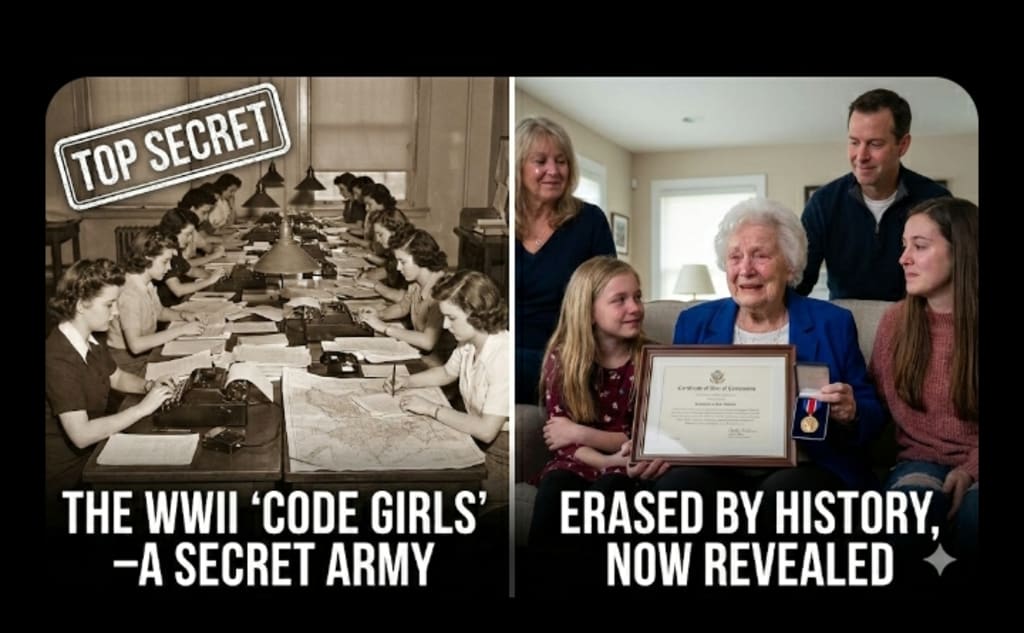
The untold true story of the "Code Girls" of World War II—American women recruited to break German and Japanese codes in total secrecy, only to be forced into silence for decades.
Introduction: The Secret in the Suburban Kitchen
For the second half of the 20th century, the image of the American grandmother was standardized. She was the woman who kept the home, who raised the Baby Boomers, who knit sweaters, and who baked casseroles. When her grandchildren asked what she did during the "Big One"—World War II—she usually gave a modest, rehearsed answer.
"I worked in an office in Washington," she might say. "I did some filing." Or perhaps, "I was a secretary for the Navy."
It was a lie. A lie told by thousands of women, repeated at dinner tables across the United States for fifty years.
The truth was far more terrifying and far more glorious. The truth was that while their brothers and husbands were storming the beaches of Normandy or island-hopping in the Pacific, these women were sitting in overheated, repurposed schoolhouses in Virginia and Washington D.C., hunting down Japanese supply convoys with a pencil and paper. They were tracking Nazi U-boats in the Atlantic. They were deciding who lived and who died based on their ability to solve a math problem.
They were the Code Girls. At the height of the war, more than 10,000 women served as cryptanalysts for the U.S. Army and Navy. They formed the backbone of American intelligence. It is estimated that their work shortened the war by more than a year, saving hundreds of thousands of lives on both sides.
And yet, when the war ended, they were not given parades. They were given a stern warning: This never happened. If you speak of it, you will be prosecuted for treason.
So, they went home, packed away their intellect, and let history forget them.
Part I: The Desperate Search for Talent
To understand the rise of the Code Girls, you must understand the desperation of 1941. Before the attack on Pearl Harbor, the United States military was woefully underprepared for global intelligence warfare. The Army and Navy had tiny, underfunded codebreaking units dominated by eccentric mathematicians and career officers.
When the bombs fell on Pearl Harbor, the U.S. realized it was effectively blind. The Axis powers—Germany and Japan—were communicating constantly over the radio waves, coordinating attacks, moving troops, and sinking supply ships. These messages were encrypted using complex machines (like the German Enigma) or intricate hand-ciphers. To the untrained ear, it was just static and noise. To the untrained eye, it was gibberish.
The military needed brains. Specifically, they needed people with an aptitude for pattern recognition, languages, mathematics, and astronomy. They needed people who could stare at a chaotic sequence of letters for twelve hours straight and spot the single repetition that revealed the key.
But the men were leaving. The draft was consuming the male population of the United States. The math professors, the engineers, the lawyers—they were being handed rifles and sent to the front.
For the first time in American history, the military establishment looked at the other half of the population and realized they had an untapped natural resource: educated women.
The recruitment process was covert and strange. In 1942, deans at women’s colleges like Wellesley, Vassar, Smith, and Bryn Mawr began receiving inquiries from the Navy. They were looking for their best seniors—specifically those excelling in astronomy, math, and foreign languages.
The women were invited to private meetings. They were asked if they liked crossword puzzles. They were asked if they were engaged to be married (an engagement was often a disqualifier, as the military feared "loose lips" or distraction). If they passed the initial screening, they were offered a job in Washington. They weren't told what the job was. They were simply told it was vital to the war effort and that they could tell no one.
Simultaneously, the Army took a broader approach. They placed ads in newspapers looking for women to do "clerical work" or "assist with communications." In some famous instances, crossword puzzle competitions were used as dragagnets to identify civilians with the right kind of mental agility.
Thousands of women answered the call. They were schoolteachers from the Midwest, debutantes from the East Coast, and farm girls who had a knack for numbers. They boarded trains to Washington D.C., a city that was rapidly becoming a boomtown of secrets.
Part II: The Factory of Secrets
When they arrived, the reality was far from the glamorous spy novels of the era. The Army’s codebreaking operation was housed largely at Arlington Hall, a former girls' school in Virginia. The Navy took over a girls' school in D.C. called Mount Vernon Seminary.
The working conditions were grueling. Washington in the summer is a swamp, and these buildings had no air conditioning. The women worked in rotating eight-hour shifts, seven days a week, in rooms so hot they had to strip down to their slips, working with fans blowing hot air over sweat-drenched papers.
Their job was cryptanalysis. This is distinct from cryptography (making codes). Cryptanalysis is the art of breaking them.
The enemy messages would come in as streams of intercept data—intercepted Morse code translated into strings of random letters or numbers. The women had to "strip" the codes. They had to figure out which "additives"—random strings of numbers added to the original message to disguise it—had been used.
It was excruciating, tedious, mental labor. It required holding massive strings of numbers in one's head, looking for the "echo" of a pattern. It was not a job for computers, because computers as we know them did not exist. The computer was the human brain.
There was a strict hierarchy, and it was deeply sexist. The men were the officers; the women were the "civilians" or "auxiliaries." Yet, as the war dragged on, the sheer volume of intercepts meant that the women were doing the bulk of the actual codebreaking.
They weren't just checking math; they were decoding the Japanese Imperial Navy’s movements. They were tracking the "wolf packs" of German U-boats in the North Atlantic.
One of the most profound aspects of their service was the segregation. While most of the "Code Girls" were white, the Army also recruited a unit of African American women. Because of the segregation laws of the time, they were kept in a separate unit, largely denied the same opportunities for advancement, yet they performed the same vital, high-stakes work, deciphering the coded traffic of commercial firms to track money and supplies flowing to the enemy.
Part III: The Blood on the Paper
The psychological toll of the work was immense. For a soldier on the front line, the enemy is physical. For the Code Girls, the enemy was abstract, but the consequences were visceral.
These women knew, often before the generals did, when a battle was about to begin. They decoded the messages organizing supply convoys.
There were moments of terrible burden. If a woman cracked a code that revealed a U-boat position, and the Navy successfully sank that U-boat, she went home that night knowing that her arithmetic had killed German sailors.
Conversely, if she failed—if she couldn't strip the additive in time, or if the Japanese changed their cipher book (which they frequently did), and an American convoy was ambushed—she carried the weight of those American deaths.
Many of these women had brothers, fiancés, and husbands serving overseas. They lived in constant terror of decoding a message that would describe the destruction of their own loved one’s unit.
One famous incident involved the "Maru" codes—the codes used by the Japanese merchant fleet. The American codebreakers became so proficient at breaking these that the U.S. submarines were able to strangle the Japanese supply lines. They sank the ships carrying food, oil, and ammunition to the Japanese troops.
By 1944, the Code Girls were reading the private misery of the Japanese army. They decoded messages from starving Japanese commanders begging for food that would never arrive. They read the last letters of doomed men. They were intimately connected to the suffering of the enemy, ghost-witnesses to the slow collapse of an empire.
But their greatest triumph was the Battle of Midway.
While this success is often attributed to male officers like Joseph Rochefort, the teams that did the grunt work of processing the intercepts were staffed by women. It was the cumulative effort of these teams that allowed the U.S. to trick the Japanese into revealing their target ("AF") was Midway Island. This intelligence allowed the U.S. Navy to set a trap, sinking four Japanese aircraft carriers and turning the tide of the war in the Pacific.
Without the sheer volume of data processed by the women in the basement, that trick might never have worked.
Part IV: The Assassination of Admiral Yamamoto
Perhaps the most dramatic moment came in April 1943. American listening posts intercepted a message detailing the travel itinerary of Admiral Isoroku Yamamoto, the architect of the Pearl Harbor attack.
The message was encrypted, but the American codebreakers tore through it. They knew exactly where he would be, at what time, and what kind of plane he would be flying.
The decision was made at the highest levels to assassinate him. American P-38 Lightning fighters were dispatched to intercept his plane over Bougainville. They shot him down.
In the history books, this is recorded as a triumph of air power and military strategy. But in the quiet rooms of Arlington Hall, the women knew the truth. Yamamoto wasn't killed by a gun; he was killed by a solved puzzle.
Part V: The Cold Silence
When the war ended in 1945, the celebrations in the streets of New York and Chicago were raucous. But in the codebreaking units, the mood was somber and strange.
The military leadership was pivoting immediately to a new threat: the Soviet Union. The Cold War was beginning.
The United States government realized that its greatest weapon during WWII had not been the atomic bomb, but its signals intelligence (SIGINT). They had read the enemy’s mail for four years.
They did not want the Soviets to know how good the Americans were at this. If the world knew that "college girls" had broken the unbreakable Enigma or the Japanese Purple code, other nations would change their encryption methods.
So, a blanket of absolute silence was dropped over the entire operation.
The women were gathered in auditoriums and given stern lectures. They were told that their service was a state secret. They were told that revealing their work would be an act of treason. They were told that "loose lips" could still sink ships, even in peacetime.
And then, they were fired.
The men were coming home. The narrative of 1950s America was about the nuclear family, the suburbs, and domesticity. The women who had tracked battleships and outsmarted generals were told to go home, get married, and have babies.
They were stripped of their careers. They received no veteran status. They received no GI Bill benefits. There were no VFW halls for them.
So they did what they were told. They went home.
They married men who had fought in the war. Their husbands would tell war stories about the Bulge or Iwo Jima. The women would listen, nodding politely, slicing the roast, never mentioning that they had known about those battles before the soldiers did.
They buried their brilliance under a facade of normalcy.
Part VI: The Rediscovery
For decades, this history was lost. It wasn't until the late 1990s and early 2000s that the NSA and the military began to declassify the documents from the WWII signals intelligence era.
Authors like Liza Mundy, whose seminal book Code Girls finally brought this story to light, began digging through the archives. They found rosters of names. They found frantic memos about "the girl who solved the coral reef problem."
They began to track down the survivors. By then, these women were in their 80s and 90s.
When the historians knocked on their doors, many of the women were terrified. They were still afraid of being arrested. They checked to make sure the "statute of limitations" on treason had passed.
When they finally spoke, the floodgates opened. They spoke of the heat in the attics, the smell of the carbon paper, the thrill of the "bust" (breaking a code), and the sorrow of the losses. They showed their families letters and commendations they had hidden in the bottoms of jewelry boxes for sixty years.
Children and grandchildren were stunned. They looked at their grandmothers—women they thought they knew—and realized they were looking at strangers. They weren't just housewives; they were the architects of victory.
Part VII: Why It Matters Today
The story of the Code Girls is not just a piece of trivia for history buffs. It is a fundamental correction of the American narrative.
We love to tell stories of individual heroism—the soldier jumping on the grenade, the pilot landing the damaged plane. But World War II was won by systems. It was won by logistics, by supply chains, and by information.
And those systems were run by women.
This story matters today because it challenges the concept of "invisible labor." In every era, there is work that is essential but unglamorous. There is work that holds the world together but gets no credit. For centuries, that work has disproportionately fallen to women.
The Code Girls prove that intelligence does not require testosterone. They prove that you can be a warrior without holding a gun.
They also remind us of the tragic loss of human potential. After the war, thousands of these brilliant female mathematicians and linguists were pushed out of the workforce. How many scientific breakthroughs were delayed because these women were forced back into the kitchen? How many inventions were never made because society decided their brains were no longer needed?
Conclusion: The Final Decryption
Today, if you visit the National Cryptologic Museum or read the plaques at Arlington National Cemetery, you will finally see their names.
But the real monument to the Code Girls is the world we live in.
If you speak English instead of German, if you live in a democracy rather than a fascist state, you owe a debt to a twenty-year-old girl in 1943 who decided to skip her lunch break because she thought she saw a pattern in the numbers.
They did the work. They kept the secret. They saved the world.
And then, with a quiet dignity that puts our modern celebrity culture to shame, they went back to their lives.
They remind us that the truest form of service isn't about getting credit. It's about getting the job done. But seventy years later, it is finally time to break the silence and give them the applause they never asked for, but so richly deserve.
About the Creator
Frank Massey
Tech, AI, and social media writer with a passion for storytelling. I turn complex trends into engaging, relatable content. Exploring the future, one story at a time
Keep reading
More stories from Frank Massey and writers in Motivation and other communities.
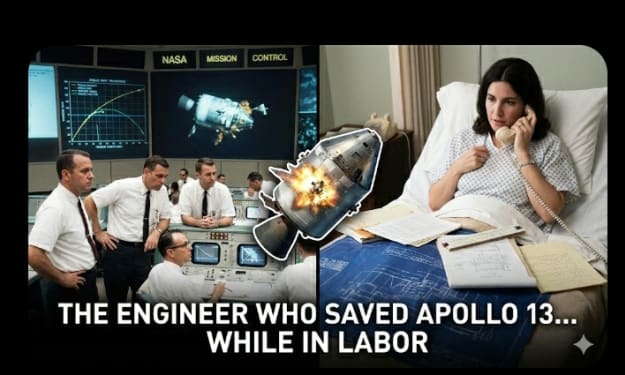
The Engineer in the Maternity Ward: How Judith Love Cohen Helped Save Apollo 13 Before Giving Birth to a Rock Star
The incredible true story of Judith Love Cohen, the aerospace engineer who finalized the Abort Guidance System for Apollo 13 while in labor with her son, Jack Black. A deep dive into the history of women in STEM and the invisible labor that saved the space program.
By Frank Massey 22 days ago in Motivation
You are not a failure
“ You look sad, David, what’s going on?” the old man noticed, as David pulled out a chair when he entered the room. “ When I look at my life, I’m not happy. Nothing is working. I’m forty-three. I have no house, no money, no kids. I make minimum wage at my job to survive. Not to mention the credit card debts and some health issues. I think that I’m a failure,” David said, almost in tears.
By Michel Tetchi 7 days ago in Motivation


Comments
There are no comments for this story
Be the first to respond and start the conversation.