
The Ill Subtle Effects of Social Media: How it Harms Your Mental Health
How persistent scrolling alters your brain, worsens anxiety, and affects your mental well-being to a greater extent than you think.

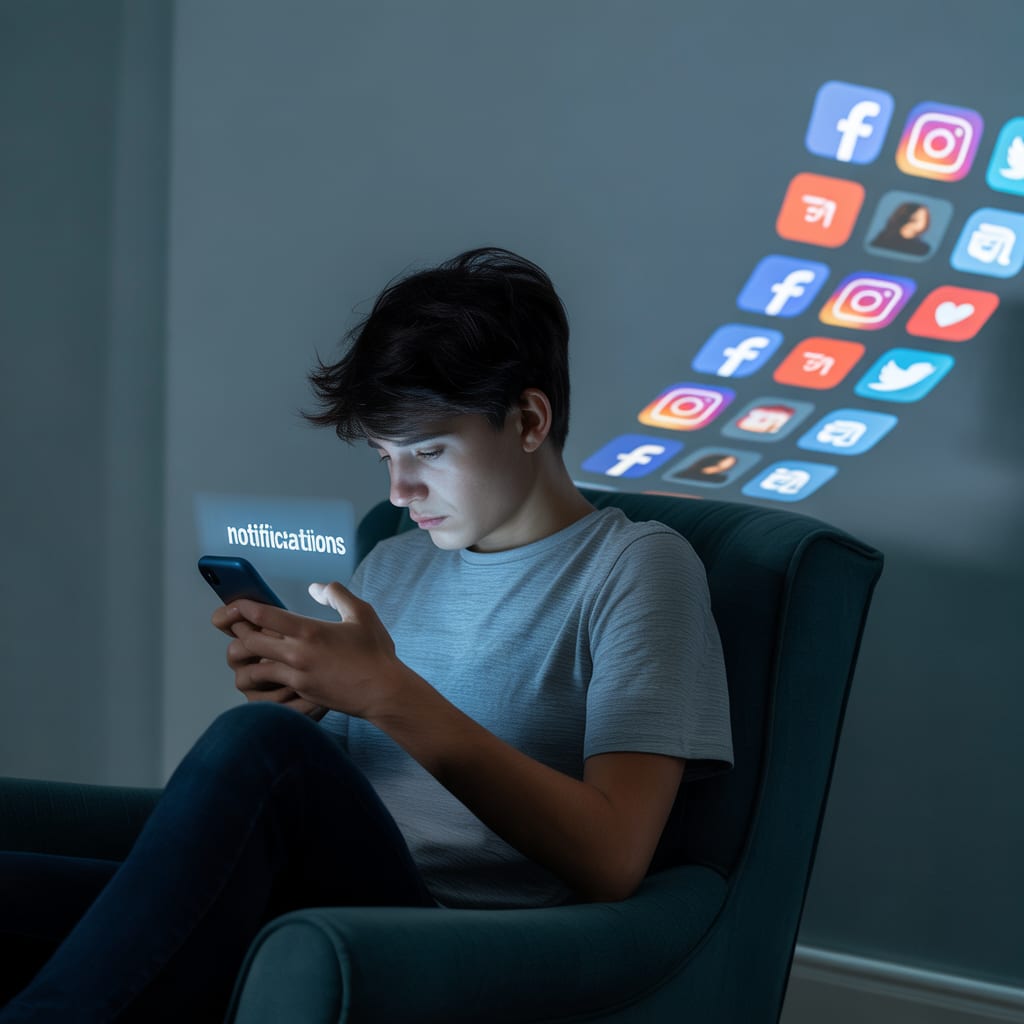
In the current era, social media has transcended the limits of just being applications on our mobile phones to becoming essentials of our daily routines. We use it to connect, mark events, along with receiving updates on the world. For a lot of us, logging into Instagram or scrolling TikTok has become as habitual as sipping on a cup of coffee during the morning.
But the social media’s multi colored shell conceals the alarming facts of it’s impact on our daily mental health. The internet does connect us, but the social media services can prove detrimental to mental health in ways we overlook, or do not wish to discuss.
In this piece, we shall uncover the real impact of social media on our mental health, along with ways to regain the control we have lost, before it’s too late.
Key take aways
Exessive social media can lead to increasing levels of anxiety and depression.
Perpetual scrolling can overload one’s mind with data or information, increasing the levels of mental fog.
Social media can damage self esteem and self worth.
Practicing mindful use of social media, or a digital detox can significantly boost well being and shift mental state.
Our attention is the “currency” being sold, therefore protecting it is of utmost importance.
The Digital Revolution and Our Brains
The digital revolution transformed our lives in many ways. Today, technology has become illimitable and intrinsic to our lives, requiring us to keep using it. Everything we do online increasingly shapes our habits, attention spans, and even our dopamine systems.
From a Few Occasional Check Ins to Endless Scrolling
Facebook and Twitter were once platforms that users accessed once or twice a day. Today, infinite scroll and push notifications have transformed the platforms. Meticulously designed algorithms and scroll systems keep us captivated.
Our ephemeral interactions today have unprecedented levels of attention and connectivity, essentially giving us the ability to stay in constant connection. Today, our interactions have become modes of completing short and instantaneous tasks. Everything feels like a game and our relentless need for novelty is giving technology the ability to manipulate us.
The Hidden Psychological Costs
The financial costs of excessive use of social media are bearable, however, expenses around our mental well-being are hard to accept. The reasons for social media's psychological damage is a cumulative result of various factors, and that increasingly fewer people can pinpoint the root cause of their stress, anxiety, or unhappiness.
Dopamine loops, social media notifications, and reward systems are in place to keep technology engaging and users glued. Each notification awards us dopamine surges, and in simpler terms is “brain candy.” Over time, social media users begin to change their behaviors to seek out “dopamine hits.”
We get stuck in endless dopamine loops because social media interacts with the same brain pathways as substances! That is the reason why it is so difficult to “just put the phone down”.
The Comparison Trap
In the modern world, people see curated social media clips from people’s lives. This makes people feel as if they are behind in life. People’s brains subconsciously register their lives against others’ filtered and staged lives. This happens, even if people are aware that the content is fake.
The result from this Comparison Trap is low self-esteem, body image issues, and the feeling of never being good enough.
Anxiety and Depression in the Digital Age
Research shows that social media and anxiety are often used in the same sentence. They happen to study the effects of social media and mental health, and they have reported a startling correlation. The study found a correlation in overuse of social media, and over the increasing rate of anxiety disorders.
In their findings, cyberbullying, nagging, and the fear of being out of the social circle was the dominant discourse among teens and young adults. Surprisingly, older adults reported a feeling of depression, specifically those that reported to be frequent users of social media. The respondents said they felt a strong sense of loneliness that took the form of depression, linked to the fact that their interactions were often through the computer.
That social media is their marketplace, and as far as the people behind the platform goes, they are the creators, and the users are the product. People seem to be oblivious to the fact that their focus is so highly valued.
These platforms earn revenue selling your eyeballs off to advertisers. That’s why they are loaded with features to keep you supremely glued to scrolling:
Endless scrolling with no designated stopping point.
Push Notifications perfectly timed to yank you back.
Custom feeds designed to showcase content that peak your interest for the day.
These are not coincidences—they are profit driven companies. The more distracted you are, the more profit they are making.
FOMO, Validation and the New Social Currencies
The main social media platforms thrive off of the the horrific duo of psychology: FOMO and social validation.
Every “like” and “comment” feels like micro-armies backing someone’s cause, allowing them to feel like they are part of something greater.
The dreaded “empty bubbles” leading to no notification bombardment sparks stress, social rejection, and the dreaded self-doubt.
Oftentimes, self-esteem is now linked to engagement numbers, which are simply not within one’s control. Solving this dilemma requires a lot of effort and a better mindset to validation.
Social Media Disruption of Sleep
Bedtime scrolling may feel innocent, but it ruins sleep and destroys it. Screen's blue light harms melatonin creation, and the content keeps the brain engaged long after sleep.
The consequences are sleep that is sluggish, concentration that is dull, and productivity that falls. “Digital sunset” is recommended: no screenshots at night for more snooze promotes natural rest.
Digital Detox:
Strategies For Regaining Control of Your Mind You do not have to delete all of your accounts to achieve a digital detox. It can be done through setting boundaries and using technologies on your on terms. Here are some steps to achieve a digital detox: Begin gradually → Place your phone on ‘do not disturb’ on during meal Set up phone-free zones → Bedrooms and dining tables are a good start. Employ screen-time tracking tools → Applications such as Freedom and Moment can help reduce overall screen time. Streamline your social media notifications → Stop following accounts that lower your mood and unfollow them. Taking breaks away from social media has been shown to improve mood and real-life social interactions for a majority of users. Achieving Technology Balance Through Mindful Utilization Lack of self-control around technology is not the answer. The following guidelines can help overcome the lack of control: Define clear phone-based rules such as ‘no social media during designated work hours’ Teach children from a young age about responsibly using technology to develop good digital habits. Restrict accesses by creating a ‘why’ for every app on your device. When used responsibly social media should be a means to stay connected and not a means to isolate users from their surroundings.
Final Comment:
The First Step Is Always Noticing The effects of social media and its addiction are both clear and clouded. The real hidden costs to these, attached through the self image internalization through digital personas such of them are: anxiety, sleep disruption, and feeling worthless.
At least, we have some control. We can reclaim our minds—and our time—through mindful use, digital detoxes, and boundaries.
Even though social media is going to be present for a longer time, we can protect our mental health and have more fulfilling lives by being more conscious of how we engage with it.
About the Creator
Mahveen khan
I'm Mahveen khan, a biochemistry graduate and passionate writer sharing reflections on life, faith, and personal growth—one thoughtful story at a time.
Keep reading
More stories from Mahveen khan and writers in Motivation and other communities.
🌧️ “When the Storm Is Inside: A Gentle Guide to Dealing With Depression and Anxiety”
Some wounds are invisible. No cast, no scars, no blood. Just the weight in your chest. The tightness in your throat. The fear that something is wrong with you — even though you can’t explain what.
By Mahveen khan5 months ago in Motivation
Hey Friend, Let's Make Mondays Your Secret Superpower (No Fancy Tricks Needed!)
Hey there! If you're anything like me, Mondays used to hit like a ton of bricks- that foggy feeling where the weekend's glow fades, and suddenly everything feels a bit overwhelming. But what if I told you there's a super simple way to flip the script? No apps, no complicated planners, just you, a quiet moment on Sunday evening, and one honest question: "What's the one thing my best energy should go into this week?"
By Arjun. S. Gaikwada day ago in Motivation


Comments
There are no comments for this story
Be the first to respond and start the conversation.