
The Grameen Bank founder Muhammed Yunus.
Blog Writer/Storyteller/Write stores and short srories.I am a writer who specializes in love,relationships and life sharing

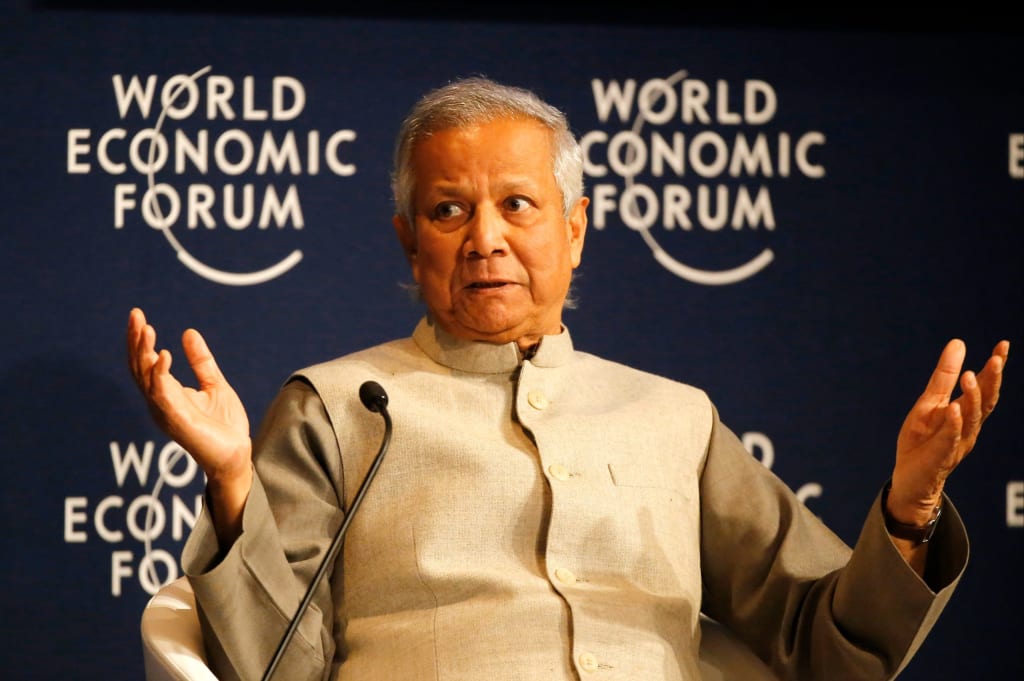
Dr. Muhammad Yunus and Grameen Bank. Revolutionizing Finance for the Poor.
Dr. Muhammad Yunus, a visionary economist and Nobel Laureate, transformed the global approach to poverty alleviation by founding Grameen Bank in 1983. This revolutionary institution pioneered the concept of
microfinance, offering small loans to the impoverished--particularly women--without requiring collateral. By challenging traditional banking norms, Yunus and Grameen Bank ignited a global movement toward financial inclusion, empowering millions to break free from cycles of poverty. This article explores the origins, principles, impact, and legacy of Grameen Bank, highlighting its role as a catalyst for social change.
The story of Grameen Bank (These women, trapped in debt to exploitative moneylenders, earned mere pennies despite their labor. Yunus lent them $27 from his pocket, enabling them to repay loans and retain profits. This simple act revealed the transformative power of small, collateral-free credit.In 1983, Yunus formalized this experiment into Grameen Bank, operating on the belief that access to capital--not charity-- could uplift the poor. The bank's model inverted conventional banking: it targeted the poorest, prioritized women (who comprise 97% of borrowers), and operated through village-based "centers" where groups of five borrowers guaranteed one another's loans. This peer-support system fostered accountability and ensured repayment rates exceeding 98%.
Grameen Bank's success lies in its innovative principles: . 1. **Trust-Based Lending**: No legal contracts or collateral. Loans are granted based on mutual trust. Recognizing women as reliable borrowers and agents of familial upliftment. Borrowers form five-member groups, creating peer pressure for timely repayment. Repayment reliability grants access to larger loans over time. Social Development. Borrowers pledge to follow theThese principles transformed banking from a profit-driven enterprise to a tool for social justice. Grameen Bank's impact is profound and measurable: over 9 million borrowers (as of 2023) have used microloans to start businesses, from livestock farming to handicrafts. Profits from enterprises fund children's education and healthcare, breaking intergenerational poverty. By injecting capital into villages, the bank spurred local economies and reduced urban migration.
Studies show that access to microcredit increases household income by 5-15% in Bangladesh. The World Bank acknowledges that microfinance has lifted 10% of the country's population out of extreme poverty since the 1990s.
Grameen Bank's focus on women challenged patriarchal norms in rural Bangladesh. By empowering women economically, it reshaped gender dynamics. Women gained control over income, elevating their status in households. Female borrowers began engaging in community leadership and voting. Women invested in their children's futures, reducing child mortality and increasing school enrollment. As Yunus famously stated, "When you change a woman's life, you change a family's life.Despite its success, Grameen Bank faces scrutiny. Over-Indebtedness. Critics argue microcredit can trap borrowers in debt cycles, especially when loans fund consumption instead of outflows. Grameen's rates (20%)-though lower than moneylenders--spark debates about 'poverty profiteering.In 2011, the Bangladeshi government accused Yunus of legal irregularities, forcing his resignation--a move many saw as politically motivated. Yunus defends the model, emphasizing that sustainability requires covering operational costs. Grameen Bank inspired a global microfinance revolution: - **Replication**: Over 100 countries adopted similar models, including India's Self-Help Groups and Mexico's Compartamos Banco. - **Social Business**: Yunus advocates for businesses prioritizing social good over profit. influencing initiatives like Grameen Danone (affordable yogurt for the malnourished). - **Awards**: Yunus won the Nobel Peace Prize (2006), the U.S.Congressional Gold Medal (2013), and the Olympic Laurel (2016).
Grameen Bank's legacy transcends finance. It redefined poverty as a systemic issue solvable through innovation and trust. While challenges persist, its model proves that marginalized communities, when empowered with resources, can drive their own progress. Dr. Yunus's vision- a world without poverty--remains a beacon of hope, reminding us that economic justice begins with believing in the potential of the poor.
Thank you for reading!
About the Creator
MD Mehedi Hasan fans of Alam Sir.
**"📝 MD Mehedi Hasan | Storyteller weaving words on tech, culture & humanity. 🌍 Exploring untold narratives & sparking conversations. ✨ Let’s journey through ideas. #VoiceMatters"**
Keep reading
More stories from MD Mehedi Hasan fans of Alam Sir. and writers in Motivation and other communities.
The China AI DeepSeek
** Deepseek's Architectural Development and Census** As a global artificial intelligence paradigm circuit company, Deepseek, the Institute of AI research in China, has redefined competitive benchmarks through cost-effective advanced model development and development, open source ETH, and technological innovations in distance. Below you can find a comprehensive analysis of its basic journeys, strategic breakthroughs, and promotions within the AI sector:
By MD Mehedi Hasan fans of Alam Sir.9 months ago in 01
The 5 Essential Traits of Effective Leaders Who Succeed in Every Industry
Effective leaders shape teams, guide decisions, and build trust across every field. Whether someone works in business, healthcare, education, technology, or nonprofit work, leadership skills matter. While tools and systems change by industry, the core traits of effective leaders stay the same. These traits help people lead with clarity, confidence, and purpose.
By Jaime Irick4 days ago in Motivation



Comments
There are no comments for this story
Be the first to respond and start the conversation.