
The Fire of the Mountains: Che Guevara’s Revolutionary Journey
From the Jungles of Cuba to the Valleys of Bolivia — The Legacy of a Fearless Rebel

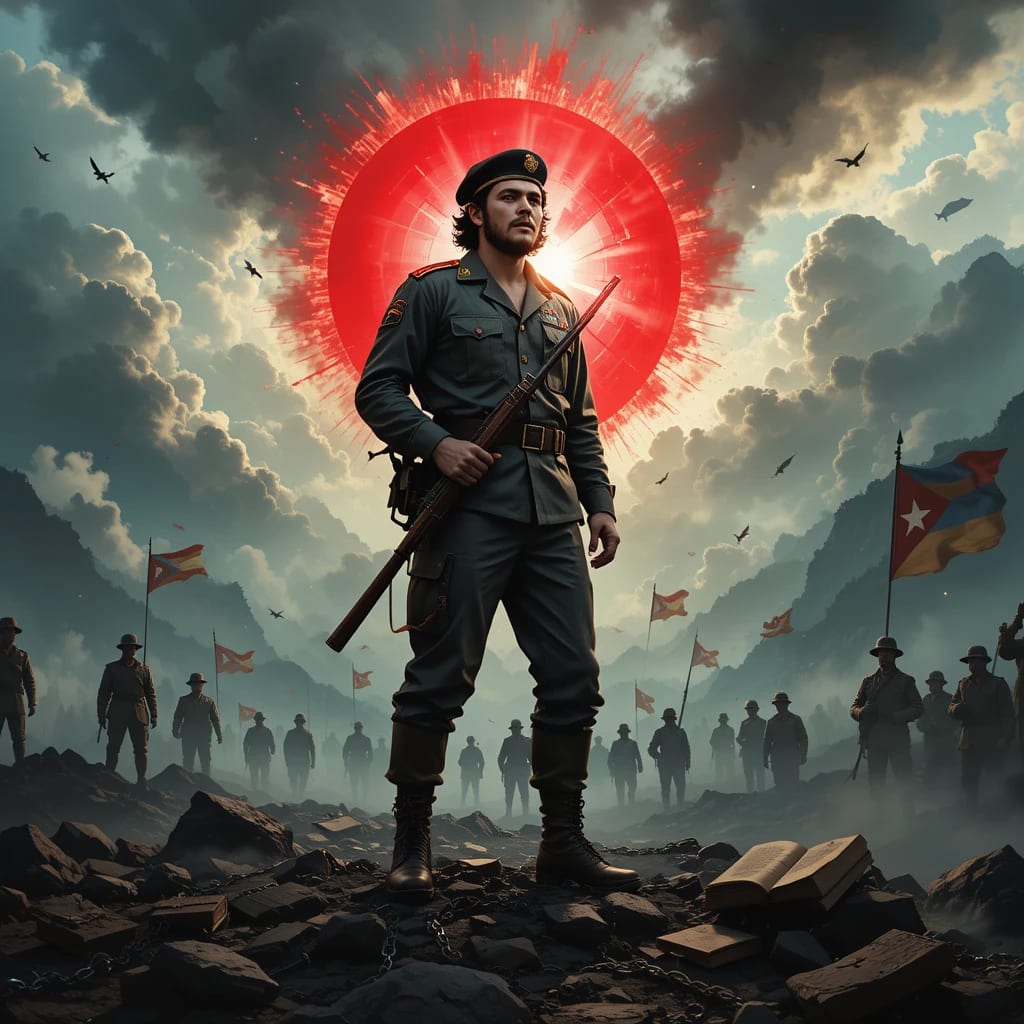
Introduction: A Dream Born in Smoke and Sacrifice
In the thick forests of Latin America, where bullets echoed louder than dreams and freedom was paid for in blood, a man emerged whose very name became the anthem of rebellion — Che Guevara. His revolutionary journey wasn’t just about overthrowing dictators. It was a burning mission to awaken the soul of the oppressed and challenge the empires of greed. This is the story of a man who walked away from comfort and safety to fight for strangers, only to become a legend.
---
Caption:
“If you tremble with indignation at every injustice, then you are a comrade of mine.” — Che Guevara
---
Chapter 1: A Doctor with a Diagnosis for the World
Ernesto Guevara, an Argentine doctor with a sharp mind and a compassionate heart, had seen enough of human suffering. In 1952, during his motorcycle journey across South America, he witnessed the lives of miners, peasants, and lepers—humans treated as shadows by a cruel capitalist system. Medicine could heal the body, he thought, but only revolution could heal society.
Upon meeting Fidel Castro in Mexico in 1955, Che's path changed forever. Castro spoke of freedom, justice, and revolution in Cuba — a land crushed under Batista's dictatorship. Che didn’t hesitate. He joined the 26th of July Movement as a combat medic, but soon proved to be much more.
---
Caption:
He came to heal, but found the world too wounded for medicine alone.
---
Chapter 2: Guerrilla in the Sierra Maestra
In December 1956, Che landed in Cuba with 81 revolutionaries aboard the yacht Granma. Most of them were killed or captured within days. But Che survived and took refuge in the Sierra Maestra mountains, where the seeds of revolution took root.
Through mud, hunger, and blood, he trained fighters, wrote diaries, and led raids. He became both feared and beloved. Known for his strict discipline, yet respected for treating wounded enemies with compassion, Che rose to the rank of commander. Villagers saw him as hope incarnate. With every ambush, they grew stronger. By 1958, Che led the decisive attack on Santa Clara, capturing it in a fierce battle that led to Batista’s flight.
---
Caption:
He didn’t just fight for Cuba — he fought to ignite hope where despair had ruled for decades.
---
Chapter 3: The Face of a New Cuba
After the revolution’s victory in 1959, Che Guevara became a pillar of the new Cuban government. But he didn’t ask for wealth or rest. Instead, he worked day and night: managing banks, giving fiery speeches, reforming land laws, and leading volunteer labor brigades.
He taught by example, cutting sugarcane alongside workers, sleeping on factory floors, and urging the youth to become the "new man" — selfless, moral, revolutionary. Yet bureaucracy frustrated him. He warned that true socialism couldn’t survive without constant revolutionary spirit. He feared comfort would rot the soul of the cause.
---
Caption:
Che wanted to build a world where dignity was the currency and equality was law.
---
Chapter 4: Leaving Power to Fight Again
In 1965, Che disappeared from Cuba. He left behind letters to Fidel, to his children, to the people — saying he was needed where the fight still burned. He first went to the Congo, hoping to assist a Marxist rebellion. But disorganization and infighting doomed the mission.
Still hungry for justice, he moved to Bolivia in 1966. With a small group of fighters, Che began training locals in the mountains. But things didn’t go as planned. The CIA, the Bolivian military, and lack of support from the peasants weakened the campaign. Yet, Che refused to give up.
Even starving, wounded, and hunted, he wrote:
"I know the fight will be hard, but victory is possible."
---
Caption:
Some men chase glory. Che chased struggle, believing justice was worth more than life.
---
Chapter 5: The End That Became a Beginning
On October 8, 1967, Che was captured after a firefight in Bolivia. His hands tied, he was held in a small schoolhouse. Refusing to beg, he spoke to his captors with calm defiance. The next day, he was executed. His last words were:
“Shoot, coward! You are only going to kill a man.”
But Che was not just a man anymore. His death immortalized him. His image, fierce and defiant, became a global banner of resistance.
---
Caption:
He died with bullets in his body, but fire in his eyes — a martyr of rebellion.
---
Conclusion: The Unfinished Revolution
Che Guevara’s story is not just history — it’s a question to every generation: Will you accept the world as it is, or fight for what it could be? His enemies called him dangerous. His followers called him a saint. But everyone remembers him.
Today, his face appears on walls, flags, and hearts — not because he was perfect, but because he dared to believe the impossible. He taught us that revolutions aren’t started by armies — they begin in the soul.
---
Final Caption:
Che Guevara — the man who died fighting, and lives on in every cry for freedom.
About the Creator
Noman Afridi
I’m Noman Afridi — welcome, all friends! I write horror & thought-provoking stories: mysteries of the unseen, real reflections, and emotional truths. With sincerity in every word. InshaAllah.
Keep reading
More stories from Noman Afridi and writers in Motivation and other communities.
Che Guevara: The Revolutionary Spirit That Shook the World
Introduction: The Man Behind the Myth Che Guevara — a name that echoes through history with fire and defiance. Born Ernesto Guevara in Argentina, he was more than just a revolutionary; he was an icon, a dreamer, and a relentless fighter for justice. His journey from a medical student to a global symbol of rebellion is a tale of passion, sacrifice, and unwavering struggle. This is not just the story of a man, but of a movement that challenged empires and inspired generations.
By Noman Afridi8 months ago in Motivation
BE HAPPY
Almost everyone have heard the hit single 'Don't Worry, Be Happy' by Bobby McFerrin. The song has a very catchy way of conveying its message of being happy to everyone. Bobby McFerrin’s simple message surely made a lot of people by telling them not to worry.
By Junaid Shahid 2 days ago in Motivation


Comments
There are no comments for this story
Be the first to respond and start the conversation.