
Che Guevara: The Revolutionary Spirit That Shook the World
From a Young Argentine Doctor to a Global Symbol of Rebellion and Freedom

Introduction: The Man Behind the Myth
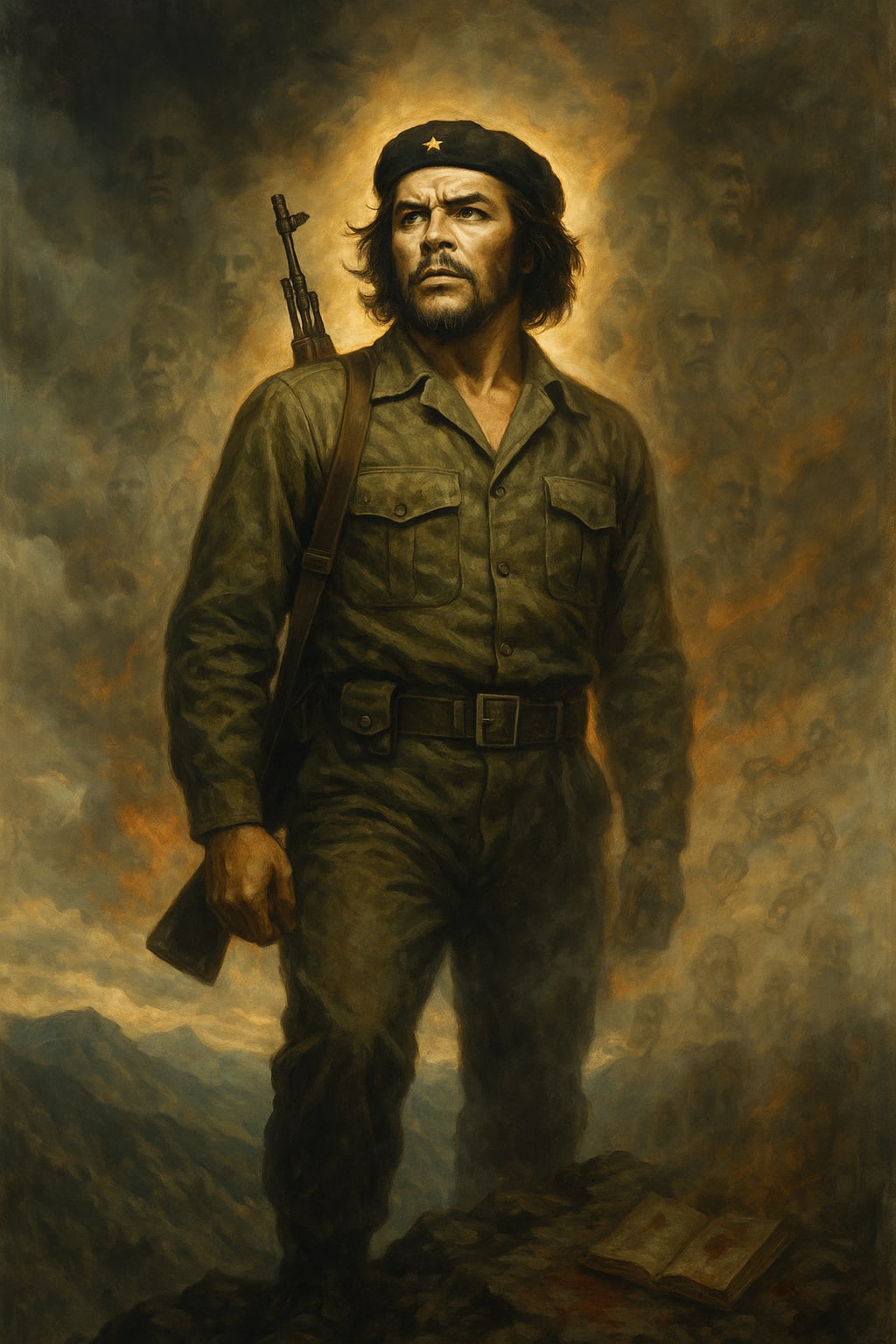
Che Guevara — a name that echoes through history with fire and defiance. Born Ernesto Guevara in Argentina, he was more than just a revolutionary; he was an icon, a dreamer, and a relentless fighter for justice. His journey from a medical student to a global symbol of rebellion is a tale of passion, sacrifice, and unwavering struggle. This is not just the story of a man, but of a movement that challenged empires and inspired generations.
---
Caption: “Let me say, at the risk of seeming ridiculous, that the true revolutionary is guided by great feelings of love.” — Che Guevara
---
Early Life and Ideals
Ernesto Guevara was born on June 14, 1928, in Rosario, Argentina, into a middle-class family. Despite suffering from chronic asthma, young Ernesto developed a fierce will and intellectual curiosity. His home was filled with books, and from an early age, he immersed himself in literature ranging from Marx to Freud and Neruda. His parents were liberal thinkers, and this deeply influenced his worldview.
He studied medicine at the University of Buenos Aires and dreamed of becoming a doctor who would serve the poor. But in 1952, everything changed when he took a motorcycle journey across South America with his friend Alberto Granado. This trip exposed him to the crushing poverty, exploitation, and social injustice faced by indigenous communities and working-class people. He began to question whether treating individual patients was enough when entire systems were sick. The seeds of revolution were sown.
---
Caption: The motorcycle journey that opened his eyes—and closed the door to a normal life forever.
---
Joining the Revolution: Cuba and Castro
In 1955, while in Mexico, Che met Fidel Castro and Raúl Castro, exiled Cuban revolutionaries planning to overthrow the brutal dictatorship of Fulgencio Batista. Che immediately joined the 26th of July Movement and began training as a guerrilla fighter. His intelligence, discipline, and fearlessness made him a natural leader.
Che was part of the historic Granma expedition in 1956 and fought in the mountains of Sierra Maestra, where he earned a reputation for his bravery and harsh discipline. By 1959, the revolution succeeded, Batista fled, and Che entered Havana as a victorious commander. His role in the revolution made him a hero among the people and a key figure in shaping the new Cuban government.
---
Caption: From doctor to soldier, from soldier to legend — Che Guevara became a face of victory.
---
Che in Power: Minister and Diplomat
Che was given major responsibilities in the new regime. He became head of the National Bank and later Minister of Industry. He worked tirelessly to reshape Cuba’s economy based on socialist ideals, promoting land reform, literacy programs, and industrialization. He also traveled as a diplomat, speaking at the United Nations and building relationships with other revolutionary nations.
However, Guevara grew increasingly disillusioned with bureaucratic politics and economic setbacks. He believed the true revolution lay in constant struggle—not in sitting behind a desk. His heart burned for action.
---
Spreading the Flame: Congo and Bolivia
After disappearing from public life in 1965, Che secretly traveled to the Congo (present-day Democratic Republic of Congo) to support a Marxist rebellion. The mission failed due to poor leadership and internal conflicts. Undeterred, he then moved to Bolivia to ignite another revolution.
But this mission also faced insurmountable challenges. The local peasants didn’t support the movement, the Bolivian army was well-prepared, and the CIA closely monitored his activities. After months of hardship, he was wounded, captured, and executed on October 9, 1967.
His last words to his executioner were: “Shoot, coward! You’re only going to kill a man.” And with that, a legend was born.
---
Caption: His blood stained the soil of Bolivia, but his spirit soaked the soul of the world.
---
Legacy: More Than a Face on a T-shirt
Che Guevara became a global icon after his death. The famous photograph taken by Alberto Korda—Che in military fatigues with a determined gaze—became the most reproduced image in history. From protest banners to pop culture, his face became a universal symbol of rebellion.
But Che’s legacy is complex. To some, he is a champion of the poor, a voice for the voiceless, and a martyr for justice. To others, he was a ruthless ideologue who believed in armed violence and failed revolutions. Regardless of perspective, no one can deny the impact he made on the world.
His writings, especially The Motorcycle Diaries and Guerrilla Warfare, continue to inspire young activists, revolutionaries, and idealists worldwide. Universities still hold debates in his name. His image still leads marches. His dream of justice still burns in hearts.
---
Conclusion: The Immortal Revolutionary
Che Guevara’s life reminds us that ideas are powerful weapons, and the courage to stand against oppression can echo through centuries. He lived for a cause larger than himself and died with unwavering conviction. His body may have been buried in the Bolivian highlands, but his spirit rises wherever there is injustice.
He remains a flame that continues to burn—challenging us all: Will we stand, or will we stay silent?
About the Creator
Noman Afridi
I’m Noman Afridi — welcome, all friends! I write horror & thought-provoking stories: mysteries of the unseen, real reflections, and emotional truths. With sincerity in every word. InshaAllah.
Keep reading
More stories from Noman Afridi and writers in Motivation and other communities.
The Broken Slippers of Hope
In the heart of a forgotten town, where the streets were filled with potholes and dreams often died before sunset, lived a boy named Iqbal. He wore broken slippers, torn at the heel, but he walked as if he wore gold beneath his feet. The town called him “the slipper boy” — not out of mockery, but because he never complained, never looked ashamed.
By Noman Afridi8 months ago in Motivation
Lauren Sanchez Bezos celebrates Jeff Bezos with a heartfelt Instagram birthday post
The vibe of the tribute felt less like a celebrity flex and more like a quiet love letter Lauren Sanchez Bezos is in full celebration mode, and this time the spotlight is on her husband, Jeff Bezos. The media personality and entrepreneur marked Bezos’ birthday with a tender Instagram Story that blended romance, nostalgia, and a quietly powerful image that spoke volumes.
By Dena Falken Esq5 days ago in Motivation


Comments
There are no comments for this story
Be the first to respond and start the conversation.