
The Dinner Party at the End of the World: How a Kitchen Table Thawed the Cold War
In the 1980s, the world was on the brink of nuclear annihilation. Governments had stopped talking. Spies were everywhere. But in a living room in California, a psychiatrist decided to invite the "enemy" over for dinner

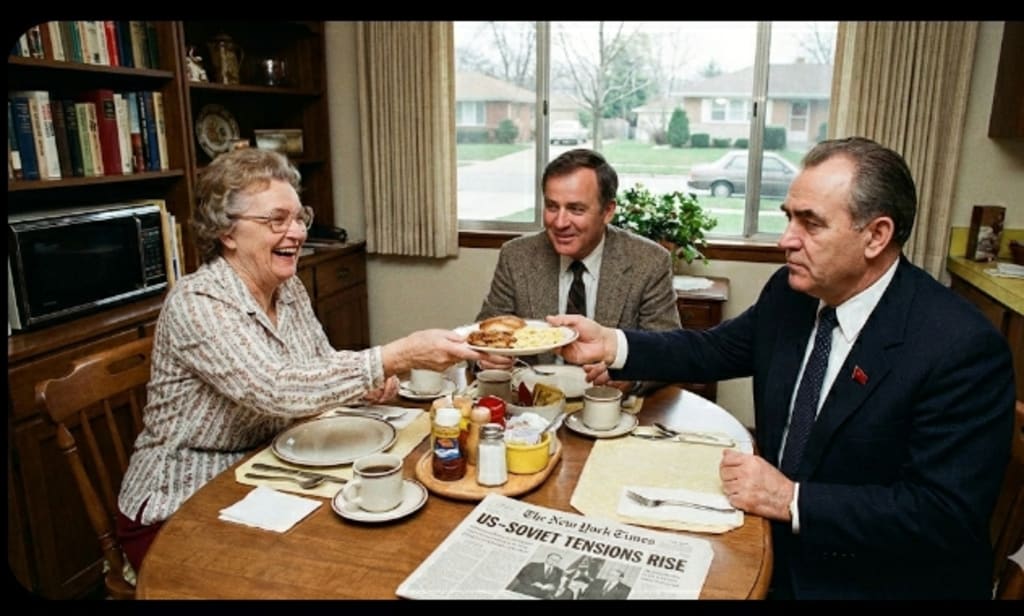
The untold story of Dr. Ruth Heifetz and the citizen diplomats who used private dinners to build trust between Americans and Soviets during the height of the Cold War.
The Cold War was not a war of territory; it was a war of the mind.
By the early 1980s, the psychological landscape of the world was frozen solid. The United States and the Soviet Union were two scorpions in a bottle, circling each other with tails raised. The logic of the era was Mutually Assured Destruction (MAD). The premise was simple: If you shoot, I shoot, and we both die.
It was a time of "psychic numbing." Children went to sleep wondering if they would wake up. Adults planned their lives around the vague, looming possibility of a flash of light followed by nothingness.
The official channels of diplomacy had become a theater of the absurd. Geneva summits were stiff, formal affairs where men in gray suits read prepared statements, accused each other of imperialism, and then left. They weren't communicating; they were posturing. Trust was nonexistent. To the Americans, the Soviets were godless, robotic automatons bent on world domination. To the Soviets, the Americans were greedy, imperialist cowboys itching to push the button.
The dehumanization was total. And when you dehumanize your enemy, it becomes very easy to kill them.
Into this frozen wasteland stepped a woman who didn't care about protocols, treaties, or missile counts. Her name was Dr. Ruth Heifetz.
She was not a diplomat. She was a physician and a psychiatrist. She understood that the Cold War wasn't just a geopolitical crisis; it was a relationship crisis. It was a pathology of paranoia. And as a doctor, she knew that you cannot cure a patient you refuse to speak to.
She was part of a movement that would become known as "Citizen Diplomacy," or "Track II Diplomacy." While the "Track I" officials (the presidents and generals) were shouting at each other, the "Track II" citizens decided to start whispering.
And the most radical thing they did was eat dinner together.
Part I: The Invitation
Dr. Heifetz and her husband lived in La Jolla, California. They were part of organizations like the International Physicians for the Prevention of Nuclear War (IPPNW). They knew the science of the bomb. They knew that there is no medical response to a nuclear war. You don't treat the survivors; there are no survivors. The only medicine is prevention.
So, when Soviet delegations—scientists, doctors, academics—visited the United States for conferences, Dr. Heifetz did something that made the FBI nervous and the State Department cringe.
She invited them to her house.
It sounds banal today. But in 1983, inviting a Soviet official into an American home was a radical, almost subversive act. These were the people who had missiles pointed at your city. They were the "Evil Empire."
The first few dinners were thick with tension. Imagine the scene: A group of Soviet scientists, dressed in ill-fitting suits, carrying the weight of the KGB officers watching them, stepping into a warm, cluttered American living room.
They expected a trap. They expected an interrogation. They expected to be lectured on the superiority of capitalism.
Instead, they got a casserole. They got wine. They got a table set with flowers.
Dr. Heifetz didn't start the conversation with disarmament treaties. She started with the universal language of humanity.
"How was your flight?"
"Do you have children?"
"Does your back hurt from the conference chairs?"
She used her skills as a psychiatrist to disarm them not militarily, but psychologically. She created a "holding environment"—a safe space where the rules of the Cold War were suspended.
Part II: The Cracking of the Mask
The magic of the kitchen table is that it is very hard to maintain a facade while passing the potatoes.
In the official summits, the Soviets had to be stoic communists. The Americans had to be rugged capitalists. But at the Heifetz table, after the second glass of wine, the masks began to slip.
One specific night captures the essence of this movement. A Soviet scientist, a man high up in the hierarchy of the USSR, was sitting next to an American colleague. For decades, they had been reading each other’s research but had been taught to view the other as a monster.
The conversation turned to their children. The Soviet man pulled out a wallet photo. "My daughter," he said. "She is starting piano lessons."
The American pulled out his own photo. "My son plays baseball."
Then, the conversation turned darker. The American admitted, "My son asked me the other day if he would grow up. He’s afraid of the bomb."
The Soviet man went quiet. He looked at his wine. Then he said, quietly, "My daughter asks the same thing. She has nightmares about the fire."
The room fell silent.
In that silence, the entire edifice of propaganda collapsed. The American realized that the Soviet wasn't a robot; he was a terrified father. The Soviet realized the American wasn't a cowboy; he was a man trying to protect his family.
They realized that the "enemy" wasn't the man across the table. The enemy was the bomb itself.
Dr. Heifetz watched this happen. She knew that this specific frequency of connection—this "humanization"—was the only thing that could stop the madness. You can drop a bomb on a coordinate. You can drop a bomb on an ideology. But it is very, very hard to drop a bomb on a man whose daughter plays the piano, just like yours.
Part III: The Underground Railroad of Ideas
These dinners were not just social calls. They became the engine of "Track II" diplomacy.
Because there were no reporters present, and because the atmosphere was informal, the scientists could say things they would never say in Geneva. They could admit weakness. They could float trial balloons.
"If our side proposed a reduction in intermediate-range missiles, how would your side react?"
"We can't accept that publicly, but if you phrased it like this, maybe the General Secretary would listen."
They were problem-solving. They were brainstorming.
These ideas didn't stay at the dinner table. The American scientists would go back to Washington and whisper in the ears of the State Department. The Soviet scientists would go back to Moscow and brief their superiors in the Kremlin.
They became an underground railroad of information. They built a bridge of trust that the official governments could walk across when they were ready.
The risks were real. The FBI monitored these groups. In the Soviet Union, returning scientists were often debriefed by intelligence officers. A wrong word could mean the end of a career, or the gulag.
But they kept coming back to the table. They returned because it was the only place in the world where they felt sane. In the insanity of the arms race, the Heifetz living room was an island of rationality.
Part IV: The Physician’s Warning
The movement grew. It wasn't just Dr. Heifetz. It was thousands of citizens across the US and USSR. The IPPNW won the Nobel Peace Prize in 1985.
Their message was simple and devastating. They stopped talking about "megatons" and "strategic dominance." They started talking about "burn units."
They told the politicians: "If a single 1-megaton bomb hits a major city, we will have 500,000 burn victims. The entire United States has fewer than 2,000 specialized burn beds. Medicine will mean nothing. There will be no doctors. There will be no morphine. There will only be the dead and the dying."
This medical reality check terrified the leaders. Mikhail Gorbachev, the Soviet leader, later admitted that the work of these citizen-scientists was a major factor in changing his thinking on nuclear weapons.
He didn't trust the generals. He trusted the doctors. And he trusted them because his own advisors had sat at dinner tables in America and looked the doctors in the eye.
Part V: The Summit and the Thaw
When Reagan and Gorbachev finally met at the Geneva Summit in 1985, and later in Reykjavik, the ice began to break. They famously went for a walk to a fireside, just the two of them.
Commentators marveled at the "personal chemistry" between the two leaders.
But that chemistry didn't come out of nowhere. It was prepared. The ground had been softened by years of invisible work. The ideas they discussed—verification, reduction, trust—had been workshopped over roast chicken and red wine in living rooms across both nations.
The treaties that followed, the INF Treaty and START, were signed with gold pens on polished desks. But the ink was mixed in the kitchens of people like Ruth Heifetz.
The Cold War didn't end with a bang. It ended because enough people refused to believe the lie that the "other" was a monster. It ended because the fear was dismantled, one conversation at a time.
Conclusion: The Architecture of Empathy
Dr. Ruth Heifetz passed away, but her legacy is woven into the fact that we are still here.
We often look at history as a game of chess played by Great Men. We think that peace is something handed down from the UN or the White House.
But the story of the kitchen table proves that peace is actually something that grows from the bottom up. It is a biological necessity.
Today, we live in a world that feels dangerously similar to the 1980s. We are polarized. We are fearful. We are told that the "other side"—whether a political rival or a foreign nation—is an existential threat. We are told they are evil. We are told they are not like us.
The algorithm feeds us the same "psychic numbing" that the Cold War propaganda did. It creates a caricature of the enemy.
The lesson of Dr. Heifetz is that we must resist this. We must be brave enough to invite the enemy to dinner.
It requires courage. It is easier to hate a caricature than to understand a human being. It is easier to tweet an insult than to listen to a fear.
But if a psychiatrist could invite the representatives of the Soviet nuclear arsenal into her home and find the humanity in them, we can surely cross the smaller divides in our own lives.
You don't need a diplomatic passport to change the world. You don't need a security clearance.
You just need a table, some food, and the willingness to listen until the stranger becomes a person.
The Cold War was broken by many things—economics, politics, military pressure. But the final blow wasn't a missile. It was a plate being passed from one hand to another, bridging the gap that fear had built.
About the Creator
Frank Massey
Tech, AI, and social media writer with a passion for storytelling. I turn complex trends into engaging, relatable content. Exploring the future, one story at a time
Keep reading
More stories from Frank Massey and writers in Motivation and other communities.
The Island That Learned to Listen: How a Small Community Beat Suicide with a Question
The inspiring story of the Gotland suicide prevention model, where a community lowered suicide rates not with more hospitals, but by training everyday people to break the silence of isolation.
By Frank Massey 23 days ago in Motivation
How to break up with your phone
You want to check an important email. So you grab your phone. You open the email app, get what you need, and close it. But instead of putting your phone down, your hand, as if with a will of its own, swipes a few times and taps the Instagram logo. You don’t know how, but several hours go by.
By Nicolas Juan7 days ago in Motivation


Comments
There are no comments for this story
Be the first to respond and start the conversation.