
The Checkout Line Sentinel: Denise Walker and the Customer Who Wasn’t Shopping
In the paranoid spring of 2020, a New Jersey grocery store manager broke every corporate rule to stop a man who wasn't there for milk. She didn't have a weapon. She had twenty years of watching people, and a gut feeling that refused to be silenced

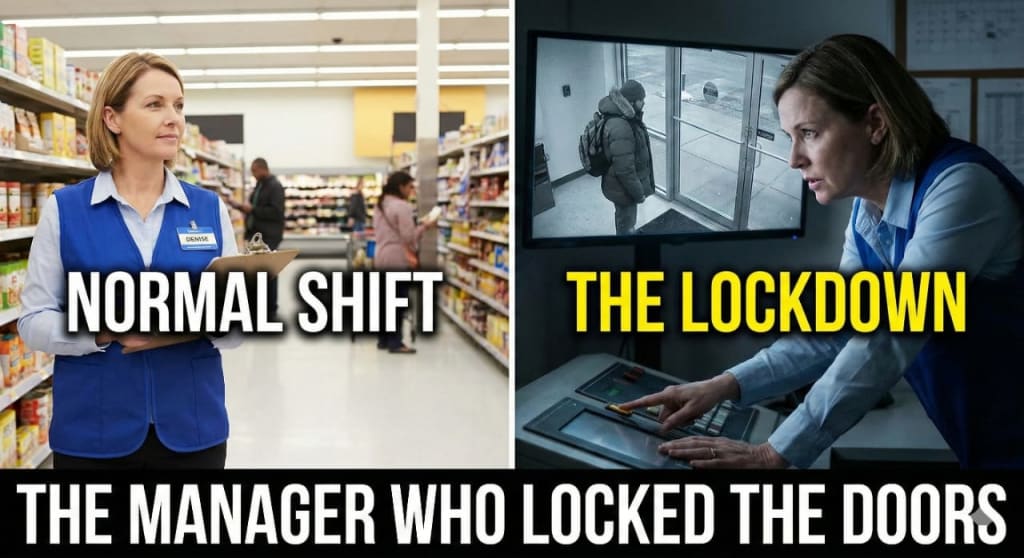
The true story of Denise Walker, a grocery store night manager who prevented a potential hostage situation in 2020 by recognizing subtle behavioral cues and locking down the store before violence could begin.
Introduction: The Bunker of Aisle 4
In the spring of 2020, the American grocery store was no longer just a place to buy eggs. It was the front line. It was a zone of high anxiety, supply chain failure, and aggressive desperation.
The world had locked down, but the grocery stores stayed open. The fluorescent lights hummed over empty shelves where the toilet paper used to be. The air smelled of industrial sanitizer and fear. Customers were angry, confused, and masked.
For the workers, the "Essential Heroes," the job had shifted from stocking shelves to managing a low-grade civilizational collapse.
In a 24-hour chain supermarket in New Jersey, the night shift manager was a 41-year-old woman named Denise Walker.
Denise was not a security expert. She had never taken a course in tactical defense. She was a mother of two who had spent twenty years in retail. She knew how to calm down a customer screaming about expired coupons. She knew how to fix the frozen food compressor with a kick. She knew the rhythm of the night.
But mostly, she knew people.
Retail is a study in human behavior. If you stand at the front of a store for two decades, you see the full spectrum of humanity. You learn to spot the nervous twitch of a shoplifter. You learn to spot the glazed eyes of an addict. You learn the body language of a drunk.
But on a Tuesday night in May, Denise Walker saw something she had never seen before. She saw a predator hunting.
And because she trusted what she saw, the night shift didn't end in a massacre.
Part I: The Ghost Shift
It was 1:00 AM. The "Ghost Shift."
The store was quiet, save for the hum of the refrigerators and the soft rock playing over the PA system. The skeleton crew was restocking. Pallets of canned goods were being dragged down the aisles.
Denise was in the glass-walled manager’s booth—the "crow’s nest"—overlooking the registers. She was tired. The pandemic had doubled her workload. Trucks were late. Staff were calling out sick. Customers were fighting in the aisles over yeast and ground beef.
She was reviewing the schedule, trying to figure out how to cover a gap for the morning, when the automatic doors slid open.
1:12 AM.
A man walked in.
In 2020, everyone looked a little strange. People were wearing bandanas, N95s, scarves. Masks were normal.
But this man wasn't just wearing a mask. He was wearing a heavy winter coat.
It was May in New Jersey. The temperature outside was 65 degrees.
Denise looked up. The retail instinct pinged. Coat means theft, she thought automatically. He’s going to stuff steaks or baby formula into the lining.
She watched him.
He didn't grab a cart. He didn't grab a basket.
He stopped in the vestibule and adjusted his gloves. Thick, leather work gloves. Not the latex gloves people were wearing for the virus.
He walked past the produce section.
Most customers at 1:00 AM are on a mission. They head for the beer, or the diapers, or the ice cream. They move with a destination.
This man moved with a pattern.
He walked the perimeter. He walked slowly, his head turning methodically from left to right. He wasn't looking at the prices. He wasn't looking at the products.
He was looking at the ceiling.
He was looking at the cameras.
Part II: The Anomaly
Denise stood up in the booth. The hairs on her arms were standing up.
She had seen thousands of shoplifters. Shoplifters are skittish. They look down. They try to be invisible. They move fast, grab the item, and look for the exit.
This man was taking up space. He was calm. Too calm.
He walked past the dairy section, all the way to the back emergency exit. He stopped. He looked at the push-bar. He looked at the ceiling above it.
He’s checking the alarms, Denise realized.
Her heart began to hammer against her ribs. This wasn't a shoplifter. Shoplifters want to get out. This man was figuring out how to keep people in.
He continued his loop. He walked past the pharmacy, which was closed for the night, barred by a metal gate.
He stopped. He brought his wrist up to his mouth.
From a distance, it might have looked like a cough. Or maybe he was scratching his nose.
But Denise was watching his reflection in the pharmacy glass.
He wasn't coughing. He was whispering.
And he wasn't talking into a phone. He was talking into his sleeve.
A radio.
Who brings a two-way radio to a grocery store at 1:00 AM?
Denise’s mind raced through the possibilities. Security audit? No, corporate would have emailed. Police? No, he’s not in uniform. Crazy person? Maybe.
But "crazy" is usually chaotic. This was precise.
He was counting. She could see his finger moving slightly as he looked at the staff stocking shelves in Aisle 9. One, two, three.
He was counting the employees.
Part III: The Violation of Policy
Corporate policy in a chain grocery store is written in stone.
The customer is always right.
Never escalate.
Never lock the doors during business hours (fire code).
Never accuse a customer of theft until they pass the last point of sale.
Denise looked at the man. He was heading back toward the front of the store. He was reaching into his coat. He wasn't pulling anything out, but he was adjusting something heavy that sat against his ribs.
She felt a wave of nausea.
She knew, with a terrifying clarity, that if she followed the rules, something terrible was going to happen in the next five minutes.
She looked at her cashier, a 19-year-old college student named Sarah. She looked at the stock boy, an older man named Miguel.
If I’m wrong, she thought, I get fired. I get sued for false imprisonment. I lose my pension.
If I’m right...
She grabbed the store microphone.
She didn't scream. She didn't say "Gun!" or "Robbery!" Panic creates unpredictable movement. She needed control.
She depressed the button. Her voice was steady, the bored, flat voice of a retail manager.
"Attention shoppers and associates. We are experiencing a technical malfunction with the register systems. Please proceed to the front of the store immediately. The store is closing for emergency sanitation."
It was a lie. But it was a believable lie in 2020. "Sanitation" was the magic word.
The few real customers in the store groaned and started pushing their carts toward the front. The stock crew stopped working and looked up.
Denise typed a code into the security panel in the booth. It was the silent alarm. It went directly to the local police precinct.
Then, she did the forbidden thing.
She flipped the toggle switch for the main entrance vestibule.
The automatic sliding doors, which were set to "Open," slid shut. The magnetic locks engaged with a heavy thud.
Part IV: The Rat in the Trap
The man in the winter coat was in the frozen food aisle, Aisle 12, heading toward the front.
He heard the announcement. He stopped.
He looked at the front of the store. He saw the cashier closing her lane. He saw the customers moving toward the exit.
It disrupted his timeline.
Violence is often a scripted event. The perpetrator has a movie in their head. I walk in, I do X, they do Y. When the script breaks, they hesitate.
He sped up. He walked briskly toward the exit doors. He didn't have a basket to put down. He just walked.
He approached the sliding doors. He expected them to part.
They didn't move.
He stepped back and stepped forward again, waving his hand at the motion sensor.
Nothing.
Denise was watching him from the booth, thirty feet away. She was holding her breath.
The man pushed on the glass. The locks held.
He turned around.
His eyes scanned the front of the store. He looked directly at the manager’s booth.
For a second, Denise locked eyes with him.
It wasn't the look of a confused shopper. It was the look of a wolf that realizes the gate has swung shut. It was a look of pure, cold rage.
He knew she knew.
He reached into his coat again.
Denise dropped below the counter of the booth. "Everybody down!" she screamed, finally breaking her calm. "Get back!"
But the man didn't draw. He calculated.
There were now six or seven people bunching up at the front, confused by the locked door. If he drew a weapon now, it would be messy. He had lost the element of surprise. He had lost control of the environment.
He turned and ran.
He didn't run toward the people. He ran toward the back of the store.
He sprinted past the dairy aisle. He hit the crash bar of the rear emergency exit.
The alarm screamed—a piercing, high-pitched wail.
The door flew open. He disappeared into the darkness of the loading dock.
Part V: The Contents of the Bag
The police arrived three minutes later.
They found the back door open. They swept the perimeter.
They didn't catch him. He had vanished into the night, likely into a waiting vehicle (the radio implied a partner).
But in his haste to jump the fence behind the loading dock, or perhaps during his sprint through the store, he had dropped his backpack.
The police brought it back into the store. They laid it on the customer service counter.
Denise stood there, her hands shaking, adrenaline crashing through her system. The district manager was already on the phone, demanding to know why she had locked the doors during business hours.
The police officer unzipped the bag.
It wasn't empty.
Inside, there was a handgun. A 9mm, fully loaded.
There was a box of extra ammunition.
There were three rolls of duct tape.
There was a bundle of heavy-duty plastic zip ties.
There was a ski mask.
And at the bottom, there was a piece of paper.
It was a hand-drawn map of the store. It marked the office. It marked the safe room.
And it had a list.
It was a list of names. Denise. Miguel. Sarah.
It wasn't a random robbery. It was a planned takeover. He knew who was working. He knew the layout. The zip ties weren't for the cash drawers. They were for the people.
The officer looked at the contents, then looked at Denise.
"You locked the front door?" he asked.
"Yes," Denise whispered.
"You blocked his exit path," the officer said. "You forced him to abort. If he had pulled that gun while you guys were scattered in the aisles... he would have tied you all up. He was planning to hold the store."
The zip ties told the story. You don't bring zip ties for a smash-and-grab. You bring zip ties when you plan to be there for a while.
Part VI: The Quiet Burial
The next day, the store opened at 6:00 AM.
There was no press conference. There was no headline in the Star-Ledger.
The corporate office was terrified of the story. A hostage plot in their store? During a pandemic? It would tank sales. It would cause a panic. Staff would quit.
They buried it.
They framed it as an "attempted armed robbery" in the internal logs.
Denise received a phone call from the Regional Vice President.
"You made a bold choice, Denise," he said. "Technically, locking the doors is a major violation of fire code and company policy. We could write you up for that."
There was a silence on the line.
"But," he continued, "considering the backpack... we’re going to let it slide this time. Good catch."
That was it. "Good catch."
No bonus. No medal. No counseling.
Denise hung up the phone. She went out to the floor. She checked the milk order. She dealt with a customer complaining that the price of eggs was too high.
Part VII: The Psychology of the Sentinel
Why did Denise act when others wouldn't?
Psychologists call it Pre-Violence Indicators (PVIs).
Violence rarely happens out of nowhere. It is preceded by a dance. A look. A positioning. A testing of boundaries.
Most people are trained to be polite. We are socialized to ignore the weird behavior of others to avoid conflict. We tell ourselves, He's just cold, that's why he has a coat. He's just eccentric, that's why he's counting.
We talk ourselves out of our own survival instincts.
Denise Walker didn't.
She allowed herself to be "rude." She allowed herself to be "paranoid."
She realized that the man’s behavior didn't match the narrative of "shopping."
* Shoppers look at products; he looked at cameras.
* Shoppers browse; he patrolled.
* Shoppers want to be seen; he wanted to assess.
By locking the door, she changed the environment. Predators rely on being the ones in control. When the environment changed—when the door didn't open—the predator became the prey. He panicked. The script broke.
Conclusion: The Invisible Shield
We imagine that our safety is guaranteed by the police, or by the military, or by the locks on our doors.
But in public spaces, our safety is often in the hands of a tired 41-year-old woman making $18 an hour.
It is in the hands of the usher at the movie theater who notices the exit door is propped open.
It is in the hands of the flight attendant who notices the passenger sweating before takeoff.
It is in the hands of the grocery store manager who notices the winter coat in May.
These are the "Soft Targets," but they are guarded by people with hard instincts.
Denise Walker is still working in retail. She still watches the door.
She is a reminder that situational awareness is not a special skill reserved for spies. It is a human skill. It is the ability to look at the world and ask: Does this make sense?
And if the answer is no, to have the courage to lock the door.
The people who worked that shift with her—Sarah, Miguel—went home to their families that morning. They ate breakfast. They watched Netflix. They complained about their feet hurting.
They have no idea that they were minutes away from being tied up in a back room.
They are alive because Denise Walker decided to break the rules.
And that is the uncomfortable truth of survival: Sometimes, to save the village, you have to be the one willing to sound the alarm, even if everyone else just wants to keep shopping.
About the Creator
Frank Massey
Tech, AI, and social media writer with a passion for storytelling. I turn complex trends into engaging, relatable content. Exploring the future, one story at a time
Keep reading
More stories from Frank Massey and writers in Motivation and other communities.
The Doctor Who Prescribed Life: Samuel Reed and the Underground Rebellion of the Night Shift
The true story of Dr. Samuel Reed, the Appalachian ER doctor who risked his medical license to distribute naloxone off the books, saving a town from the opioid crisis before the laws caught up.
By Frank Massey 3 days ago in Motivation
The Long Game of Becoming
Introduction: Why the Second Chapter Matters Motivation is often portrayed as a sudden spark—a lightning strike that changes everything in an instant. In reality, meaningful change rarely begins with fireworks. It begins quietly, often invisibly, in moments that feel too small to matter. This second chapter is written for those moments.
By Chilam Wonga day ago in Motivation



Comments
There are no comments for this story
Be the first to respond and start the conversation.