
The Alarm on the Shoes: How a Swedish Worker Exposed the Soviet Union’s Deadliest Secret
On a rainy Monday morning in 1986, a technician at a Swedish nuclear plant couldn't get past the security gate. His shoes set off an alarm. He thought it was a glitch. It turned out to be the first warning of the Chernobyl disaster, proving that the biggest secrets are often revealed by the smallest details

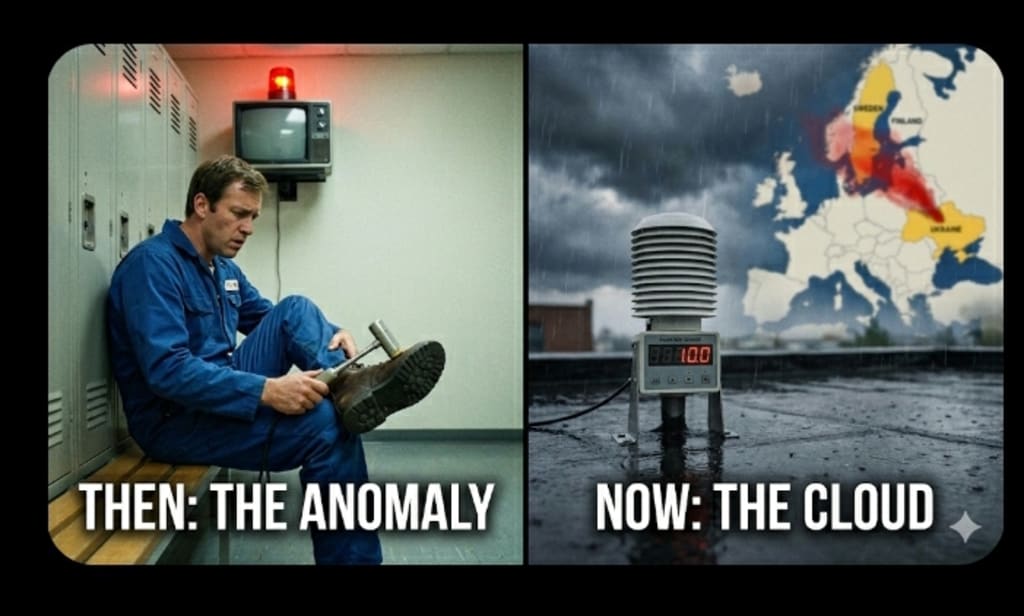
The gripping true story of the Forsmark Nuclear Power Plant worker who detected the Chernobyl radiation before the USSR admitted the disaster, changing the course of history through a simple routine check.
History is rarely changed by a speech. It is rarely changed by a treaty signed with a gold pen. Most of the time, history is changed by something boring. A file left on a desk. A wrong turn. A machine that beeps when it shouldn't.
On the morning of April 28, 1986, history changed because of a pair of shoes.
The setting was the Forsmark Nuclear Power Plant, a fortress of concrete and steel located on the coast of the Baltic Sea, about an hour north of Stockholm, Sweden. Forsmark was a symbol of Swedish efficiency. It was clean, it was modern, and above all, it was safe. The culture of the plant was built on precision. Every valve was checked, every switch was labeled, and every anomaly was investigated.
Cliff Robinson, a chemistry technician at the plant, arrived for work just like he did every other day. It was a Monday morning. The weekend had been rainy and gray. He parked his car, walked through the drizzle, and entered the facility.
In a nuclear power plant, the movement of people is strictly controlled. There are "clean" zones (offices, cafeteria) and "controlled" zones (near the reactor). To move between them, you have to pass through radiation monitors—machines that look like airport metal detectors but are designed to sniff out invisible particles.
Usually, you check yourself after leaving the reactor to make sure you aren't bringing anything out.
But that morning, Cliff had just arrived. He hadn't been near the reactor yet. He had been in the locker room. He had been in the cafeteria for coffee. He was, theoretically, "clean."
He stepped into the monitor to pass through a checkpoint.
BEEP. BEEP. BEEP.
The alarm shrieked. A red light flashed. The machine locked the turnstile.
Cliff sighed. It was Monday. Machines malfunctioned. Sensors got dusty. He stepped back, probably shook his head, and assumed it was a glitch. He reset the machine. He stepped in again.
BEEP. BEEP. BEEP.
This was annoying. But then, it became worrying. Cliff looked at his shoes. He looked at the sensor readings. The machine wasn't malfunctioning. It was detecting high levels of radiation on the sole of his boot.
Part I: The Impossible Contamination
Cliff Robinson was a professional. He knew the protocols. If you are contaminated, you wash.
He went to the decontamination area. He scrubbed his shoes. He scrubbed his hands. He followed the procedure that was drilled into every employee: Wash, rinse, measure, repeat.
He went back to the monitor.
BEEP. BEEP. BEEP.
The levels hadn't gone down. In fact, as he looked closer at the readings, he realized something that made the hair on the back of his neck stand up. The radiation wasn't just on his shoes. It was on his clothes.
And then, another worker arrived. The alarm went off for him, too. Then another.
Within minutes, the routine annoyance of a Monday morning had transformed into a full-blown crisis. The alarms at the exit gates were silent, but the alarms at the entrance gates were screaming.
This broke the fundamental logic of a nuclear accident.
In a meltdown, the radiation comes from the inside and leaks out. The people leaving the reactor should be the ones glowing. But here, the people coming in from the parking lot were radioactive.
Panic began to ripple through the control room. The immediate assumption was terrifying: Forsmark is leaking.
The plant managers assumed they had a breach. Somewhere, a pipe had burst. Somewhere, a seal had failed. Invisible death was escaping into the ventilation system, drifting into the locker rooms, settling on the employees' cars.
They hit the big red button. Code Red.
The plant was locked down. Evacuation protocols were initiated. Hundreds of workers were ordered to freeze. Engineers scrambled to check the reactor pressure gauges. They looked at the coolant levels. They looked at the containment dome sensors.
They expected to see chaos. They expected to see warning lights flashing across the dashboard.
But the dashboard was green.
The reactor was running perfectly. The pressure was normal. The temperature was optimal. There was no leak.
For several hours, the engineers at Forsmark were trapped in a logical paradox. The sensors said they were covered in radiation. The reactor said it was clean.
Part II: The Detective Work
Cliff Robinson and the safety officers didn't stop at the "glitch" theory. They didn't stop at the "leak" theory. They did something that defines the difference between a bureaucrat and a savior: They followed the data, even when it didn't make sense.
If the radiation wasn't coming from the reactor, where was it coming from?
They took samples from the shoes. They analyzed the isotopes.
Nuclear fingerprints are specific. Different types of reactors use different fuel mixes. Different types of accidents release different cocktails of elements. If this was a leak from Forsmark, the chemical signature would match the fuel in the Forsmark core.
They ran the analysis.
It didn't match.
The radioactive particles on Cliff’s shoes were not Swedish. They contained specific isotopes—Cesium-134 and Cesium-137—in a ratio that suggested a very specific type of fuel, and a very recent, very violent reaction.
Then, someone had a realization. It had rained that weekend. The ground outside was wet.
They went outside to the parking lot. They held a Geiger counter over the grass. The machine clicked furiously.
They went to the roof of the building. The machine clicked even faster.
The realization hit them with the force of a physical blow. The radiation wasn't coming from the plant. It wasn't coming from the locker room.
It was falling from the sky.
Part III: The Wind from the East
The mystery of the shoes had been solved, but it had been replaced by a nightmare of global proportions.
If radiation is falling from the sky in quantities large enough to set off alarms in a locker room in Sweden, something catastrophic has happened somewhere else.
The Swedes looked at the weather maps. For the past two days, the wind had been blowing steadily from the southeast. They traced the trajectory backward.
It crossed the Baltic Sea. It crossed the Soviet states of Lithuania and Latvia. It went deep into Ukraine.
It pointed like an arrow at a place few people in the West had ever heard of: The Chernobyl Nuclear Power Plant.
This was April 28th. The explosion at Chernobyl had happened in the early hours of April 26th.
For two days, the Soviet Union had said nothing.
Reactor 4 at Chernobyl was an open crater, spewing Hiroshima-levels of radiation into the atmosphere every hour. The graphite core was burning. The smoke, heavy with death, was rising kilometers into the air, catching the high-altitude winds, and drifting north.
The people of Pripyat, the city next to Chernobyl, had been living in the fallout for 36 hours before they were evacuated. The Soviet government, paralyzed by its own culture of secrecy and denial, was trying to hide a nuclear sun with a blanket. They believed they could contain the news. They cut phone lines. They forbade officials from speaking.
They thought that if they didn't admit it, it didn't happen.
But they forgot about the wind. And they forgot about the sensors on Cliff Robinson’s shoes.
Part IV: The Call to Moscow
Once the analysts at Forsmark realized the scale of what they were seeing, the Swedish government got involved.
This was the Cold War. Accusing a superpower of a nuclear disaster was a dangerous game. You had to be sure.
The Swedish diplomats contacted Moscow. They asked, politely but urgently: "We are detecting high levels of radiation. Have you had an accident?"
Moscow denied it. "Everything is normal," they said. "Our facilities are operating within parameters."
But the Swedes had the data. The levels on the grass at Forsmark were rising. Other monitoring stations in Finland and Denmark began to report similar spikes. The cloud was moving.
Sweden escalated. They essentially told the Soviet leadership: "We know you are lying. We have the isotopes. We have the wind patterns. If you don't admit this, we will go to the United Nations and announce that you are poisoning the continent."
The pressure was unbearable. The denial was no longer sustainable. The radiation was not a state secret; it was a physical fact, measurable by anyone with a Geiger counter.
On the evening of April 28th, forced by the evidence discovered on a Swedish worker’s boot, the Soviet news agency TASS released a terse, twenty-second statement:
"An accident has occurred at the Chernobyl atomic power station. One of the atomic reactors has been damaged. Measures are being taken to eliminate the consequences of the accident. Aid is being given to victims. A government commission has been set up."
It was a small admission, but it changed the world.
Part V: The Value of the Routine
If that alarm at Forsmark hadn't gone off—or, more importantly, if Cliff Robinson had ignored it—the history of Europe might have been very different.
Without that early warning, the Soviet Union might have tried to cover it up for days or weeks longer. They might have delayed the evacuation of the surrounding zones even further.
Crucially, the rest of Europe would have been unprepared.
Because of the alarm at Forsmark, authorities across Europe were alerted. Farmers in Poland were told to keep their cows indoors so the milk wouldn't be contaminated. Parents in Scandinavia were told to keep their children out of the rain. Food supplies were checked.
The "iodine cloud" was tracked. Measures were taken.
We will never know exactly how many cancers were prevented because of that early warning. We will never know how many children were saved from thyroid damage because a Swedish technician couldn't get through a turnstile. But the number is likely in the thousands.
Conclusion: The Moral of the Anomaly
The story of the Forsmark alarm is a masterclass in the difference between "following orders" and "seeking truth."
In most organizations, when an alarm goes off, the instinct is to silence it. We treat alarms as annoyances. We assume the machine is broken. We assume the user is at error. We wash our shoes, reset the breaker, and try to get on with our day.
Our brains are wired to normalize anomalies. We have a cognitive bias that makes us want the world to be normal.
Cliff Robinson and the staff at Forsmark broke that bias. They respected the anomaly.
They didn't act like janitors cleaning up a mess; they acted like scientists confronting a new reality. They didn't say, "This is inconvenient." They said, "This is impossible, therefore we must understand it."
The irony is profound. The Soviet system collapsed in part because it suppressed the truth. It punished the people who pointed out problems. It created a culture where a reactor could explode and the managers would deny it to their own deaths.
The Swedish system worked because it elevated the truth. It empowered a worker to say, "My shoes are wrong," and it empowered the managers to shut down an entire power plant based on that observation.
One system tried to command reality. The other system listened to it.
Today, we face different kinds of invisible threats. We don't have Geiger counters for all of them. But we have the same choice. When we see something that doesn't fit—a glitch in the data, a strange pattern in the weather, a discrepancy in the accounts—do we wash our shoes and keep walking? Or do we stop and ask why?
The hero of this story didn't run into a burning building. He didn't defuse a bomb. He stood in a locker room, looked at a red light, and refused to believe that it was a mistake.
He saved the world by noticing that his feet were dirty.
About the Creator
Frank Massey
Tech, AI, and social media writer with a passion for storytelling. I turn complex trends into engaging, relatable content. Exploring the future, one story at a time
Keep reading
More stories from Frank Massey and writers in Motivation and other communities.
The Quiet Power of Winter
When winter arrives, most people slow down. They complain about the cold, curse the shorter days, and wait impatiently for warmth to return. Snow becomes an excuse... to rest, to pause, to delay goals until “things feel easier.” But for those who understand its hidden power, snowy winter is not a setback. It’s an advantage.
By MIGrowtha day ago in Motivation
Violence Begets
"Any last words, cowboy?" "None you'd understand, sodbuster." "Funny. That's Marshall Sodbuster to you. But I meant some last nugget that would help us in the adjudication of the myriad offenses counted against you and your gang. I wasn't asking for penitence."
By Adam Diehl5 days ago in Fiction



Comments
There are no comments for this story
Be the first to respond and start the conversation.