
Saddam Hussein: The Last Roar of Arab Pride
From Village Boy to Revolutionary Leader — The Rise, Reign, and Fall of Iraq’s Fiercest Voice

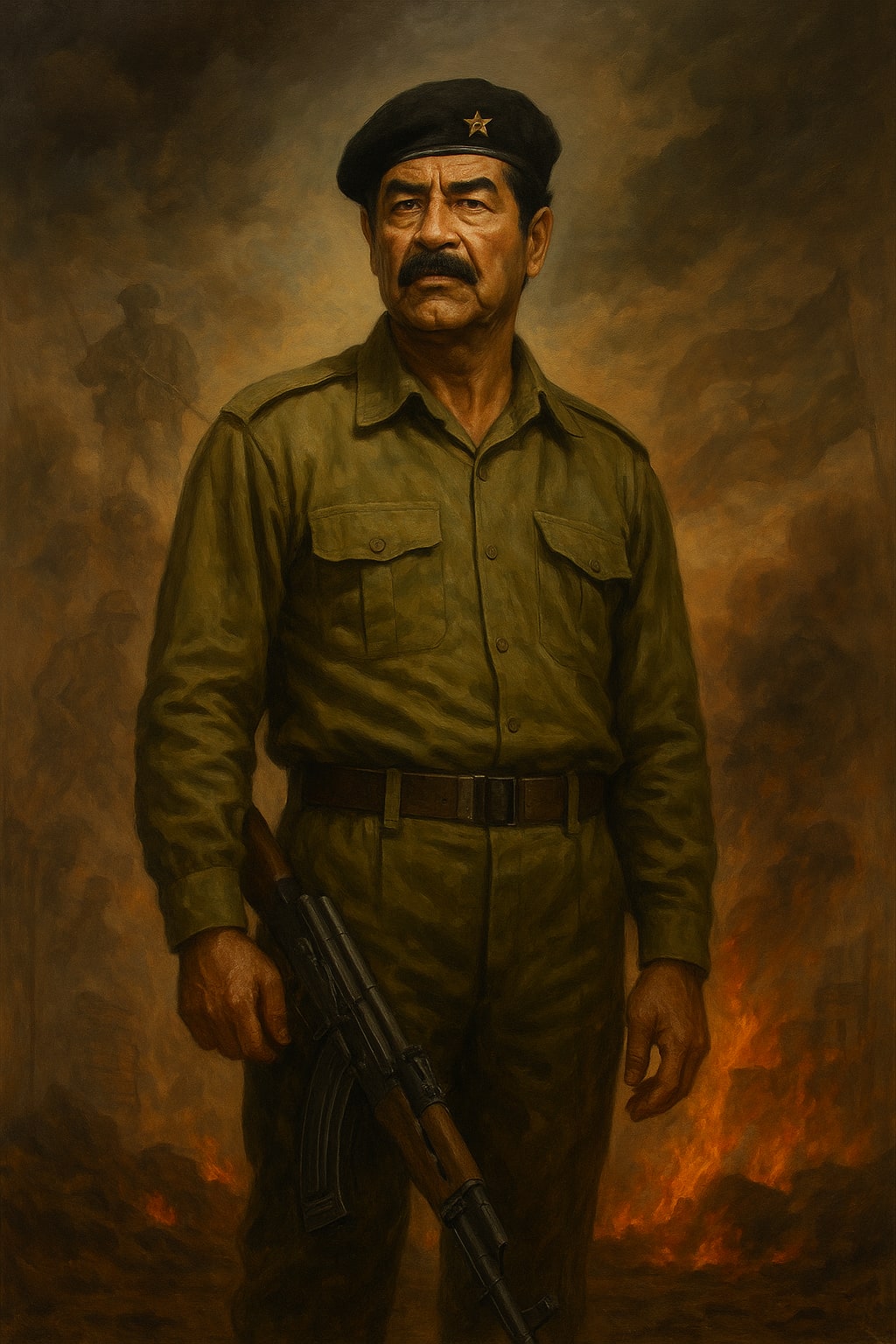
The Beginning of a Storm
Born in 1937 in the humble village of Al-Awja, near Tikrit, Saddam Hussein rose from poverty and abandonment to become one of the most influential — and controversial — figures of the Arab world. Orphaned young and raised by a harsh uncle, his early life was molded by survival, ambition, and a deep resentment toward colonial influence and oppression.
By the 1950s, Saddam had joined the Arab nationalist Ba'ath Party, a political movement that believed in Arab unity, anti-imperialism, and strong leadership. His commitment was not just ideological — it was action-driven, daring, and often dangerous. He participated in the failed 1959 assassination attempt on then Prime Minister Abd al-Karim Qasim, marking the beginning of his reputation as a fearless nationalist.
---
The Rise to Power
Saddam's political climb was swift and calculated. In 1968, the Ba'ath Party seized power in Iraq. Saddam, though initially vice president under President Ahmed Hassan al-Bakr, quickly became the real force behind the government. By 1979, he formally took over the presidency — and Iraq would never be the same.
Under his rule, Iraq experienced a unique blend of authoritarianism and advancement. He nationalized the oil industry, funneled revenues into education, infrastructure, and healthcare, and aimed to build Iraq as a modern Arab power. Literacy soared, universities expanded, and Baghdad emerged as a cultural and political capital of the Arab world.
But his leadership came with an iron fist. Dissent was crushed with brutal precision. Political opponents vanished, and fear became a tool of governance. To some, he was a savior; to others, a tyrant. But even his critics could not ignore his defiance of Western dominance.
---
The Revolutionary Voice
What made Saddam Hussein distinct in the Arab world was not just his rule — but his roar. He dared to speak against Western imperialism, challenged Zionist expansion, and openly defied the United States. During the Iran-Iraq War (1980–1988), Saddam positioned himself as a bulwark against the spread of Iran's Islamic revolution into the Arab world. Though the war brought immense devastation, many Sunni Arab leaders saw him as their shield.
In 1990, he invaded Kuwait, a move that would prove catastrophic. While his reasons were strategic — economic pressure, territorial disputes, and regional dominance — the reaction from the global stage was swift. The U.S.-led Gulf War in 1991 devastated Iraq's military and economy. International sanctions followed, isolating Iraq and plunging its people into suffering.
---
The Downfall and the Trial
The U.S. invasion of Iraq in 2003, under the pretext of weapons of mass destruction, marked the beginning of Saddam’s final chapter. Baghdad fell within weeks. Saddam disappeared, only to be found months later in a small underground hideout near Tikrit.
His trial was public, polarizing, and emotionally charged. Supporters saw it as humiliation by foreign forces; critics called it justice long overdue. On December 30, 2006, Saddam Hussein was executed. His final words praised God, condemned foreign occupation, and invoked Arab unity.
---
The Man, The Myth, The Memory
To this day, Saddam Hussein remains one of the most debated figures in modern history. For some, he was a dictator who ruled through fear and war. For others, he was the last lion who dared to challenge the West and speak for Arab dignity.
In a region fragmented by foreign interests and weakened leadership, Saddam stood out as a symbol of strength — even if his strength came with scars. His statues were torn down, but his image still appears on walls, in whispers, and in hearts yearning for self-respect and independence.
---
A Final Salute
History will always be divided about Saddam Hussein. But what cannot be denied is his impact — on Iraq, on the Arab identity, and on the global order. He ruled with fire, fell with defiance, and left behind a legacy that still echoes in debates, documentaries, and dreams of a united Arab future.
Saddam Hussein was not just a man — he was a moment in Arab history. A moment that roared.
About the Creator
Noman Afridi
I’m Noman Afridi — welcome, all friends! I write horror & thought-provoking stories: mysteries of the unseen, real reflections, and emotional truths. With sincerity in every word. InshaAllah.
Keep reading
More stories from Noman Afridi and writers in Motivation and other communities.
The Fire of the Mountains: Che Guevara’s Revolutionary Journey
Introduction: A Dream Born in Smoke and Sacrifice In the thick forests of Latin America, where bullets echoed louder than dreams and freedom was paid for in blood, a man emerged whose very name became the anthem of rebellion — Che Guevara. His revolutionary journey wasn’t just about overthrowing dictators. It was a burning mission to awaken the soul of the oppressed and challenge the empires of greed. This is the story of a man who walked away from comfort and safety to fight for strangers, only to become a legend.
By Noman Afridi8 months ago in Motivation


Comments
There are no comments for this story
Be the first to respond and start the conversation.