
Reiki: History, Techniques, and Sacred Symbols
Reiki as a way of life, not just a technique

Introduction
Reiki is a gentle yet powerful energy healing practice that has traveled across the world, touching millions of lives. At its heart, Reiki is based on the idea that there is a universal life force energy — known as Ki in Japanese, Chi in Chinese, and Prana in Sanskrit — that flows through all living beings. When this energy is balanced and abundant, we experience physical vitality, emotional stability, mental clarity, and spiritual connection. When it becomes blocked or depleted, imbalance and illness may arise.
What makes Reiki unique among healing arts is its simplicity and accessibility. Unlike complex healing systems that require years of training before any results can be seen, Reiki can be learned by anyone willing to receive an attunement from a qualified Reiki Master. From that moment, the practitioner becomes a channel for universal energy — able to direct it for self-healing, to help others, and even to send it across time and space.
This article will take you on a journey through the origins of Reiki, its guiding philosophy, practical techniques, and the sacred symbols that give it depth and focus. We will also explore how Reiki is used today, its growing acceptance in modern healthcare, and how you can begin your own Reiki journey.
Origins of Reiki
Reiki’s story begins in Japan at the turn of the 20th century, with a man named Mikao Usui. Born on August 15, 1865, in the Gifu Prefecture, Usui was a scholar, martial artist, and spiritual seeker. He was deeply curious about the nature of healing and dedicated much of his life to studying medicine, religion, and metaphysics.
According to traditional accounts, Usui’s life took a transformative turn during a spiritual retreat on Mount Kurama in 1922. After fasting and meditating for 21 days, Usui experienced a profound spiritual awakening. In this altered state of consciousness, he received an understanding of sacred healing symbols and how to channel universal energy to restore balance and promote healing.
Usui began teaching and sharing Reiki in Tokyo, founding the Usui Reiki Ryoho Gakkai (Usui Reiki Healing Society). His approach was simple yet deeply effective, focusing on hand placements, energy channeling, and living by the Five Reiki Principles.
Two of Usui’s students played pivotal roles in spreading Reiki beyond Japan:
Chujiro Hayashi, a former naval officer, refined the system and kept detailed records of treatments.
Hawayo Takata, a Japanese-American woman, brought Reiki to Hawaii and later to the mainland United States in the late 1930s.
From these beginnings, Reiki grew into a global movement, evolving into multiple branches such as Usui Reiki, Karuna Reiki, and Tibetan Reiki — each preserving the core essence while adding unique perspectives and techniques.
The Philosophy Behind Reiki
At the heart of Reiki lies a simple yet profound philosophy: healing begins with the self. Mikao Usui believed that physical ailments often have roots in emotional or mental disharmony, and that true healing requires balance in mind, body, and spirit.
Usui summarized his teachings into what he called the Five Reiki Principles, or Gokai, intended to be recited daily as a form of meditation and moral guidance:
Just for today, I will not be angry.
Anger disrupts the flow of energy and clouds the mind. By letting go of anger, we open ourselves to compassion and clarity.
Just for today, I will not worry.
Worry projects fear into the future and drains our life force. Trusting in the present moment allows energy to flow freely.
Just for today, I will be grateful.
Gratitude shifts our perception, attracting positive experiences and nurturing harmony.
Just for today, I will do my work honestly.
Integrity in our actions fosters trust and alignment with universal truth.
Just for today, I will be kind to every living thing.
Kindness extends the healing energy of Reiki beyond the self, touching the world around us.
These principles are not mere affirmations; they are a daily practice of aligning oneself with universal energy. By living them, Reiki practitioners keep their channels clear and their intentions pure, ensuring the energy they transmit is of the highest vibration.
How Reiki Works
Reiki operates on the understanding that all living beings are sustained by a subtle energy that flows through and around them. This energy nourishes organs, cells, and systems, keeping them in balance. Stress, trauma, negative thoughts, and environmental factors can create blockages in this energy flow, leading to discomfort or illness.
A Reiki practitioner acts as a conduit for universal life force energy. During a session, the practitioner places their hands lightly on or just above the recipient’s body, allowing energy to flow wherever it is needed. Importantly, the practitioner does not direct or control the energy — they simply allow it to pass through, trusting that the energy itself, guided by universal intelligence, will go to where it’s most beneficial.
Scientific and Holistic Perspectives
While Reiki is spiritual in nature, it is not tied to any religion, and it does not require belief to be effective. From a holistic perspective, Reiki stimulates the body’s innate healing mechanisms, promotes deep relaxation, and reduces stress — which in turn enhances overall well-being.
Some scientific studies suggest that Reiki can help lower heart rate, reduce blood pressure, ease pain, and improve emotional states, although research remains ongoing. Many hospitals and wellness centers now integrate Reiki into patient care, particularly for those undergoing surgery, cancer treatment, or dealing with chronic pain.
The Role of Intention
An essential aspect of Reiki is intention. The practitioner’s state of mind influences the quality of the session. By focusing on compassion, love, and the recipient’s highest good, the practitioner creates a safe energetic space where healing can unfold naturally.
Reiki Techniques
One of the most remarkable aspects of Reiki is its versatility. The same universal energy can be applied in many ways — for self-healing, helping others, cleansing spaces, or even sending healing across time and distance. While the techniques may vary between Reiki lineages, the core principle remains the same: the practitioner becomes a channel for life force energy.
Below are the most widely used Reiki techniques, many of which originate from Usui’s original teachings and have been adapted over time.
1. Self-Healing
Self-healing is the foundation of Reiki practice. Before a practitioner can effectively help others, they must learn to maintain their own energetic balance.
Basic Steps for Self-Healing:
Sit comfortably or lie down in a quiet space.
Take a few deep breaths, focusing on the present moment.
Place your hands gently on specific areas of your body, starting at the crown of the head and moving downward.
Hold each position for 2–5 minutes, or longer if you feel drawn to.
End the session by placing your hands over your heart, giving thanks for the energy received.
Common Hand Positions for Self-Healing:
- Crown of the head
- Eyes and temples
- Throat
- Heart center
- Solar plexus
- Lower abdomen
- Knees and feet
2. Healing Others (In-Person Sessions)
When offering Reiki to another person, the process is similar to self-healing, but with a greater emphasis on creating a calm, sacred environment.
Guidelines:
Always ask for permission before starting.
Ensure the recipient is comfortable, usually lying on a massage table.
Begin at the head, moving systematically down the body.
Use a light touch or hover your hands 2–5 cm above the body.
Allow your intuition to guide you to areas needing more attention.
3. Distance Healing (Enkaku Chiryo)
One of Reiki’s most fascinating aspects is its ability to transcend space and time. Using the Hon Sha Ze Sho Nen symbol (explored later in this article), practitioners can send energy to someone anywhere in the world — or even to a past or future event.
Basic Distance Healing Method:
Sit quietly, visualize the recipient in your mind’s eye.
Draw or visualize the distance healing symbol.
Intend for the energy to reach them for their highest good.
Perform hand positions in the air as if they were physically present.
Conclude with a moment of gratitude.
4. Reiki for Animals and Plants
Animals and plants are highly receptive to Reiki. For animals, sessions should be short and offered without forcing contact. With plants, Reiki can be sent during watering or by placing hands near the leaves.
5. Space Clearing
Reiki can also cleanse the energy of a room, home, or workplace. This is especially helpful after conflict, illness, or moving into a new space. The practitioner can stand in the center or move through each room, sending energy and visualizing it filling the space with light.
6. Advanced Techniques
Some advanced Reiki practices include:
Byosen Scanning: Sensing energy blockages with the hands.
Kenyoku: A dry bathing technique to cleanse one’s energy field.
Gyoshi-ho: Sending Reiki through the eyes.
Reiji-ho: Using intuition to guide hand placement.
These techniques expand a practitioner’s toolkit, allowing for more precise and personalized sessions.
Transition to Sacred Symbols:
While Reiki can be practiced without symbols, they add a powerful layer of focus and intention. Each symbol carries its own energetic frequency, unlocking specific qualities of healing. In the next section, we’ll explore these sacred keys in depth — from the strength and grounding of Cho Ku Rei to the expansive spiritual illumination of Dai Ko Myo.
The Sacred Symbols of Reiki
Although Reiki can be practiced without any symbols, the introduction of sacred symbols in the second degree (Okuden) profoundly deepens the practice. These symbols serve as energetic keys — each one unlocking a specific frequency or aspect of universal energy. When a practitioner draws, visualizes, or intones a symbol’s name, it amplifies intention and focuses the flow of Reiki.
In Usui Reiki, four primary symbols are traditionally taught. Each has its own vibration and purpose, yet they all work harmoniously together.
1. Cho Ku Rei – The Power Symbol
Translation & Meaning:
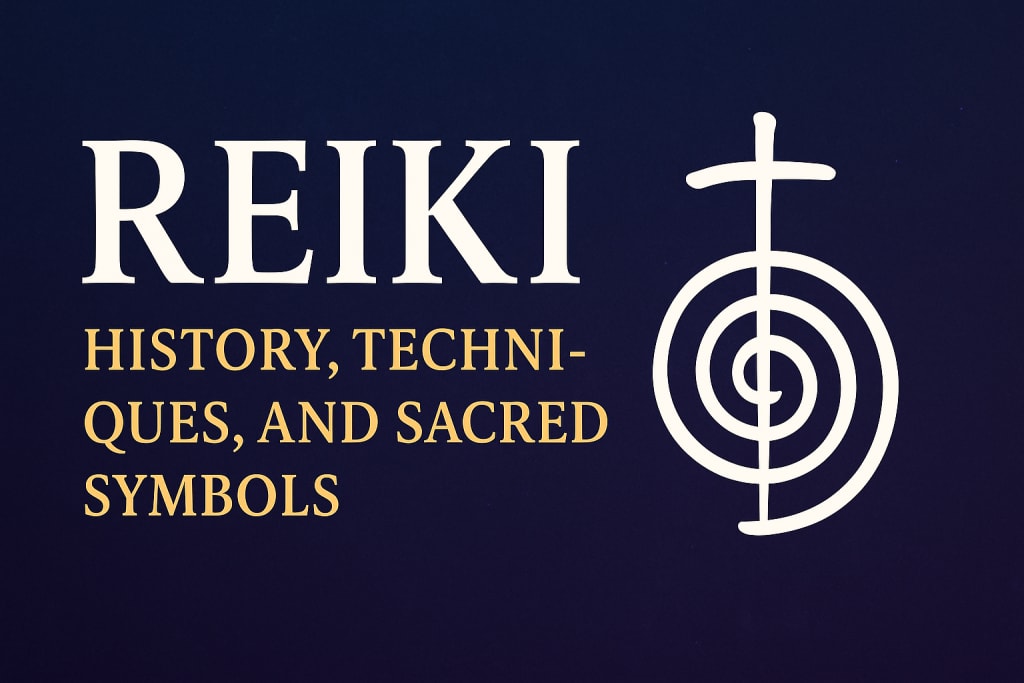
Cho Ku Rei (pronounced “Choh-Koo-Ray”) is often translated as “Place the power of the universe here.” It is the first symbol taught in Reiki Level 2 and is considered the power switch for Reiki energy.
History:
Though the origins of Cho Ku Rei’s exact shape are not fully documented, it is believed to be inspired by ancient Japanese and Buddhist symbols representing energy spirals and connection to divine power. Usui incorporated it to help practitioners intensify the flow of energy.
How to Draw It:
Start with a vertical line from top to bottom.
From the top, draw a horizontal line to the right.
Create a spiral clockwise (in traditional Usui), circling three times until it meets the vertical line again.
Uses:
Amplifying Energy: Cho Ku Rei boosts the intensity of Reiki energy, like turning up a dimmer switch.
Protection: It can be drawn over oneself, another person, or a space to create an energetic shield.
Cleansing: Use it to purify objects (crystals, food, water) before use.
Grounding: Helps to anchor scattered energy into the physical body.
Practical Example:
If you are about to begin a healing session and feel your energy is low, you can draw Cho Ku Rei over your palms to enhance the flow before placing your hands on the recipient.
2. Sei He Ki – The Mental/Emotional Symbol
Translation & Meaning:
Sei He Ki (pronounced “Say-Hay-Key”) means “God and man become one” or “Unity of mind and spirit.” It is the balancing symbol, harmonizing the emotional and mental bodies.
History:
Sei He Ki’s form resembles a wave and a bird, symbolizing the release of emotional burdens and the freedom that follows. It was introduced to address emotional imbalances, which Usui recognized as a major cause of illness.
How to Draw It:
Draw a vertical line.
Add a sweeping curve to the left, then a horizontal line to the right.
Draw a wave-like shape across, ending in a small upward stroke.
Uses:
Emotional Healing: Reduces anxiety, sadness, and emotional distress.
Breaking Bad Habits: Supports people in overcoming addictions or destructive patterns.
Mental Clarity: Clears confusion and aids in decision-making.
Memory Enhancement: Helps in recalling information before exams or presentations.
Practical Example:
If a client is feeling overwhelmed and anxious, you might visualize Sei He Ki over their heart and solar plexus, focusing on bringing calm and clarity.
3. Hon Sha Ze Sho Nen – The Distance Healing Symbol
Translation & Meaning:
Often translated as “No past, no present, no future,” Hon Sha Ze Sho Nen connects the practitioner to the recipient beyond space and time.
History:
This symbol is believed to be influenced by old Japanese kanji and Buddhist mantras, embodying the concept of oneness. It enables Reiki energy to flow regardless of physical location.
How to Draw It:
Its complex form is usually taught directly by a Reiki Master. It involves multiple kanji-like strokes arranged in a vertical sequence.
Uses:
Distance Healing: Send Reiki to people, places, or events far away.
Healing the Past: Address unresolved trauma or emotional wounds.
Future Empowerment: Send energy to support upcoming challenges.
Practical Example:
If a loved one is undergoing surgery in another country, you can use Hon Sha Ze Sho Nen to send Reiki to them for the duration of the operation.
4. Dai Ko Myo – The Master Symbol
Translation & Meaning:
Dai Ko Myo translates as “Great Bright Light” or “Great Shining Illumination.” It is the most powerful Reiki symbol, representing enlightenment, spiritual awakening, and deep healing.
History:
Reserved for Reiki Masters, Dai Ko Myo is said to align the practitioner with the highest frequency of Reiki energy, working on the soul level.
How to Draw It:
Like Hon Sha Ze Sho Nen, it has a complex kanji-style structure best learned in person during Master-level training.
Uses:
Spiritual Healing: Works at the soul level to bring profound transformation.
Empowerment: Boosts the effect of all other symbols.
Attunements: Used by Masters to initiate students into Reiki.
Practical Example:
When initiating a new Reiki student, the Master will use Dai Ko Myo to open and align the student’s energy channels to receive the Reiki frequency.
Reiki in Modern Healthcare
In recent decades, Reiki has moved from being seen as an alternative practice to becoming part of integrative healthcare in hospitals, hospices, and wellness centers around the world. While Reiki is not a replacement for medical treatment, it is increasingly recognized for its supportive role in patient care.
Why Healthcare Institutions Are Using Reiki
Stress Reduction: Many patients experience significant anxiety before surgery or medical procedures. Reiki’s calming effect helps lower stress levels and promotes relaxation.
Pain Management: Studies suggest Reiki can help alleviate pain in patients with chronic conditions, post-surgical discomfort, or cancer-related symptoms.
Emotional Support: For individuals dealing with terminal illness, Reiki can provide a sense of peace and comfort that complements emotional and spiritual care.
Faster Recovery: By encouraging deep relaxation, Reiki supports the body’s natural healing processes, potentially speeding up recovery times.
Examples of Reiki in Clinical Settings
Hospitals: Some U.S. hospitals, like the Cleveland Clinic and Yale New Haven Hospital, offer Reiki to patients undergoing surgery or cancer treatments.
Hospice Care: Reiki helps provide comfort to patients in end-of-life care and supports family members coping with loss.
Mental Health Facilities: Reiki sessions can reduce anxiety and support therapy for depression, PTSD, and trauma recovery.
How to Begin Your Reiki Journey
Starting with Reiki doesn’t require any special ability — only an open mind and the willingness to learn. Whether you are drawn to Reiki for personal self-care or as a service to others, the path is accessible and deeply rewarding.
1. Learn from a Qualified Reiki Master
Reiki is traditionally taught through direct transmission from teacher to student. The most important part of this process is the attunement, where the Reiki Master opens your energetic channels to the universal life force.
2. Progress Through the Levels
Level 1 (Shoden): Focuses on self-healing and learning to channel Reiki to others through physical touch.
Level 2 (Okuden): Introduces the sacred symbols, distance healing, and more advanced techniques.
Level 3 / Master Level (Shinpiden): Deepens spiritual practice, teaches the Master symbol, and prepares you to attune others.
3. Practice Daily
Consistency is key in Reiki. Practicing daily self-healing, meditating on the Five Principles, and using the symbols regularly will strengthen your connection to Reiki energy.
4. Join a Reiki Community
Sharing experiences, practicing with others, and continuing education through workshops can help you grow as a practitioner.
Final Thoughts
Reiki is not just a healing modality — it is a way of living. By harmonizing mind, body, and spirit, Reiki empowers individuals to take charge of their own well-being while offering compassionate support to others. Whether you practice it privately or integrate it into professional healthcare, Reiki opens the door to a life of balance, purpose, and connection to the universal energy that sustains us all.
About the Creator
Stefano D'angello
✍️ Writer. 🧠 Dreamer. 💎 Creator of digital beauty & soul-centered art. Supporting children with leukemia through art and blockchain innovation. 🖼️ NFT Collector | 📚 Author | ⚡️ Founder @ https://linktr.ee/stefanodangello
Keep reading
More stories from Stefano D'angello and writers in Motivation and other communities.
Awaken Your Inner Warrior: How to Transform Hidden Fear into Unbreakable Calm and Lasting Strength
Introduction: Society’s Myth of Unshakable Strength We live in a world that often confuses the performance of confidence with true inner peace. At school, in the workplace, and even on social media, we are taught to show strength—to project boldness, certainty, and control. And yet, beneath even the most iron-willed exteriors, many struggle with private, persistent fears. Sometimes, it’s a sudden anxiety before a big meeting, a shaky voice during conflict, or a restless heart at night. Fear, though deeply human, is still mistakenly seen as a flaw. But what if fear were not our enemy? What if it could become our most powerful inner ally?
By Stefano D'angelloExclusive • 4 months ago


Comments
There are no comments for this story
Be the first to respond and start the conversation.