
Peaceful Jewels
How I use jewellery making for mindfulness
I have been making jewellery for over 25 years, and over that time as I’ve experienced my own struggles with stress, anxiety and depression, it has become increasingly apparent how therapeutic different creative activities can be. The focus and attention needed, particularly for certain types of tasks within jewellery making, as well as the tactile, hands on nature of making something by hand gives a great way into the practice of mindfulness. This has been brought into further clarity to me by my students, who regularly report how much they love the classes because it gives them a time away from any problems in their general daily life.
Mindfulness is focusing on the present moment – it often focuses on the breath, the body, or on an object, but concentrating on what is happening in the present – connecting to what you feel, see, hear, rather than thinking or worrying about other people, events from the past or what might happen in the future. I have found that taking the time to do this, and repeating the process on a regular basis, is a great way to clear your head, ground yourself and to help train your focus for other times in your life / day, as well as to bring a subtle energy, focus and positivity to your daily life.
I’d like to share with you how I use these concepts in my jewellery work to help bring positive energy into my day, in the hope that you might find something in this that you could apply to your own life and see how it might work for you.
Making jewellery (or a lot of different creative pursuits) will almost always work in some way as an escape from ‘real life’ or whatever else is going on around you, and can be very focussed and meditative. A process to be enjoyed for itself, to concentrate on doing the right moves in the right order, or to make sure to apply the right pressure or contact in the right places, takes all of your attention and for the most part doesn’t allow for any external distractions. The process requires that you connect with your body, your hands and focus on what you are doing with them.
To make the work consciously even more mindful, there are three things that I find most helpful…
• To select particular tasks – some tasks are naturally more helpful for mindfulness and for the most part these come into three categories;
o tasks that are repetitive
o tasks that require particularly close attention
o tasks that are particularly tactile, where you need to ‘feel your way’ or particularly use your fingers or hands to shape or connect with your materials
• To clear your workspace of outside distractions… Don’t get me wrong, I do tend to be a very messy worker, but it does really help me when starting a project, or when I most need to focus on my work, to have a tidy up beforehand. Having a clear (or relatively clear) work space, with enough room to work comfortably, with no visual distractions, physical clutter or other half done jobs and bits and pieces around that suck away your focus, really does help to allow you to have a clearer, less distracted mind. Distractions are primarily visual, as for the most part, people working with their hands tend to be pretty visual people, but this could also include blocking out distracting noises, adjusting blinds so there isn’t a beam of bright light blinding or distracting you, or even closing off any draughts or distracting smells as well.
• Make yourself comfortable – think about the ergonomics of your working space. You should be considering this anyway, as sitting (or standing) to work comfortably are vital, to prevent future problems such as RSI, or straining your neck / back. When being mindful however, this is also important, as if you are having to lean or stretch uncomfortably, or you are straining to see the details you are working on, for example, can easily become a distraction to your focus.
Make a conscious decision to be particularly mindful when doing your selected task. Of course all sorts of tasks that need doing along the way in creating your work that will also require your focus and if you find it helpful/appropriate, you can do this more often, but I find it really helpful to once a day when I’m working, decide on my task and choose to be especially mindful for the duration of that task (or for anywhere between 10-30 minutes) – if needed, I set a timer. More than 30 minutes is usually too long to be consciously mindful on one specific task without a break. Deciding to specifically pay particular attention to a task for a certain amount of time, with a mindful focus, is particularly beneficial, on top of just generally ‘finding your flow’ or being ‘in the zone’ for the rest of your creative session.
As you work on your task – the aim is to be truly conscious of yourself – how your hands and body are moving, what it feels like, what it sounds like, what your materials feel or smell like. Mindfulness in this sense is to truly feel and connect through your hands with your work. To feel every move of the materials or tools under your fingers, to connect your heart and hands and to ground yourself in the making process. Taking the time to really notice and enjoy the process and to complete the task fully, rather than rushing while you maybe worry about other jobs. Working in this way, you can create your own rhythm and truly start to understand the process and the material/s that you are working with.
If your mind does drift off and you lose this focus – this is completely normal and not a problem, the key is to notice this and bring your focus back onto your hands and your actions whenever this happens.
This process helps me to truly connect with my work, to allow it to be a fulfilling process and to become better connected with myself and the world around me, as well as I believe, making my work better.
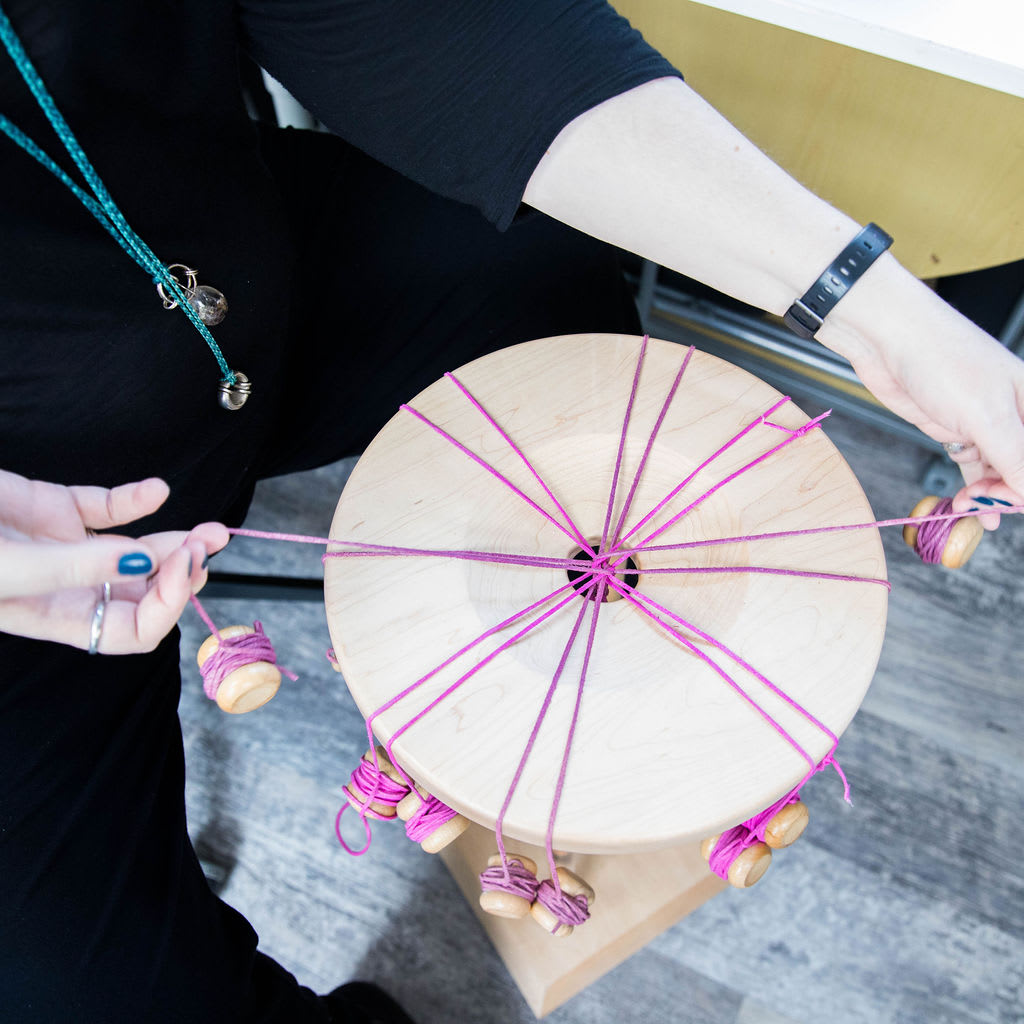
As a jeweller – some ideas of tasks I find particularly valuable for mindful attention are: - filing or sanding objects, polishing, piercing (sawing / cutting out shapes), hammer forming metals. These tasks are all quite repetitive, and if you don’t focus completely on the metal (or wax, stone or other material) and its feel, markings and sounds, you will easily go wrong and create the wrong marks, shaping or effect, sometimes irreversibly changing your piece. I also include in my jewellery practice some non metalwork based techniques that I incorporate into my designs, and my teaching, including stitched (off loom) bead weaving, and Kumihimo which is the art of Japanese braiding. These are also very suitable for practicing mindfulness, particularly involving a lot of repetition – as in the braiding, which I am doing in the photo above and use to make custom cords for my jewellery pieces.
I hope if you are a maker of any sort that you will have a go at applying some of these ideas to your own work or hobby and seeing how it affects your creations, as well as your mindset… I’d love to know what you find!
About the Creator
Penny Akester
Jeweller and Jewellery Tutor based in London UK.
I have been making jewellery since around 1994 and teaching jewellery making to adults since 2009.
I am fascinated by the process of transforming basic materials into treasured artefacts...
Keep reading
More stories from Penny Akester and writers in Motivation and other communities.
Making it Mindfully
Jewellery making is my passion, and my job, and I’ve been lucky enough to have been making jewellery for 25+ years, including sharing this passion with students across London and beyond since 2009. I believe that working on a creative project, like jewellery making, can be used as a form of stress relief and mindful mediation and my aim is to find ways to enhance this potential and share it with others.
By Penny Akester 5 years ago in Humans
The Layers Of Healing
On March 7th, 2022, my life changed drastically when I escaped domestic violence. Since then, I have begun to understand the true extent of what I survived, and I have been forced to take a deep look within to learn why I, and so many others, didn’t see their situations for what they truly were. In that journey, I have begun to see the patterns that led to the past. In most cases of domestic violence, the red flags present themselves right away; however, most victims have other circumstances that lead them not to see or straight-up ignore them. With self-love and motivation, you can heal your soul and live your best life.
By Kristine Franklin4 days ago in Motivation


Comments
There are no comments for this story
Be the first to respond and start the conversation.