
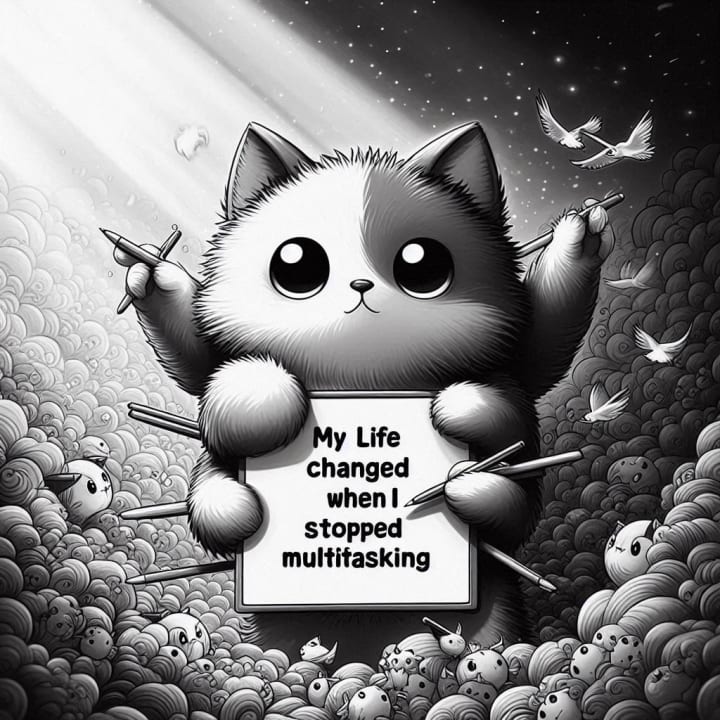
My Life Changed When I Stopped Multitasking
How Doing Less Helped Me Accomplish More Than I Ever Thought Possible



I used to wear multitasking like a badge of honor. I thought it made me efficient, sharp, and productive. I would juggle answering emails while eating breakfast, half-listening to podcasts while working on reports, and texting during conversations with friends or family. I felt busy all the time. But if I’m honest, I rarely felt present. And even more rarely did I feel satisfied.
I was always doing so much—but nothing felt done. Nothing felt complete.
One day, I had a moment that quietly but powerfully changed everything.
I was writing an important email for work, something that required careful thought and clarity. As I typed, I also had music playing in the background, my phone buzzing with notifications, and a video paused mid-sentence on another tab. Somewhere in the chaos, I reread my email draft and realized it made no sense. I had written the same sentence twice, left a thought unfinished, and misspelled basic words. Worse, I couldn’t remember what the email was even supposed to be about.
That was the first time I really noticed how divided my attention had become. I wasn’t writing an email—I was just frantically moving between noise.
That night, I sat quietly with myself. I thought about how long it had been since I’d done just one thing at a time. When had I last read a book without picking up my phone every few pages? When had I enjoyed a meal without a screen? I couldn’t remember.
So, the next morning, I decided to try something radical.
I committed to doing only one thing at a time for the entire day.
When I brushed my teeth, I just brushed my teeth. When I ate, I ate without checking messages or watching a video. When I worked on a task, I closed all unrelated tabs and silenced my phone. When I talked to someone, I gave them my full attention.
By the end of that day, something had shifted. I felt calmer. My thoughts felt less foggy. And even though I had done less overall, everything I did do felt more meaningful.

I continued the experiment the next day. And then the next.
The Hidden Cost of Multitasking
We live in a world that glorifies busyness. We’re expected to move fast, answer instantly, and constantly stay "plugged in." But what I’ve learned is that multitasking isn't a superpower—it’s a distraction. It’s not about doing more; it’s about spreading ourselves so thin that nothing gets our best.
I discovered that the brain doesn’t truly multitask. What it actually does is switch between tasks rapidly. That switching comes with a cost—mental fatigue, decreased performance, and shallow focus. I was tired, anxious, and unfocused not because I had too much to do, but because I was doing too many things at once.
When I stopped multitasking, I started to regain control of my time and mind. I gave each activity the respect of my full attention, and it gave me back a deeper sense of presence.
What Changed in My Life
The changes weren’t dramatic at first, but over time, they became undeniable:
I started finishing tasks faster. Without bouncing between activities, I completed work more quickly and with fewer mistakes.
I became a better listener. Friends and coworkers noticed I was more present in conversations. My relationships deepened.
I felt less stressed. Instead of trying to hold a dozen things in my mind, I only held one. That alone lifted an invisible weight.
I enjoyed small things again. A walk, a cup of tea, or a quiet moment felt rich and full when I wasn’t also checking email or scrolling.
I gained clarity. Focusing helped me better understand what truly mattered and what was just noise.
How You Can Try This
You don’t have to overhaul your entire life to stop multitasking. Here are a few small ways you can start:
Silence notifications when working on a task.
Use full-screen mode to eliminate visual distractions.
Schedule time blocks for different activities instead of mixing them.
Practice mindfulness—even in simple moments like washing dishes.
Be fully present with people. Put the phone away during meals or conversations.
These small changes have had a massive impact on my life. The more I single-task, the more I find joy, peace, and meaning in everyday moments.
The Moral of the Story
You don’t need to do more to live a fulfilling life.
Sometimes, the secret isn’t in adding more tasks to your list—it’s in giving each moment your full attention. In a noisy world that constantly demands our focus, choosing to do one thing at a time is a quiet revolution. It’s a path to clarity, calm, and deeper connection—with others and with ourselves.
I changed my life when I stopped multitasking.
You can, too.
-----------------------------------
Thank you for reading...
Regards: Fazal Hadi
About the Creator
Fazal Hadi
Hello, I’m Fazal Hadi, a motivational storyteller who writes honest, human stories that inspire growth, hope, and inner strength.
Keep reading
More stories from Fazal Hadi and writers in Motivation and other communities.
10 Simple Habits That Can Make You Unstoppable
There was a time in my life when I felt stuck. Not dramatically broken—just quietly stuck. I had goals, ambition, even talent, but somehow I wasn’t moving. I felt like I was waiting for a sign, a burst of motivation, or the "right moment" that never seemed to arrive.
By Fazal Hadi7 months ago in Motivation
“The Power Beneath a Mother’s Feet: The True Path to Success”
In a small village nestled between rolling hills and winding rivers, there lived a young boy named Ayaan. He was ambitious, curious, and had dreams that reached far beyond the boundaries of his little village. Every evening, Ayaan would sit under the old banyan tree near his home and gaze at the stars, imagining a life full of achievements and recognition.
By Ihtisham Ulhaq7 days ago in Motivation


Comments
There are no comments for this story
Be the first to respond and start the conversation.