
My Last $100 Wasn't a Lottery Ticket. It Was a Dare.
I thought financial freedom meant being rich. I discovered it meant being able to breathe again.

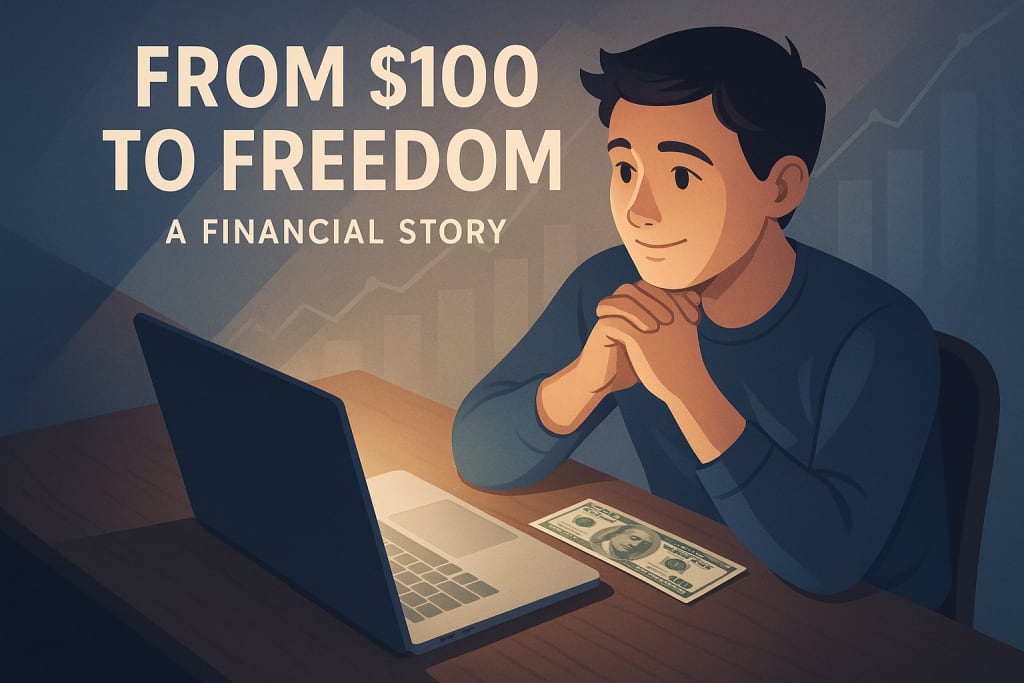
My Last $100 Wasn't a Lottery Ticket. It Was a Dare.
I thought financial freedom meant being rich. I discovered it meant being able to breathe again.
At one point, the only thing standing between me and complete collapse was a single, worn-out $100 bill. I was armed with nothing but fear, a heavy cloak of shame, and the feeling that I had reached the end of the road. I didn't know it then, but that small bill wasn't going to be the end. It was going to be the ink I'd use to write an entirely new chapter. A chapter about freedom.
The Anatomy of Rock Bottom
I was 27, stuck in a studio apartment I could barely afford, and my phone rang more with calls from debt collectors than from friends. The bottom isn't just a lack of money; it's a state of mind. It’s the empty space where your own voice echoes back at you, asking, "How did I get here?"
That $100 bill wasn't just a small amount of money; it was an insult. A stark reminder of every wrong turn I'd ever taken. I avoided my friends, making up excuses because I couldn't admit I couldn't even afford a cup of coffee. But worse than the debt and the overdue rent was the paralysis. The feeling of being stuck in quicksand, where every move you make only sinks you deeper.
But at the very bottom, there’s one strange advantage: you have nothing left to lose.
A Desperate Search, Not a Miracle
One long night, staring at the ceiling, I did what so many people do when they feel trapped: I opened Google. I typed a vague and desperate plea for a way out, something like, "how to earn extra income from home."
I wasn't expecting a magic wand. I was expecting to drown in a sea of ads for expensive courses and get-rich-quick promises. As I scrolled, I found something different. A simple video of a guy talking about buying old electronics from thrift shops, cleaning them up, and reselling them for a small profit.
No promises of a mansion. No secret formulas. Just simple, tangible work.
I closed the tab.
But the idea stuck with me. It felt small enough to be possible and realistic enough to be believable. Five minutes later, I reopened it.
My First Real Bet
I took my only hundred-dollar bill and went to a local flea market. The smell of dust and old memories hung in the air. I spent hours scanning piles of things that time had forgotten, feeling foolish, like I was searching for treasure in a junk pile.
And then I found them. A classic Game Boy for $40 and a pair of old Bose headphones for $30. That left me with $30 for emergencies. I went back to my apartment and got to work. The sharp, sterile smell of alcohol wipes—as I erased years of someone else's dust from those gadgets—was the first truly productive thing I'd done in months.
I took the best photos I could with my old phone, wrote an honest description, and listed them online.
Two days later, my phone buzzed. An email notification with a subject line I’ll never forget: "Your item has sold!" I didn't shout. I didn't jump for joy. Instead, a wave of relief so powerful it almost buckled my knees washed over me. I just sat there, staring at the screen through tears. It was real.
The Game Boy sold for $115. After the platform fees and the cost of the shipping label, the actual profit was closer to $60. It wasn't life-changing money. But it wasn't about the amount. It was proof. Proof that I could do *something*—anything—and see a result. For the first time in years, I felt like I was holding one of the strings to my own future.
The Un-Glamorous Truth of the Grind
This is where I have to be honest. Success stories always skip over the boring and frustrating parts. The truth is, the path forward wasn't a smooth, upward climb.
I reinvested every dollar I earned. Headphones, cameras, used books. The first month, I cleared a net profit of $320. But the second month, I made a terrible buy on a box of old cameras that turned out to be junk, and my profit nearly vanished. I lost money. Another time, I shipped the wrong item and had to eat the cost of shipping twice.
My weekends were filled with the smell of cleaning supplies, the click of my phone's camera, and the rustle of bubble wrap, all while my friends' lives continued on social media without me. This work wasn't glamorous. It was repetitive, tiring, and required real discipline. I wasn't just "flipping" things; I was learning the harsh, un-glamorous lessons of running a tiny, one-person business from the ground up.
Redefining What "Rich" Means
Three years later, I run my small online reselling business. And I'm here to tell you a secret: I haven't achieved what the online gurus call "financial freedom." I don’t have a luxury car or work from a beach in Bali.
But I have a different kind of freedom. A kind that is far more precious.
* I have the freedom to wake up without a crushing sense of dread from my debts.
* I have the freedom to buy groceries without my heart pounding at the checkout counter.
* I have the freedom to help my parents with an unexpected bill.
* I have the freedom to say "no" to projects I don't believe in.
This is real freedom. It isn't the absence of work; it's the presence of choice.
Your Start Is What Matters
I know that luck played a role in my story. Maybe if I hadn't found that Game Boy on that particular day, things would have been different. I can't promise you this path will make you rich, or even that it will work for you. Anyone who tells you there's a guaranteed formula for success is selling you something.
But that hundred dollars taught me something more important: the opposite of "stuck" isn't "successful." It's "moving."
A small start isn't just a beginning. It's a rebellion against despair. It's a declaration that you haven't given up yet.
So, I'll leave you with the question that hundred-dollar bill forced me to answer:
What is one small, imperfect, slightly scary move you can make today to just start moving?
About the Creator
Moh Hussein
Mohamed Hussein is an writer exploring the intersection of technology, culture, and identity in the Middle East, telling the human stories behind how digital systems shape a new generation.
Keep reading
More stories from Moh Hussein and writers in Motivation and other communities.
What I wish I knew in my 20s as a Muslim
Assulamu Alaykum, I wish I had reminded myself that I’m not meant to be perfect all the time. I just have to try. Same with my daily prayers. They don't have to be perfect right now; I just have to try and work towards what Allah expects of me, little by little.
By Jakayla Toneya day ago in Motivation
Miss Persephone's Manual to a Seemingly Ordinary Life
Miss Persephone was found at the dining table, her blue eyes swollen, her tears arriving and retreating like the tides of the ocean. Earlier that day, her family had visited her in the retirement home where she had lived for eight years. It was her eightieth birthday.
By Imola Tóth4 days ago in Fiction


Comments
There are no comments for this story
Be the first to respond and start the conversation.