
I Have a Cracked Phone Screen and No Degree. Here’s How I Built a Life Anyway.
No Degree, No Network, No Problem — How I Built a Freelance Life from Scratch.


Title: I Have a Cracked Phone Screen and No Degree. Here’s How I Built a Life Anyway.
No Degree, No Network, No Problem — How I Built a Freelance Life from Scratch.
I. The Rejection
Three years ago, I was sitting in a noisy Cairo café that smelled of burnt coffee and cigarette smoke. The plastic table wobbled every time I shifted my weight. I had ordered one cup of tea—three hours ago—and the waiter kept glancing over, not annoyed, but with a kind of quiet sympathy.
On the screen of my cracked, secondhand phone, I refreshed my email again. Another rejection. Not from a dream job—just a call center. Minimum wage, long hours, no benefits. “Not dynamic enough,” the recruiter had said.
Around me, the world buzzed: the clink of glass cups, a street vendor shouting outside, a couple arguing softly in Arabic. But in my head, all I could hear was the silence of failure.
I opened Instagram. Perfect lives. Career wins. Digital smiles. Everyone seemed to be sprinting toward success. I didn’t even know where the track was.
II. The Lie We're All Sold

We’ve all been sold a single story of success: get the degree, land the job, climb the corporate ladder. Your value, in this story, is a stamp of approval from an institution. But that story is a lie, or at least, it’s dangerously outdated.
The stable staircase to success is now a shapeshifting maze. The job you study for might be automated in five years. The degree you earned doesn't guarantee security. In a world of personal branding, the resume you spent years building can lose to someone with a more compelling 60-second video on TikTok.
That night in Cairo, staring at my rejection email, I realized the twist: the very system that had excluded me was now desperate for the one thing it can’t teach in a classroom—authenticity. Resilience. A perspective shaped by failure, not just by textbooks.
III. The Skills That Actually Matter
There’s a hunger that no curriculum can instill. When you have no safety net, your creativity becomes a muscle. When no one is betting on you, your vision becomes your only currency.
You learn to see problems everywhere—not as obstacles, but as opportunities. A confusing menu at a local restaurant isn't just a menu; it's a chance to offer your skills as a copywriter. A small business with a dead Instagram page isn't a failure; it's a potential client. You learn to connect with people, not to impress them. You learn that competence is more valuable than credentials. That’s something no university can give you: a different way of seeing the world.
IV. My Path Wasn't a Ladder; It Was a Series of Small Steps
I didn't have a grand plan. I just had a strategy born of desperation: solve the smallest problem in front of me.
I Learned a Skill That Solved a Problem: The next day, I walked into that same café where I’d been nursing my tea. I told the owner, a kind but overworked man, that his menu was confusing. I offered to rewrite it for him—not for money, but for a week's worth of coffee and food. He agreed. I spent two days working on it, making the descriptions clearer, more appealing. He loved it. That was my first "job." I learned copywriting.
I Started Before I Was Ready: My "office" was a corner of that café. My "portfolio" was a single, laminated menu. I didn't wait to build a website or print business cards. I took a picture of the new menu and showed it to the owner of the bakery next door. I told him I could improve his.
I Served, Then Scaled: That bakery owner didn't have money, but he paid me in bread and pastries, which I shared with my family. He then recommended me to his cousin, who had a small online shop. That cousin became my first paying client—$50 to write product descriptions. I wasn't building an empire. I was building a reputation, one small, solved problem at a time.
V. You Are the Glitch in the System
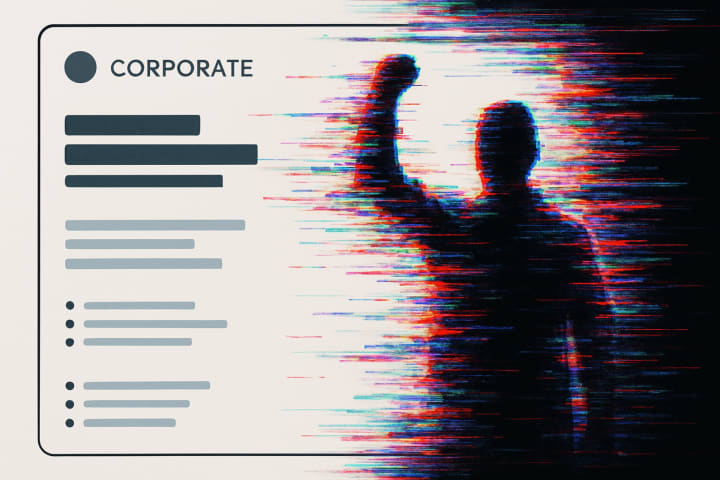
The old world is built on gatekeepers—degrees, certifications, interviews. They want you to believe their path is the only one. But when you build your own path, you become a glitch in their algorithm.
You prove that success isn't granted from above, but earned from within. You aren’t just working around the system; your very existence exposes its fragility. And to the gatekeepers, that is terrifying, because it means they are losing control.
VI. The New Success Story

Today, I still have a phone with a cracked screen. I'm not a tech millionaire, and I don't have an MBA. I'm a freelance writer and marketing consultant for small businesses. Some months are great, others are a struggle.
But the money in my pocket is my own. The words I write are mine. The path I’m on was carved by my own two hands.
In a world that applauds polish, dare to be real. In a world that sells speed, dare to build with intention. You don’t have to climb their ladder. You can turn away and build your own.
And that, my friend, is a success story no one can take from you.
-----------------------
A Note on Tools
My story started with a borrowed laptop and a phone with a cracked screen. I am proof that you don't need expensive gear to begin. The most important tool is your own determination.
But as I grew, I realized that investing in the right tools can remove friction and allow you to focus on what truly matters: your craft. Many readers ask what I use now. While I built my foundation on the basics, the single biggest upgrade to my freelance life was investing in a reliable, fast laptop.
If you're at a point where your old equipment is holding you back, the one I personally use and recommend is the MacBook Air. It’s fast, incredibly light, and the battery lasts forever—perfect for a freelancer working from cafes, libraries, or wherever the journey takes you.

(Just so you know, this is an affiliate link. If you choose to buy through it, I’ll earn a small commission at no extra cost to you. I only recommend tools I genuinely believe in and that have made a real difference in my own work.)
About the Creator
Moh Hussein
Mohamed Hussein is an writer exploring the intersection of technology, culture, and identity in the Middle East, telling the human stories behind how digital systems shape a new generation.
Keep reading
More stories from Moh Hussein and writers in Motivation and other communities.
Looking back: 2025 was a beast
It's difficult to know how to start this. I've suggested that it's been a tough one from my title and in many ways, it has; however, there is an argument that it's not been that extraordinary at all, merely this wonderful thing we call "life" with all its climaxes and pitfalls.
By Rachel Deeming28 days ago in Motivation
THE NATURE OF ABUSE
The nature of abuse is fundamentally defined by an imbalance of power and control, where one seeks dominance to achieve obedience within the powerless state of another. The path to restorative peace, emancipation, and freedom must reside within the state of truth. To become a catalyst of change one must force the mask to drop for transparency and accountability to emerge. The façade or persona others may project to the world, often conceals their core real true-self. True character is often revealed within moments of critical crisis, where someone who has experienced grave injustice, torture, ridicule, resistance to help, or silencing is forced to walk without assistance. Within moments of despair one enters into the ascended state of revelation, awakening, and enlightenment of the true self. One must acutely address and recognize where policy, legislation, legal frameworks, leadership, or lack of compassionate care or empathy may not be apparent. What resides or lies beneath, will always emerge to the surface within time, especially when another’s superficial mask drops. What is often revealed is the performative façade is no longer evident. Within the critical moments of relationships, genuine intent is demonstrated by compassion, understanding, support, and a willingness to set aside personal selfish interests for the common good of all. Unfortunately, within the realms of cruelty or manipulative intent, there can be a stark contrast to the reality initially being presented prior by the abuser, as the charm inevitably fades. Survivors of abuse can identify a change in character when loss of control is evident. Within the moments of absence, indifference, apathy, or silence, abusers are often challenged in the sense, that they must confront what they have inevitably become. Abusers are often publicly caught in a lie that they cannot explain away. A turning point emerges for a victim of abuse, when there is a shocking devastating realization that the person they confided in, was engaging in a performance act. This knowledge can be a catalyst for a victim to begin their healing journey and leave an abusive relationship, as it provides certainty, that their instincts and moral judgement were correct all along.
By ELISABETH BABARCI 5 days ago in Motivation


Comments
There are no comments for this story
Be the first to respond and start the conversation.