
Imran Khan: From Cricket Legend to Political Icon – A Journey Through the Ages
The life and legacy of Imran Khan, from the pitch to politics

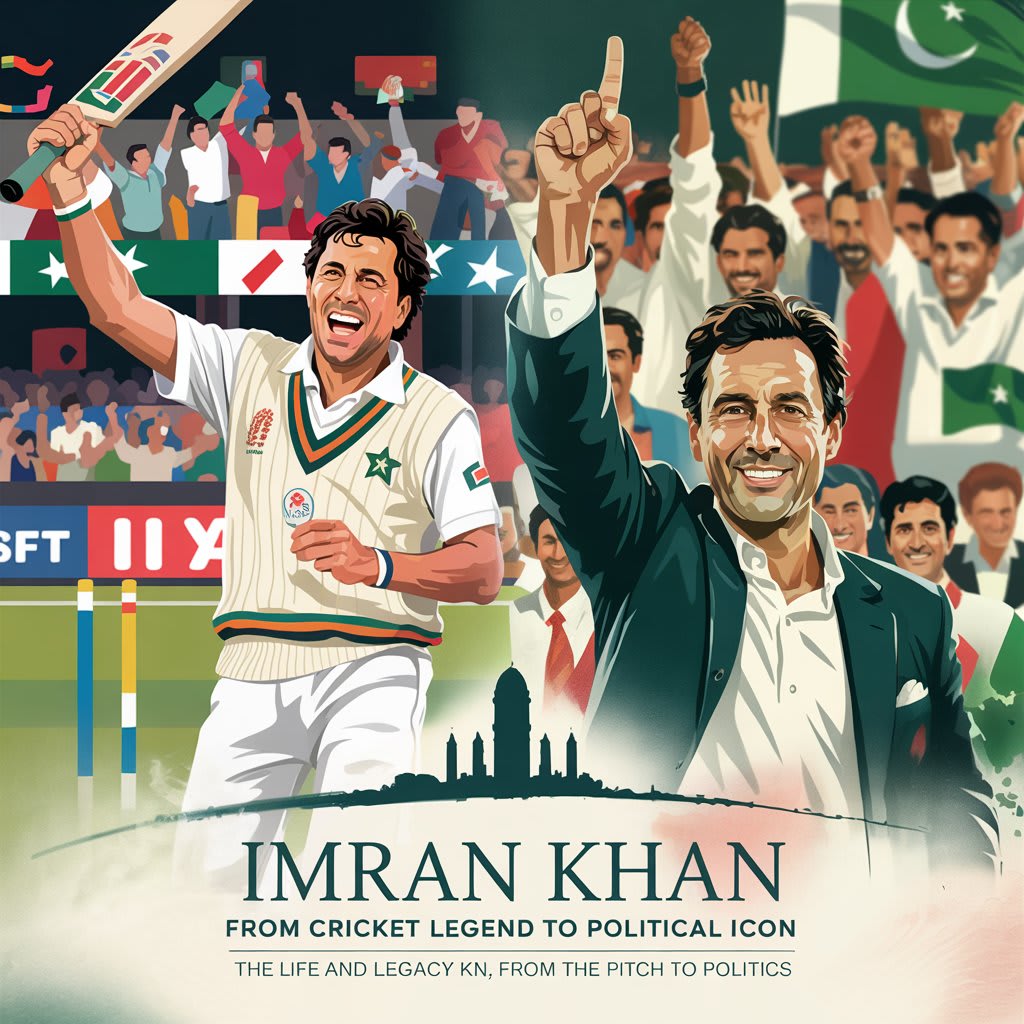
- I divide Mr Imran Khan life in three parts
- No.1 1year old to 30 yeat old
- No.2 31years old to 60 years old
- No.3 61years old imran khan to till now
Part No. 1
Imran Ahmed Khan Niazi, born on October 5, 1952, in Lahore, Pakistan, is a name that resonates across the world. His journey from a privileged childhood to the heights of international cricket stardom is a testament to his resilience, determination, and vision. In this first part of the article, we delve into the early years of Imran Khan’s life—from his childhood through his cricket career up until the age of 30.
Early Life and Education
Imran Khan was born into a well-to-do family, with his father, Ikramullah Khan Niazi, a prominent civil engineer, and his mother, Shaukat Khanum, a housewife with a deep appreciation for education. The family’s roots trace back to the Niazi tribe, which has a rich history in the region. Raised in a comfortable environment, Imran's early years were marked by a strong emphasis on education and discipline.
Imran attended Aitchison College in Lahore, one of the most prestigious schools in Pakistan. It was here that he displayed his first signs of athletic ability, excelling in various sports. His academic achievements were commendable as well, with Imran being a top student in school. However, it was cricket that captured his heart early on.
After completing his early education in Lahore, he moved to the United Kingdom in 1972 to study at the prestigious Royal Grammar School in Worcester. It was during his time at the school that Imran’s passion for cricket flourished. He soon became a standout cricketer, playing for the school’s team and developing skills that would later define his career.
Imran went on to study at Keble College, Oxford, where he pursued a degree in Philosophy, Politics, and Economics (PPE). While academics were important, it was his involvement in cricket that took precedence during his university years. At Oxford, Imran not only proved himself as a gifted student but also refined his cricketing abilities, representing the university in various matches and showcasing his potential as a future international player.
The Cricketing Journey Begins
Imran Khan’s journey in cricket began at an early age, but it was at Oxford that he made the decision to pursue it professionally. He made his debut for the Pakistan national team in 1971 at the age of 18, against England. His performance in his debut match was modest, but it marked the beginning of a career that would span over two decades.
Throughout the 1970s, Imran’s cricketing career progressed steadily. He played domestic cricket in Pakistan and quickly became known for his fast bowling and leadership qualities. However, it wasn’t until 1976 that he truly broke into the international cricket scene. His performance in the West Indies, where he showcased his ability to bowl fast and with precision, earned him recognition as one of the best young bowlers in the world.
Imran’s cricketing career took a major turn in the early 1980s. He began to be seen as one of the most formidable all-rounders in the world, possessing not only excellent bowling skills but also impressive batting ability. In 1982, Imran was appointed the captain of the Pakistan national cricket team, a role that would define his career in the coming years.
Imran as Captain: Rising to Leadership
Imran Khan’s leadership abilities became evident when he took charge of the national cricket team in 1982. At the time, Pakistan’s cricket team was often seen as disorganized and lacking in discipline. Imran, however, was determined to instill a sense of professionalism and commitment within the team. His captaincy marked a turning point for Pakistan cricket, as he worked hard to build a cohesive unit, focused on team dynamics and strategy.
Under Imran's leadership, Pakistan's cricket team began to see a significant improvement in performance. Imran’s approach was unconventional—he emphasized discipline, hard work, and mental toughness. He also brought in young, talented players, such as Javed Miandad, Wasim Akram, and Abdul Qadir, who would go on to become cricketing legends in their own right.
The pinnacle of Imran’s career came in 1992 when he led Pakistan to victory in the ICC Cricket World Cup in Australia. This victory remains one of the most iconic moments in Pakistan’s cricketing history and cemented Imran Khan’s status as not just a cricketer, but as a national hero.
The Road to 30
By the time Imran Khan reached the age of 30, he had already achieved considerable success on the cricket field. He had captained his country to numerous victories and built a reputation as one of the finest all-rounders in the game. But beyond his success in cricket, Imran’s personal and professional life was beginning to evolve. He had become a figurehead for national pride and unity, embodying the hopes and dreams of millions of Pakistanis.
Imran's marriage to British socialite Jemima Goldsmith in 1995 added a new dimension to his public life. His rise to international fame, his transition into social and political circles, and his deepening involvement in humanitarian efforts, particularly through the establishment of his cancer hospital, Shaukat Khanum Memorial Cancer Hospital & Research Centre, marked the early stages of his journey toward becoming more than just a cricket icon.
Imran Khan’s first 30 years were nothing short of extraordinary, laying the groundwork for what would become a multi-faceted life, blending sports, politics, and social activism. His cricketing achievements, combined with his personal charisma and commitment to social causes, set the stage for what would be an even more transformative chapter in his life......
To be continued...........
About the Creator
Umair Ali Shah
Writer exploring life, truth, and human nature through words. I craft stories, essays, and reflections that aim to inspire, challenge, and connect. Every piece is a step on a shared journey of thought and emotion.
Keep reading
More stories from Umair Ali Shah and writers in Motivation and other communities.
Corrosion Resistance That Endures: The Strength of Hot-Dip Galvanized Steel
Steel remains essential to infrastructure, manufacturing, and development across the nation. However, corrosion constantly threatens its durability and performance. When steel comes into contact with moisture and oxygen, rust begins to form and slowly spreads. Over time, this process weakens structures and increases safety risks. Therefore, engineers and asset owners seek protection methods that deliver long-term reliability. Hot-dip galvanizing provides a proven answer to this ongoing challenge.
By Frontier Galvanizing2 days ago in Motivation


Comments
There are no comments for this story
Be the first to respond and start the conversation.