
How to Stop Waiting for Motivation (The Secret Most People Miss
Why Action Isn't the Result of Inspiration—It's the Cause of It

Leo stared at the blank page. The cursor blinked back at him, a tiny, metronome of mockery. Tap. Tap. Tap. It seemed to echo the hollow feeling in his chest. The deadline for his novel’s next chapter was a specter looming over tomorrow, but tonight, he felt nothing. No spark. No divine wind of inspiration. Just the crushing weight of expectation and the utter absence of motivation.
He’d tried all the tricks. He’d rearranged his desk. He’d made a fourth cup of coffee. He’d put on the “epic writing music” playlist. He’d even scrolled through motivational quotes on social media: “Follow your passion!” “The universe rewards boldness!” “If you can dream it, you can do it!”
It all felt like a lie. A billboard on the road to failure, cheerfully telling him his empty gas tank was all in his head.
Frustrated, he slammed his laptop shut. The silence in his apartment was deafening. He needed a break, something to clear the cobwebs. He remembered his grandfather, a man of few words and countless skills, who lived on the outskirts of town. Maybe a drive would help.
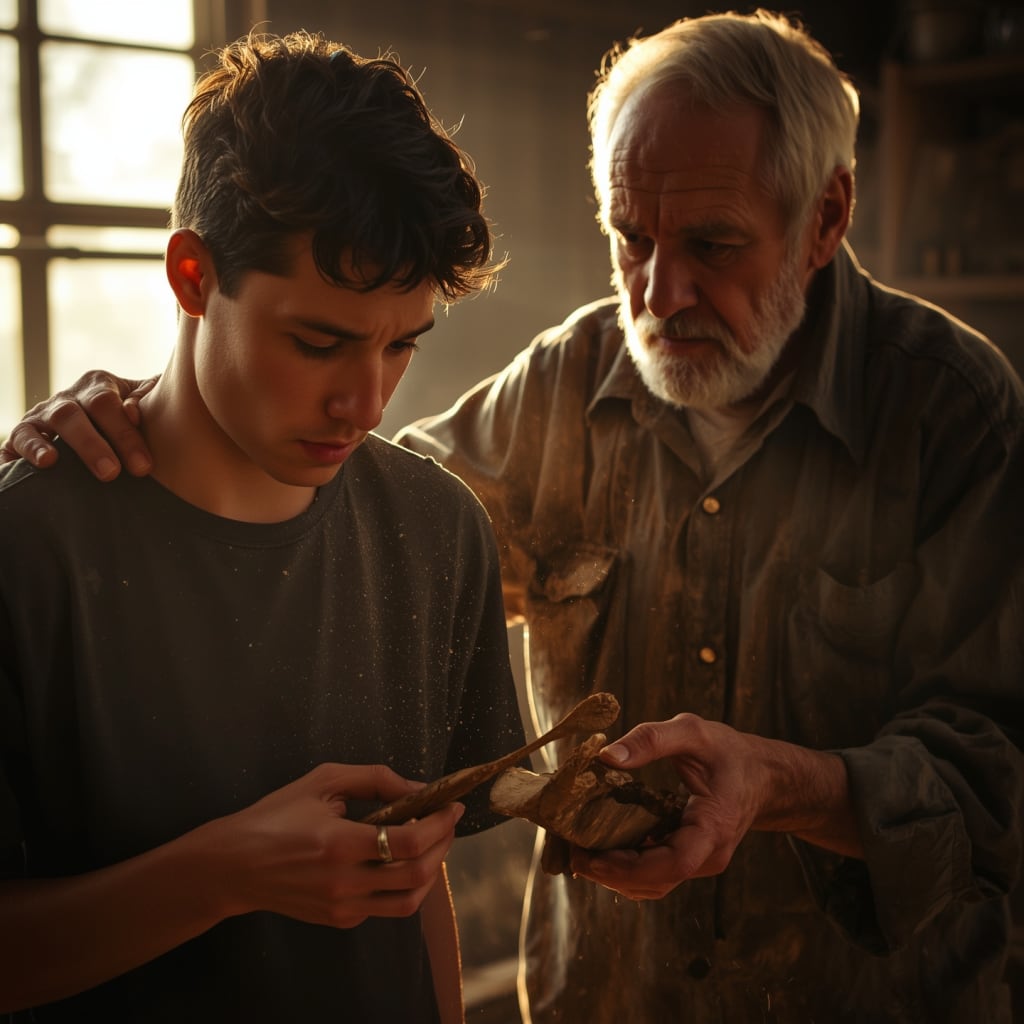
An hour later, he was sitting in his grandfather’s weathered workshop, the air thick with the scent of sawdust and linseed oil. He didn’t even need to explain. Grandpa Henry took one look at his grandson’s defeated posture and nodded towards a block of cherry wood on his workbench.
“It’s supposed to be a spoon,” Grandpa Henry said, his voice a calm, gravelly rumble. “Carve a spoon.”
Leo blinked. “What? Grandpa, I can’t carve a spoon. I’m not a carpenter. I don’t even know where to start. And honestly, I’m not really in the mood.”
“Exactly,” the old man said, a faint smile playing on his lips. He picked up a chisel and a mallet and placed them in Leo’s hands. “The wood doesn’t care about your mood. The tools don’t care if you’re motivated. They only care what you do with them.”
Feeling foolish but too weary to argue, Leo picked up the mallet. He gave the chisel a tentative tap. A small, useless flake of wood skittered across the bench.
“See? Nothing,” Leo said, the frustration bubbling back up.
“You tapped,” Grandpa Henry corrected. “Now strike. Don’t think about making a spoon. Think about making one cut. Then another.”
With a sigh, Leo focused. He set the chisel’s edge and brought the mallet down with more force. Thunk. A satisfying curl of wood peeled away. He repositioned the chisel. Thunk. Another piece. He wasn’t thinking about the spoon’s bowl or the handle’s curve. He was only thinking about the next cut. The next thunk.
His mind, which had been a chaotic storm of anxiety and self-recrimination, began to quiet. The rhythm of the work—position, strike, clear—became a form of meditation. He wasn’t writing, but he was doing. His muscles began to ache, a real, physical sensation that grounded him.
After twenty minutes, he paused, his forehead damp with sweat. He looked down. The block of wood was no longer a block. It was rough, clumsy, and unmistakably spoon-shaped.
“I… I started a spoon,” Leo said, a flicker of surprise cutting through his gloom.
Grandpa Henry picked up the nascent spoon, examining it with a critical but not unkind eye. “You did. Now, why do you think you could do that, but you couldn’t write your words?”
Leo shrugged. “Because this is different. This is physical.”
“Is it?” Grandpa Henry asked. “Or did you just stop waiting?”
“Waiting for what?”
“For the feeling,” the old man said, his eyes wise and clear. “You came here waiting for motivation to strike you like lightning. But it doesn’t work that way. That’s the secret most people miss. Motivation isn’t the starter. It’s the reward.”
He gestured to the spoon. “You didn’t feel motivated to carve. You felt frustrated. But you carved anyway. And look.” He pointed at Leo’s face. “What do you feel now?”
Leo thought about it. The hollow feeling was gone. In its place was a faint but definite buzz of accomplishment. A curiosity about how to smooth the handle. A desire to see the grain of the wood emerge. He felt… engaged. Interested.
Inspired.
“I feel… like I did something,” Leo said.
“Exactly. You took action. The action itself created the momentum. The momentum created a result, however small. And that result,” Grandpa Henry said, tapping the spoon against his palm, “that is what creates the motivation to take the next action. You confused the cause and the effect.”
The truth of it landed on Leo with the weight of the mallet. He had been standing on the track, waiting for a train called Motivation to arrive and carry him to the land of accomplishment. He never realized he was the train. He just had to start moving.
Action → Momentum → Result → Motivation → More Action.
He had been trying to start with motivation, the final link in the chain, and was perpetually confused why the engine never started.
“The page doesn’t care about your mood, son,” Grandpa Henry said, echoing his earlier words. “The keyboard doesn’t care if you’re inspired. They only care what you do with them. Don’t write a chapter. Don’t even write a page. Just write one sentence. Make one cut. Strike the chisel once. The feeling will come after.”
Leo drove home that night with the rough cherry wood spoon on his passenger seat. He didn’t turn on the radio. He just thought about the rhythm. Thunk. Thunk. Thunk.
He walked into his apartment, sat down at his desk, and opened his laptop. The cursor still blinked. Tap. Tap. Tap. But now it sounded less like mockery and more like a metronome, ready to keep time.
He didn’t think about his chapter. He didn’t think about his deadline. He didn’t search for a feeling.
He placed his fingers on the keys and made one cut.
He wrote a single sentence. Then another. And as the words began to form on the screen, a familiar, long-awaited feeling began to bloom in his chest. It wasn’t a lightning strike. It was a quiet, steady kind of fire, built not from waiting, but from doing. He had stopped waiting for the spark and finally started chopping the wood.
About the Creator
Alexander Mind
Latest Stories
Keep reading
More stories from Alexander Mind and writers in Motivation and other communities.
Self-Reliance is the Key to Life
The old man’s hands, a roadmap of veins and weathered skin, trembled slightly as he placed the small, wooden box on the table between us. The cottage, his sanctuary for over sixty years, smelled of pine resin, old books, and woodsmoke. Outside, the Scottish Highlands brooded under a leaden sky, the loch a sheet of hammered steel.
By Alexander Mind4 months ago in Motivation
How to Wake Up
Introduction: Follow the following instructions for how to wake up each morning to ensure a lovely day. Allow yourself to awaken naturally. Don’t force yourself to wake up. Sometimes a bird’s whistle can lull you alert, or a slight bump. Once you are roused, don’t move just yet. Lie still. Be calm and relaxed. Step by step, do the technique below:
By Shareese Aouad7 days ago in Motivation
The Devil's Cut
“Comrade, finally you’re awake.” The voice was smooth, sensual. A flickering incandescent bar was all that lit the white, sterile room. All Vladimir remembered was everything going black. He tried to move his arms and found them strapped to the gurney.
By Matthew J. Fromm5 days ago in Fiction


Comments
There are no comments for this story
Be the first to respond and start the conversation.