
Self-Reliance is the Key to Life
Self-Reliance is the Key to Life: The Unseen Compass Within

The old man’s hands, a roadmap of veins and weathered skin, trembled slightly as he placed the small, wooden box on the table between us. The cottage, his sanctuary for over sixty years, smelled of pine resin, old books, and woodsmoke. Outside, the Scottish Highlands brooded under a leaden sky, the loch a sheet of hammered steel.
“They’ll tell ye the key tae life is love, or money, or faith,” he said, his voice a low rumble like distant thunder. “And there’s truth in that, aye. But they’re all doors. And a door is useless without a key to open it. That key,” he tapped the box, “is self-reliance.”
My grandfather, Alistair, was not a man of many words, but each one was weighed and measured before he offered it. I had come to him feeling adrift, a recent university graduate with a head full of other people’s theories and a heart empty of my own convictions. The world seemed a vast, confusing labyrinth, and every path was marked with a signpost erected by someone else.
“Tell me,” I asked, my own voice feeling young and thin in the thick silence of the room.
He didn’t open the box immediately. Instead, he told me a story.
“I wasnae much older than you when I left this very glen for the first time,” he began, his eyes losing focus, gazing into the peat fire on the hearth. “I went to Glasgow, a city that roared and screamed and never slept. I had a job in a shipyard, big, brutal work. I lived in a boarding house with a dozen other men, all of us thinking we were chasing a future.”
He paused, sipping his tea. “I was good at the work. Strong. I listened to the foreman, kept my head down. I got my pay every Friday and spent most of it in the pub on Saturday, listening to the others complain about the bosses, the government, their rotten luck. I started to echo them. My life became a reaction to things outside my control. I felt smaller and smaller, a cork bobbing on a angry ocean.”
“What happened?” I leaned forward, captivated. I had never heard this part of his history.
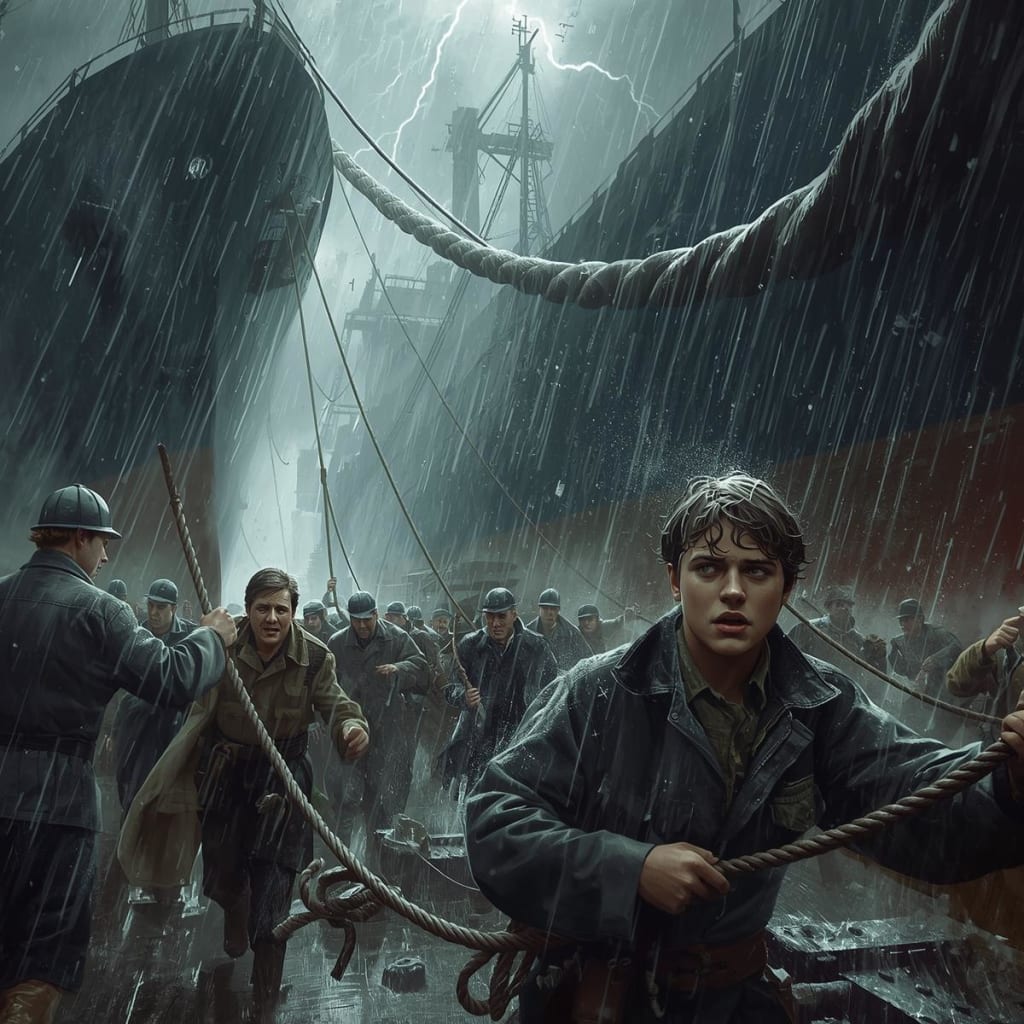
“One raw November day,” he continued, “a gale was blowing in from the river. A cable snapped on a hull we were fitting. It whipped through the air like a devil’s tail. It missed me by an inch. It didnae miss the man next to me.” His face grew grim. “He was a complainer, that one. Always blaming the company for cheap equipment, blaming the weather, blaming his fate. As they carried him away, I had a thought that chilled me more than the wind: his last thought was probably a complaint. An accusation against a universe that had wronged him. He never had a moment of ownership over his own life, not even at its end.”
That was the catalyst. The near-miss was not a lesson about mortality, but about agency. Alistair realized he had been entrusting the navigation of his life to everyone but himself—to the foreman, to his complaining friends, to the whims of fortune.
“I quit the next week,” he said, a faint smile touching his lips. “Not in a fury, not blaming the company for being unsafe. I simply thanked them for the work and left. I came back here. Everyone thought I was a fool. ‘What will you do?’ they asked. ‘What do you have?’”
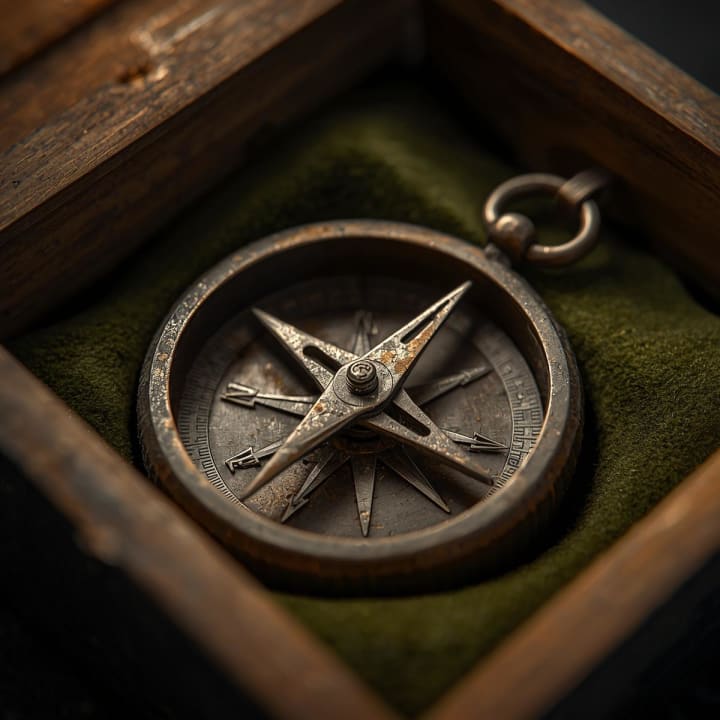
He finally opened the wooden box. Inside, nestled on a bed of faded velvet, wasn’t a medal or a deed or a jewel. It was a simple, hand-forged iron compass. The needle was still, locked in place.
“I had this,” he said, lifting it gently. “My father gave it to me when I left. He said, ‘When ye cannae find your way, this will point north.’ But in the city, I’d never once used it. I was too busy asking others for directions.”
“But it’s broken,” I observed, seeing the motionless needle.
“Is it?” he challenged, his eyes sharp. He handed it to me. “Point it north.”
I looked around the cottage, disoriented. I knew the loch was outside, the village was a mile east. But in that enclosed space, without windows to orient me, I realized I didn’t know. I couldn’t point north. I had relied on external markers for so long I had lost my innate sense of direction.
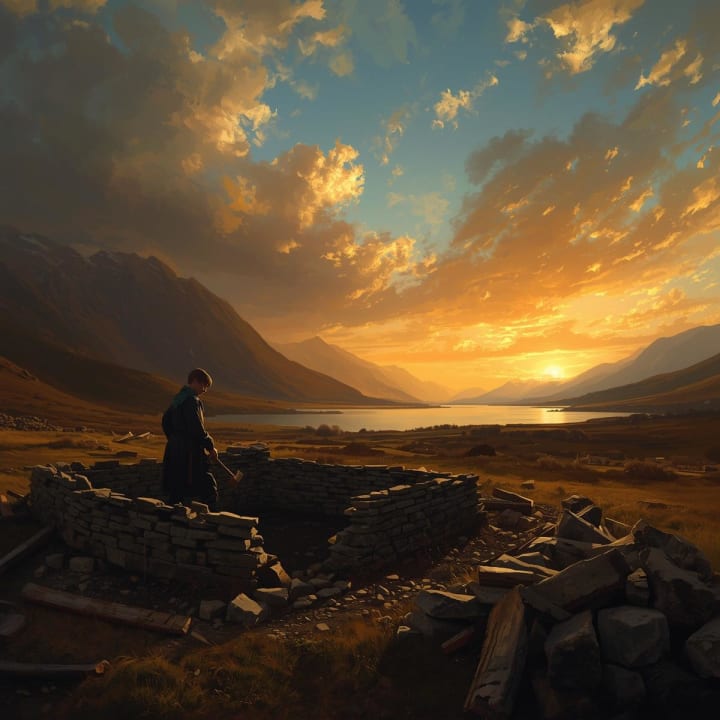
Grandfather Alistair took the compass back. “It’s not broken. The needle knows where north is. It always knows. It doesnae need to spin and search for it. It’s resolute. It’s reliant on its own knowledge.” He placed it in my palm and closed my fingers around it. “I came back here with nothing but the clothes on my back and this compass. I stopped listening to the noise of the world and started listening to the quiet voice inside. That voice told me I could build this cottage with my own hands. It told me which trees to fell, where to find the best stone. It told me to read, to learn, to grow my own food. It was hard. I failed often. But every failure was my failure, and every success was my success. I was no longer a cork on the ocean. I was the ship, and the captain, and the compass.”
He looked at me, his gaze profound. “Self-reliance isnae about living alone in the woods. It’s about owning your choices. It’s the courage to trust your own judgment when the world shouts you’re wrong. It’s the engine of invention, the bedrock of character. Love? You cannot truly love another until you can rely on yourself, or else it becomes need, a chain of dependency. Faith? It must be a faith you arrive at yourself, not one that is given to you. Money? It is a tool, and only a self-reliant mind knows how to wield it wisely instead of being enslaved by it.”
I held the cold, steadfast iron compass in my hand. It was the heaviest thing I had ever held. I understood now. The key wasn’t in the object itself, but in the principle it represented. True north wasn’t a point on a map; it was the unwavering core of self-belief within.
Leaving the cottage that evening, the world hadn’t changed. The labyrinth was still there. But my grandfather had given me the tools to navigate it. I no longer looked for the signposts erected by others. I had my own compass now, its needle silent and sure, pointing resolutely toward my own north. I had learned that the key to life isn’t found in any external treasure, but forged in the quiet, unwavering certainty of one’s own soul. It is the ultimate key, and it only ever fits one lock: your own.
About the Creator
Alexander Mind
Latest Stories
Keep reading
More stories from Alexander Mind and writers in Motivation and other communities.
My Husband’s Forgotten Letter Revealed a Truth That Changed Our Family Forever
My Husband’s Forgotten Letter Revealed a Truth That Changed Our Family Forever The letter was so ordinary, at first. Tucked behind a stack of cookbooks in the kitchen cabinet, it was folded neatly, sealed in an envelope the color of old paper. I found it on a quiet Sunday morning while rearranging the shelves. The handwriting on the front—James’s—was unmistakable: slanted, deliberate, the same loops and crosses he used to sign our anniversary cards.
By Alexander Mind4 months ago in Motivation


Comments
There are no comments for this story
Be the first to respond and start the conversation.