
How I Survived Homelessness and Found Purpose in Helping Others
The Sidewalk Was My Bed. The Cold Taught Me Compassion. Here’s How I Rebuilt My Life.
The Night Everything Fell Apart
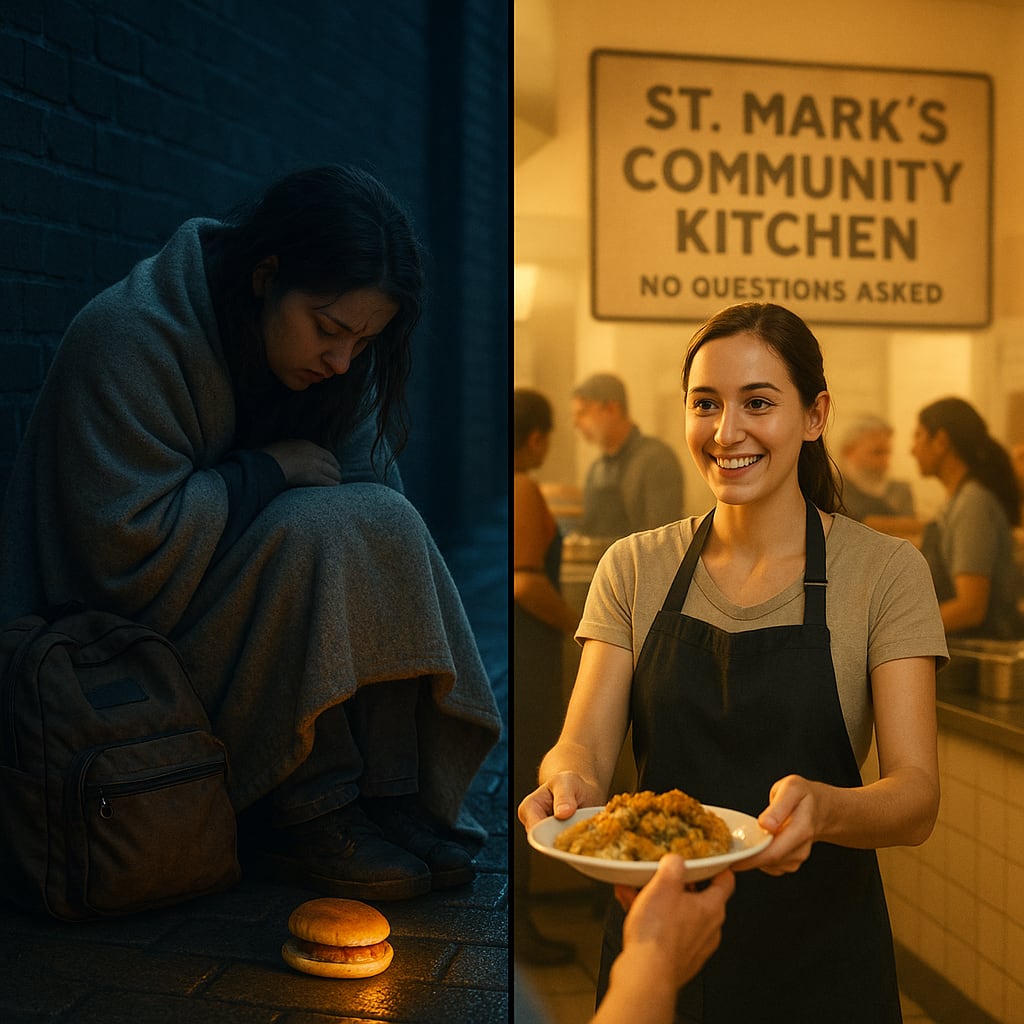
The smell of damp concrete filled my nostrils as I curled tighter under the threadbare blanket. My “bed” was a cardboard box behind the 24 hour laundromat, and my pillow was a backpack holding everything I owned: a half-empty water bottle, a torn family photo, and $3.27 in loose change. Three weeks earlier, I’d been a college student with a part-time job. Then Mom’s cancer relapsed. I dropped out to care for her. When she died, the medical bills swallowed our savings, and the eviction notice came 10 days later.
Homelessness doesn’t start with hunger or cold—it starts with shame. I avoided eye contact with strangers, scrubbed my face in gas station bathrooms, and slept in shifts, terrified of being noticed. But on that freezing November night, something broke. A man in a tattered coat shuffled past me, clutching a plastic bag. Our eyes met, and he wordlessly dropped a warm sausage biscuit into my lap. “You look like my daughter,” he muttered before disappearing into the dark. I cried so hard my ribs ached. That small act of kindness became my lifeline.
---
Rules of Survival
Surviving the streets meant learning new rules:
1. Never sleep in the same spot twice. Cops, addicts, and predators all prey on routine.
2. Find the “angels”: Librarians who let you charge your phone, church volunteers with sandwich bags, and diner waitresses who “accidentally” overfill coffee cups.
3. Hide your fear. Vulnerability attracts danger.
For months, I rotated between shelters, park benches, and subway stations. Panhandling brought in $10 on a good day—enough for a meal or a bus ticket to a warmer city. But the worst part wasn’t the hunger or the cold; it was the invisibility. People walked past me like I was a discarded soda can.
Then came the pneumonia.
---
The Stranger Who Changed Everything I woke up shivering behind a dumpster, my lungs crackling like cellophane. A woman’s voice cut through the fog: “You need a hospital.” I tried to wave her off, but she knelt beside me. Her name was Rosa, a nurse who’d once been homeless herself. She drove me to a clinic, paid for my antibiotics, and handed me a slip of paper with an address: St. Mark’s Community Kitchen – Free meals, job training, no questions asked.
“This place saved me,” she said. “Let it save you too.”
---
Rebuilding, One Meal at a Time
St. Mark’s wasn’t a shelter—it was a . Volunteers taught me to cook bulk meals for the homeless, and for the first time in a year, I felt useful. I’d stand over industrial pots of chili, thinking, This could’ve kept me warm on so many ni.. Regulars started recognizing me: veterans, runaway teens, elderly folks abandoned by their families. I listened to their stories, and slowly, mine began to matter less.
One afternoon, a teen girl named Lila lingered after lunch. “How’d you get out?” she asked, pointing to my St. Mark’s staff badge. I told her about Rosa, the pneumonia, and the day I chose to ask for help instead of hiding. She burst into tears. “I’m so scared,” she whispered. I hugged her, my own tears mixing with hers. This, I realized, was why I’d survived.
---
The Ripple Effect.
Today, I run St. Mark’s outreach program. We’ve housed 200+ people and connected countless others to rehab and jobs. But my real purpose? Showing the homeless what Rosa showed me: You are not your worst day.
Last month, Lila brought her first paycheck to the kitchen. “I got an apartment,” she beamed. I gave her the same words Rosa once gave me: “Now go save someone else.”
---
What Homelessness Taught Me (And Why It Matters to You)
1. Kindness is a currency. That sausage biscuit and Rosa’s address cost little but gave me everything.
2. Rock bottom can be a foundation. My worst moments taught me resilience I now use to uplift others.
3. We all have a role. You don’t need money to help—just eyes that see people.
If you take one thing from my story, let it be this:
The world is saved in small ways. Buy a coffee for someone struggling. Volunteer. Or simply smile. That’s how we heal—together.
---
Final Line (Call to Action):
“The next time you pass someone on the street, remember: they’re not a ‘homeless person.’ They’re a person. And every person deserves a chance to become their own miracle.”
About the Creator
Wilfred
Writer and storyteller exploring life, creativity, and the human experience. Sharing real moments, fiction, and thoughts that inspire, connect, and spark curiosity—one story at a time.
Keep reading
More stories from Wilfred and writers in Motivation and other communities.
I Stopped Chasing Success—Here’s What I Found Instead
For most of my life, I ran. Not physically—I was never much of an athlete—but mentally, emotionally, spiritually. I ran after success like it was oxygen, believing that if I could just achieve more, earn more, be more, then I’d finally feel… enough.
By Wilfred8 months ago in Motivation


Comments
There are no comments for this story
Be the first to respond and start the conversation.