
Holistic Health: Why Treating the Whole You Matters More Than Ever
"A Practical Guide to Embracing Holistic Health for a Happier, Healthier Life"

Introduction
In today’s fast-paced world, health is more than just the absence of illness. It’s about feeling good physically, mentally, emotionally, and even spiritually. But too often, healthcare focuses only on treating symptoms, missing the bigger picture. That’s where holistic health comes in—a way of caring for the whole person, not just a part. In this article, we’ll explore what holistic health really means, why it’s so important, and how it can help you live a fuller, healthier life.
What Is Holistic Health?
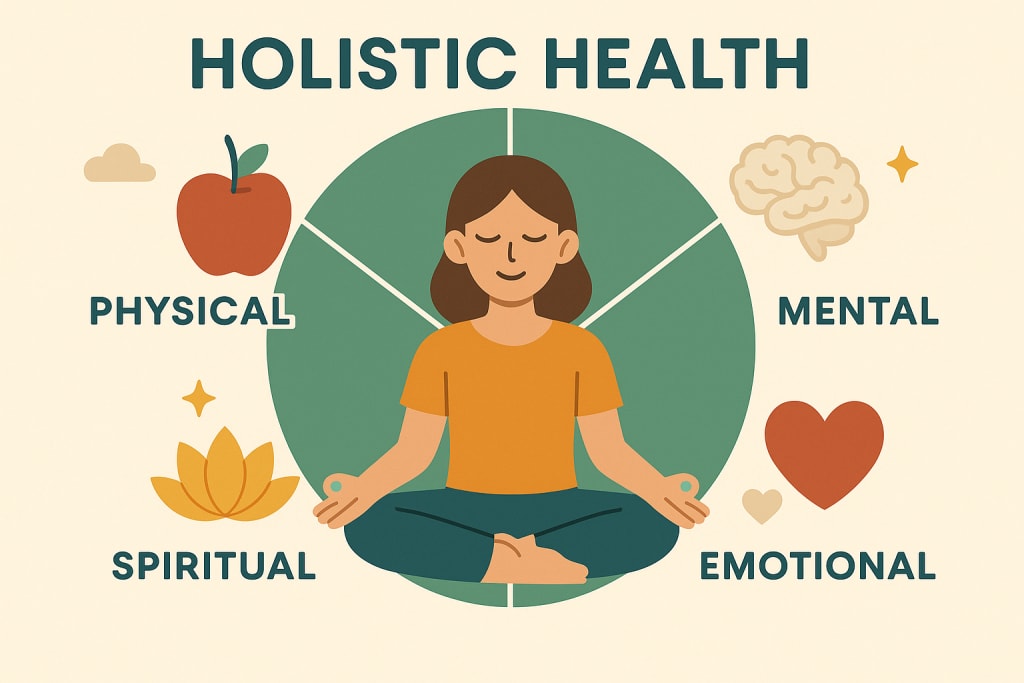
Holistic health means looking at every part of you—your body, mind, emotions, social life, and environment—and understanding how they all connect. Instead of just treating a headache or a cough, holistic care asks: What’s causing this? How can we support your overall well-being?
Research shows that when healthcare providers treat the whole person, patients stick to their treatments better, feel less stressed, and have fewer hospital visits. It’s about healing, not just fixing.
Nutrition: Food as Medicine
You’ve probably heard the saying, “Let food be thy medicine.” It’s true! What you eat affects everything—from your heart and brain to your mood and energy.
Eating plenty of fruits, veggies, whole grains, and healthy fats can lower your risk of heart disease, diabetes, and even some cancers. On the flip side, too much sugar, processed foods, and unhealthy fats can cause inflammation and weight gain.
One of the best diets out there? The Mediterranean diet. It’s rich in olive oil, fish, nuts, and fresh produce—and it’s been proven to keep hearts healthy and bodies strong.
If you want to eat healthier, don’t just hear “eat better”—get advice that fits your culture, budget, and lifestyle. And if you’re struggling, talk to a dietitian who can help you find affordable, tasty options.
Move Your Body: Exercise Is Medicine
Exercise isn’t just about looking good—it’s about feeling good and staying healthy. Regular movement helps your heart, bones, and immune system. It also boosts your mood and brainpower.
Even small changes—like taking the stairs or walking during breaks—make a big difference. If you’re not sure where to start, healthcare providers can help you set goals that fit your life and abilities.
Mental and Emotional Health: The Often Forgotten Piece
Your mind and body are connected. Stress, anxiety, and depression can worsen physical health problems and make recovery harder.
Practices like mindfulness, yoga, and therapy can reduce stress and improve resilience. Healthcare providers should check in on your mental health and help you find support when needed. And remember, caregivers need care too—burnout is real.
Sleep: The Foundation of Health
Sleep isn’t a luxury—it’s essential. Poor sleep increases risks for obesity, heart disease, memory loss, and mood disorders.
Good sleep habits include going to bed and waking up at the same time, avoiding screens before bed, and creating a calm, dark environment. If you have trouble sleeping, talk to your doctor—they can check for sleep disorders and help you find solutions.
Social and Environmental Factors Matter
Your health is shaped by where you live, how much money you have, your education, and your community. These “social determinants” can make it easier or harder to stay healthy.
Healthcare providers can help by connecting you with resources like food banks or housing support. And they can advocate for policies that make healthy living possible for everyone.
Prevention: The Best Medicine
It’s better to stop problems before they start. Vaccines, screenings, and healthy habits save lives and money.
Doctors and nurses should remind you about these and help you make prevention part of your routine.
How Healthcare Can Change
For holistic health to work, healthcare providers need to take care of themselves too. Burnout hurts everyone.
They also need to listen, build trust, and work with you as a partner in your health. When providers live what they teach, it inspires patients to do the same.
Bringing It All Together
Holistic health isn’t just a trend—it’s the future of care. It means treating you as a whole person, respecting your story, and supporting all parts of your well-being.
By embracing this approach, healthcare can become more effective, compassionate, and fair for everyone.
Thank you for reading! If you want to learn more about how holistic health can transform your life, stay tuned for our next article on the power of positive affirmations.
If you want, I can also help you create catchy social media posts or podcast scripts based on this article. Would you like me to do that?
About the Creator
Stefano D'angello
✍️ Writer. 🧠 Dreamer. 💎 Creator of digital beauty & soul-centered art. Supporting children with leukemia through art and blockchain innovation. 🖼️ NFT Collector | 📚 Author | ⚡️ Founder @ https://linktr.ee/stefanodangello
Keep reading
More stories from Stefano D'angello and writers in Motivation and other communities.
Awaken Your Inner Warrior: How to Transform Hidden Fear into Unbreakable Calm and Lasting Strength
Introduction: Society’s Myth of Unshakable Strength We live in a world that often confuses the performance of confidence with true inner peace. At school, in the workplace, and even on social media, we are taught to show strength—to project boldness, certainty, and control. And yet, beneath even the most iron-willed exteriors, many struggle with private, persistent fears. Sometimes, it’s a sudden anxiety before a big meeting, a shaky voice during conflict, or a restless heart at night. Fear, though deeply human, is still mistakenly seen as a flaw. But what if fear were not our enemy? What if it could become our most powerful inner ally?
By Stefano D'angelloExclusive • 4 months ago
How I earn $100 in a day
There was a time when earning $100 in a single day felt like a fantasy to me. Not a goal — a fantasy. I remember staring at my phone late at night, doing small mental calculations: If I earn $5 today and $10 tomorrow, maybe by the end of the month… Even those numbers weren’t guaranteed. Some days, nothing came in at all. And that silence — the absence of notifications, emails, or messages — was louder than failure. People online love to talk about success like it’s loud and shiny. For me, it was quiet. Heavy. Full of doubt. The day I earned $100 didn’t begin with excitement. It began like every other day: tired eyes, a slow morning, and a question I kept asking myself — Is this even worth it? What kept me going wasn’t motivation. It was necessity. I didn’t suddenly become smarter or more talented. I didn’t discover a secret website or a hidden trick. I simply stopped waiting for the “perfect” moment and started using what I already had. I offered small digital work. Simple things. Work that wouldn’t impress anyone on social media — but work that people genuinely needed. And I did it sincerely. That day, the first payment came in early. It wasn’t big. Just enough to remind me that someone trusted me with their money. That feeling mattered more than the amount. Later, while I was offline, something unexpected happened. A digital product I had created earlier — something I almost didn’t upload because I thought it wasn’t good enough — sold. Then it sold again. I stared at the screen for a few seconds, unsure whether to smile or stay calm. By evening, another small task came my way. Then one more. None of these moments felt dramatic. No fireworks. No victory music. Just quiet confirmations that effort, even imperfect effort, still counts. When I finally added everything together late at night, my heart paused. It crossed $100. I didn’t jump. I didn’t celebrate. I just sat there — still — because for the first time, the number felt real. What hit me hardest wasn’t the money. It was the realization that I had been underestimating myself for a long time. I believed earning like this was reserved for “others” — more confident people, more skilled people, luckier people. That belief was wrong. Earning $100 in a day didn’t change my life instantly. But it changed something inside me. It replaced doubt with proof. And proof is powerful. Now I understand something important: money doesn’t always come from doing big things. Sometimes it comes from doing small things consistently and with sincerity. Some days I still don’t reach $100. Some days are quiet again. But the fear is gone. Because once you know something is possible, it stops being a dream and starts being a process. I no longer wait for motivation. I work, even when I feel unsure. I trust that effort never disappears — it just takes time to show itself. If you’re reading this while feeling stuck, tired, or invisible, I want you to know something honestly: You’re not behind. You’re just early in your story. And one ordinary day — without warning — things can start to add up.
By Shah Fayaz 5 days ago in Motivation




Comments
There are no comments for this story
Be the first to respond and start the conversation.