
Burnout Isn't Laziness, Its Sign You Have Been Strong Too Long
A brutally honest guide to healing when you're exhausted, unmotivated, and silently breaking down behind your laptop.

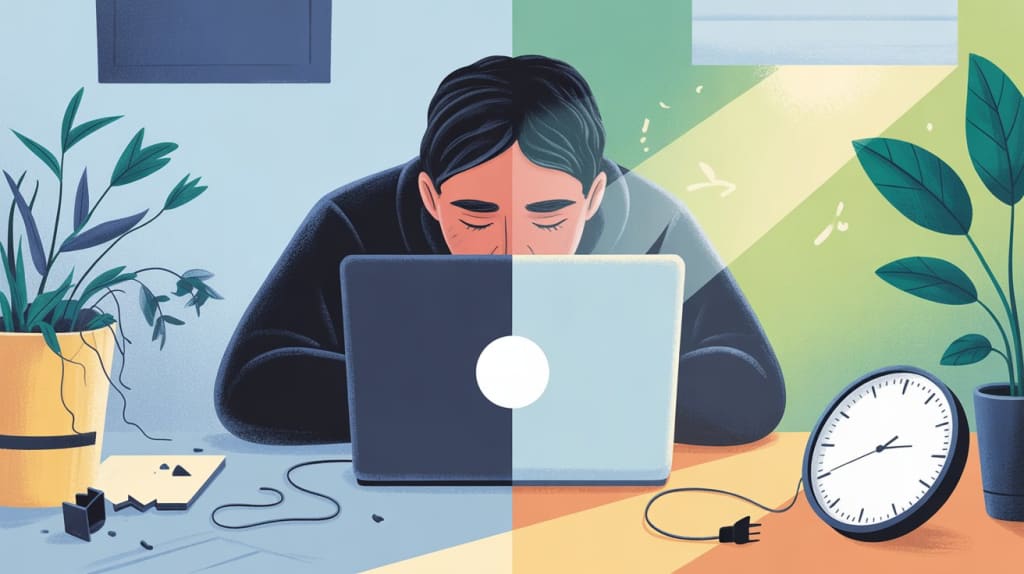
In a world that praises productivity over peace, burnout has become the silent epidemic—especially among freelancers and remote workers.
We left our 9-to-5s dreaming of freedom, flexible hours, and creative control. But somehow, many of us have ended up more tired than ever—glued to screens, juggling deadlines, and constantly feeling like we’re not doing enough.
Let me say it clearly: burnout isn’t a weakness. It’s not laziness. It’s a warning sign.
🔥 The Invisible Burnout of Freelancers
Unlike traditional jobs, freelancing doesn’t come with boundaries. There’s no “clocking out,” no HR department, and often, no one checking in to ask if you're okay.
We chase gigs. We overdeliver. We sacrifice weekends and sleep—and we call it hustle.
But underneath the surface, many freelancers experience:
- Brain fog and lack of focus
- Emotional numbness or apathy
- Constant guilt for resting
- A drop in creativity and joy
- Anxiety every time a new email pings
Sound familiar?
🔍 Psychology Insight:
According to a 2019 World Health Organization report, burnout is now officially recognized as an “occupational phenomenon,” characterized by emotional exhaustion, depersonalization, and reduced performance. The report emphasized its growing impact, especially among knowledge and creative workers.
🧩 What Burnout Really Feels Like
Burnout doesn’t always look like lying in bed for days. Sometimes, it’s still showing up—just without your soul in it.
It’s replying to client emails with a fake smile. It’s dreading every Monday even though you “set your own schedule.” It’s waking up tired no matter how much you sleep.
If this is where you are right now, you’re not alone—and you’re not broken. You’re just burnt out.
💬 Real Story: Freelance Designer in the UK
Emma, a 32-year-old freelance graphic designer from London, shared:
“I was living the dream—designing for brands I loved, working from Bali, sipping lattes... But I cried every night. The freedom I craved became a prison of deadlines, expectations, and feeling like I always had to do more. When I hit rock bottom, my therapist told me: You can’t heal in the same environment that burned you. That hit me.”
She took three months off, lost a few clients—but returned stronger, rebranded her services, and now works 4 days a week on her own terms.
💡 Step 1: Name It Without Shame
Burnout thrives in silence. It gets stronger when you convince yourself that “you’re just being lazy” or “you should be grateful to even have work.”
No. You are allowed to say:
“I’m overwhelmed. I’m exhausted. I need to pause.”
🧠 Research-Backed Insight:
A 2022 study from Stanford University found that self-compassion is directly linked to faster recovery from burnout. Those who acknowledged their limits and allowed rest had higher emotional resilience than those who tried to "push through."
🧘♀️ Step 2: Redefine Rest (It’s Not Just Sleeping)
Rest isn't just closing your eyes—it's doing things that refill your energy.
Mental rest: Unplug. Let your brain breathe. No phone, no screens, no productivity.
Emotional rest: Talk to someone. Cry. Journal. Let your feelings out without judgment.
Creative rest: Step away from output. Consume beauty—books, nature, silence.
“Almost everything will work again if you unplug it for a few minutes… including you.”
— Anne Lamott
🧱 Step 3: Build Boundaries That Actually Stick
As freelancers, we say yes too much. To everything. To everyone.
But healing from burnout requires fierce boundaries:
Set non-negotiable work hours and communicate them. Don’t respond to messages after 6 PM (the world won’t end). Block one day a week as a "no-client" day. Use it to reset, learn, or just be.
🔍 Science Says:
Psychologist Dr. Adam Grant notes that people with high “agreeableness” are more prone to burnout, especially if they don’t develop healthy assertiveness. Saying “no” is a burnout prevention tool.
🔄 Step 4: Rebuild Your “Why”
Burnout often detaches us from why we started in the first place.
So ask yourself:
- Why did I choose this path?
- What type of work makes me feel alive?
- What’s one project I want to say no to—and one I’d love to create?
💬 Quote from Viktor Frankl:
“When we are no longer able to change a situation, we are challenged to change ourselves.”
This includes the way we work and why we work.
🧭 Step 5: Healing Is Not Linear
Some days, you’ll feel like yourself again. Other days, even brushing your teeth feels hard.
That’s okay. Don’t rush the recovery. Don’t force the productivity. Instead, allow slowness. Allow softness. Allow being human.
💬 Therapist and bestselling author Nedra Glover Tawwab reminds us:
“Rest is not a reward. It’s a basic human need.”
💌 Final Words
If you’re burnt out, please don’t wait for your body to crash or your spirit to shut down completely. You don’t have to earn your rest. You don’t need to prove your worth by grinding.
You’re allowed to be a masterpiece and a work in progress at the same time. This world needs your creativity but more importantly, it needs you well.
📩 Reader Call-To-Action:
Have you experienced burnout as a freelancer or remote worker? Share your story in the comments. You never know who it might help feel less alone.
❤️ If this resonated with you, leave a like or a tip to support more writing on mental health and emotional healing.
About the Creator
Nowshad Ahmad
Hi, I’m Nowshad Ahmad a passionate storyteller, creative thinker, and full-time digital entrepreneur. Writing has always been more than just a hobby for me; it's a way to reflect, connect, and bring life to ideas that often go unspoken.
Keep reading
More stories from Nowshad Ahmad and writers in Motivation and other communities.
The Cafe' Window
The first time I walked into that café, I was twenty-one—fresh off a heartbreak and looking for something warm that wasn’t just the coffee. It was tucked between a bookstore and a florist, the kind of place you’d miss unless you needed to find it. I did.
By Nowshad Ahmad6 months ago in Motivation
How I earn $100 in a day
There was a time when earning $100 in a single day felt like a fantasy to me. Not a goal — a fantasy. I remember staring at my phone late at night, doing small mental calculations: If I earn $5 today and $10 tomorrow, maybe by the end of the month… Even those numbers weren’t guaranteed. Some days, nothing came in at all. And that silence — the absence of notifications, emails, or messages — was louder than failure. People online love to talk about success like it’s loud and shiny. For me, it was quiet. Heavy. Full of doubt. The day I earned $100 didn’t begin with excitement. It began like every other day: tired eyes, a slow morning, and a question I kept asking myself — Is this even worth it? What kept me going wasn’t motivation. It was necessity. I didn’t suddenly become smarter or more talented. I didn’t discover a secret website or a hidden trick. I simply stopped waiting for the “perfect” moment and started using what I already had. I offered small digital work. Simple things. Work that wouldn’t impress anyone on social media — but work that people genuinely needed. And I did it sincerely. That day, the first payment came in early. It wasn’t big. Just enough to remind me that someone trusted me with their money. That feeling mattered more than the amount. Later, while I was offline, something unexpected happened. A digital product I had created earlier — something I almost didn’t upload because I thought it wasn’t good enough — sold. Then it sold again. I stared at the screen for a few seconds, unsure whether to smile or stay calm. By evening, another small task came my way. Then one more. None of these moments felt dramatic. No fireworks. No victory music. Just quiet confirmations that effort, even imperfect effort, still counts. When I finally added everything together late at night, my heart paused. It crossed $100. I didn’t jump. I didn’t celebrate. I just sat there — still — because for the first time, the number felt real. What hit me hardest wasn’t the money. It was the realization that I had been underestimating myself for a long time. I believed earning like this was reserved for “others” — more confident people, more skilled people, luckier people. That belief was wrong. Earning $100 in a day didn’t change my life instantly. But it changed something inside me. It replaced doubt with proof. And proof is powerful. Now I understand something important: money doesn’t always come from doing big things. Sometimes it comes from doing small things consistently and with sincerity. Some days I still don’t reach $100. Some days are quiet again. But the fear is gone. Because once you know something is possible, it stops being a dream and starts being a process. I no longer wait for motivation. I work, even when I feel unsure. I trust that effort never disappears — it just takes time to show itself. If you’re reading this while feeling stuck, tired, or invisible, I want you to know something honestly: You’re not behind. You’re just early in your story. And one ordinary day — without warning — things can start to add up.
By Shah Fayaz 6 days ago in Motivation
The Devil's Cut
“Comrade, finally you’re awake.” The voice was smooth, sensual. A flickering incandescent bar was all that lit the white, sterile room. All Vladimir remembered was everything going black. He tried to move his arms and found them strapped to the gurney.
By Matthew J. Fromm5 days ago in Fiction



Comments
There are no comments for this story
Be the first to respond and start the conversation.