
Being Bored vs. Being Boring
Being bored and being boring are not the same.


Being Bored Is Not the Same As Being Boring
After publishing my article, “Can a Person Really Be Bored to Death?” I kept thinking that there are differences between being bored and being boring. Often, the two words are used interchangeably, but they describe entirely different human experiences.
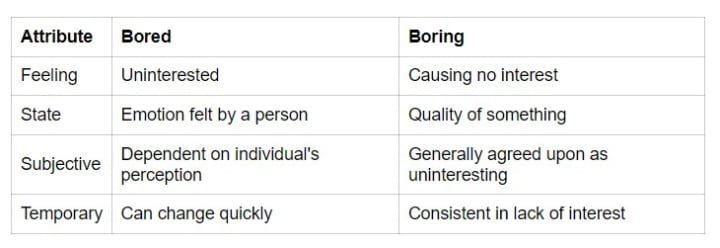
Bored and boring are two related but distinct concepts. Being bored is a feeling of restlessness or lack of interest, typically experienced by an individual. Boring, on the other hand, describes something that causes boredom or lacks excitement. While someone can feel bored, an activity or situation can be described as boring. In essence, being bored is a subjective experience, while something being boring is an objective quality.
Being Bored
Boredom is an internal state. It is something that happens to a person. Psychologists describe it as a condition of under-stimulation, but that definition barely scratches the surface. Boredom is not simply the absence of activity; it is the absence of meaningful engagement. You can be busy all day and still be bored. You can be surrounded by noise, screens, and people and feel an almost physical hollowness.
Boredom is a state of being weary and restless because of a lack of interest in something or someone. It reflects a mismatch between what we want and what we are experiencing, frequently indicating that a current activity or situation isn't providing engagement or meaning.
Boredom is diagnostic. It signals that our attention has nowhere satisfying to go. Something in us wants more depth, novelty, challenge, or purpose than the moment is offering. That doesn’t make boredom trivial. It makes it existential. Prolonged boredom has been linked to depression, risk-taking behavior, and a diminished sense of self. It shouldn't be ignored. It’s a warning light to make meaningful changes in your life.
What one person finds dull, another may find absorbing. Most people would describe a lecture on quantum physics as boring, unless they were scientists. It could be painful for an uninterested person who might say, “I was bored to death.”
A person can feel deeply bored in a situation that others find fascinating. Conversely, someone can be passionately engaged in what they’re saying while everyone else quietly checks their phones.
Being Boring
- Bored is what you feel.
- Being boring is what you are (or judged to be).
Being boring is not a feeling. It’s a judgment. And more often than not, it’s a judgment made by someone else.
When we call a person, conversation, or activity boring, we’re really saying it failed to hold our attention. That verdict depends on context, expectations, mood, culture, and even power dynamics.
The personal qualities most strongly associated with being boring include the following:
- Not having any interests, having only very narrow ones, or perhaps having only one
- Not being funny and having no sense of humor
- Lacking in opinions
- Complaining a lot and being negative
- Talking too much and being a bad listener
- Lacking creativity and ambition
- Having no social skills
- Not having interest or knowledge of what is going on around them or in the world.
“Bored” is an adjective that describes a feeling of weariness or dissatisfaction due to lack of interest, while “boring” is an adjective that describes something that causes boredom or lacks interest.
Think of it this way:
- You can be bored while watching a boring movie.
- You might not be boring yourself, but you get bored by being around a boring person, whether that person is a family member, a friend, or a co-worker.
Read the article: “Can A Person Really Be Bored To Death?”
About the Creator
Margaret Minnicks
Margaret Minnicks has a bachelor's degree in English. She is an ordained minister with two master's degrees in theology and Christian education. She has been an online writer for over 15 years. Thanks for reading and sending TIPS her way.
Keep reading
More stories from Margaret Minnicks and writers in Motivation and other communities.
I Hit Rock Bottom Before I Learned the Truth About Success
Hit Rock Bottom Before I Learned the Truth About Success There was a time when nothing in my life seemed to work, no matter how hard I tried. Every effort ended the same way — disappointment, exhaustion, and a quiet feeling of failure that followed me everywhere. I would wake up each morning with hope, convincing myself that today would be different. But by night, I was lying in bed replaying my mistakes, wondering why I was still stuck while everyone else seemed to move forward.
By Iazaz hussain7 days ago in Motivation
Ludacris and Nelly draw backlash over bookings at MAGA-coded music festival
Ludacris and Nelly headlining a mostly right-wing event is good for them. It’s also great for the genre of hip hop. The two rap veterans have showcased their talents on other stages. Why can’t they perform for mostly MAGA folks and grab that bag?
By Skyler Saunders6 days ago in Beat




Comments (1)
True. Guess I'm in the "Boring" category." :p