
Angelina Jolie: The Heart Beyond Hollywood – Part 2
Queen

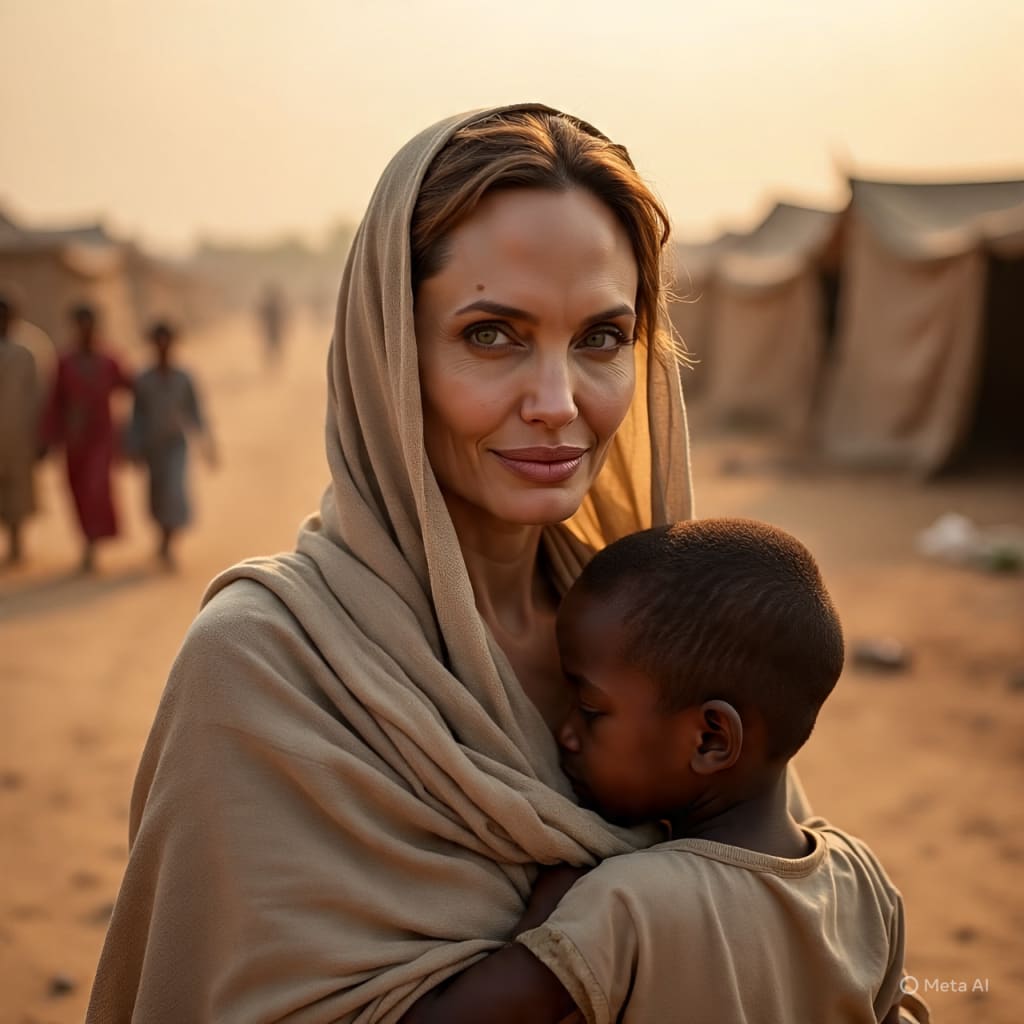
The red carpets of Hollywood had long been familiar to her feet, but by the mid-2000s, Angelina Jolie was walking down far different paths—dusty roads in war-torn regions, narrow hospital corridors in refugee camps, and desolate landscapes where children carried water jugs heavier than their own bodies. Her life had already been a tapestry of extremes, but now, she was about to weave in a thread that would change not just her own story, but the lives of countless others.
The Turning Point
In 2001, while filming Lara Croft: Tomb Raider in Cambodia, Jolie’s life took a turn no script could have predicted. The lush landscapes were beautiful, but behind them was a nation scarred by decades of war. The sight of villages where children had no schools, mothers had no medicine, and fathers had no means to feed their families struck her deeply. It wasn’t just pity—it was a call to action.
That same year, she was appointed a Goodwill Ambassador for the United Nations High Commissioner for Refugees (UNHCR). While many celebrities lent their names to causes, Jolie threw herself into the work with raw commitment. She didn’t just visit refugee camps for photo opportunities; she stayed in basic accommodations, ate the same food as locals, and listened—really listened—to stories of loss, resilience, and hope.
On the Ground
From Sierra Leone to Afghanistan, from Darfur to Pakistan, Jolie traveled to more than 30 countries in her first decade with UNHCR. She learned to navigate conflict zones where gunfire echoed in the distance and the air was thick with both fear and determination.
In Afghanistan, she met women who risked their lives to educate girls in secret. In Chad, she walked through camps where the desert heat was unforgiving and yet laughter still rose from children playing with makeshift toys. These experiences were not distant news headlines for her—they became personal memories etched into her heart.
“I realized that life in Hollywood was a bubble,” she once said. “Out here, in these camps, you see what really matters. You see courage in its purest form.”
Motherhood Beyond Borders
It was during her early humanitarian work that Jolie decided to expand her family in a way that reflected her growing connection to the world. In 2002, she adopted her first child, Maddox, from Cambodia. She was a single mother then, fiercely protective and determined to give him a safe and loving home.
Three years later, she adopted Zahara from Ethiopia, a little girl who had suffered from malnutrition and illness. Then came Pax from Vietnam in 2007, whose shy smile would later light up countless family photographs.
For Jolie, adoption wasn’t charity—it was family. “My children are not from one place,” she said. “They are from the world. And they will carry that with them for life.”
Her growing family became a mirror of her global values, a living example that love knows no borders.
Brad, the Media, and the “Power Couple” Era
Her relationship with Brad Pitt became one of the most publicized love stories in Hollywood. The two met while filming Mr. & Mrs. Smith in 2004, sparking endless media frenzy. Together, they were not just co-stars but partners in both parenting and humanitarian work.
They traveled together on UN missions, donated millions to causes, and even co-founded the Jolie-Pitt Foundation, which funded projects from wildlife conservation in Namibia to education programs for refugee girls.
Their blended family—three adopted children and three biological ones—seemed to embody the idea that love could be boundless. Family photos often showed them walking through airports in a tight cluster, holding hands, surrounded by a swarm of flashing cameras.
The Private Battles
Behind the glamorous photographs, however, life was far from perfect. The pressures of constant media attention, the demands of parenting six children, and the intensity of their public image put a strain on their relationship.
In 2013, Jolie made a deeply personal and public decision: she underwent a preventive double mastectomy after learning she carried a gene that greatly increased her risk of breast cancer. Later, she also had surgery to remove her ovaries and fallopian tubes to reduce her risk of ovarian cancer.
Her openness about these choices sparked global conversations about women’s health, genetic testing, and the power of making informed medical decisions.
“I wanted other women to know they have options,” she said. “We don’t have to be afraid of the truth.”
Separation and the Storm
In 2016, the world was stunned when Jolie filed for divorce from Brad Pitt, citing irreconcilable differences. The media turned the split into a spectacle, dissecting every rumor and whisper. For Jolie, it was a period of intense emotional strain.
Her priority remained the well-being of her children. “I just want my family to heal,” she told interviewers, her voice quiet but firm. She spoke about the need for resilience, about the importance of protecting one’s inner peace even when life is breaking apart.
In the years following the separation, she continued to balance acting, directing, and humanitarian work. Films like First They Killed My Father, which she directed, reflected her deep connection to the countries and histories she had encountered through her activism.
The Humanitarian Legacy
In 2012, Jolie was appointed Special Envoy to the UNHCR, a role that allowed her to focus on major crises and represent the organization at the diplomatic level. She advocated for refugees before world leaders, urging them to see displaced people not as burdens, but as individuals with dignity and potential.
Her speeches were not the polished, detached statements of a celebrity—there was grit and emotion in her voice, shaped by the countless stories she had witnessed firsthand.
She pushed for policies to end sexual violence in conflict zones, co-chairing a global summit with former UK Foreign Secretary William Hague. She supported education for girls in refugee camps, funded schools, and lobbied for stronger legal protections for victims of war crimes.
A Life Still Unfolding
Today, Angelina Jolie continues her work on and off the screen, raising her children to be curious, compassionate, and aware of the wider world. She remains a figure who defies easy categorization—Hollywood star, mother of six, refugee advocate, director, survivor.
Her life is proof that fame, when paired with empathy, can be transformed into a force for real change. She has walked in places most celebrities will never see, sat with people whose names will never appear in the credits, and brought their stories into rooms where decisions are made.
As she once said in a speech to young people:
"Do not be afraid of the unknown. Embrace it. Go to the places where your heart tells you you are needed. And remember—your life is your message to the world."
If Part 1 was the story of a rebellious young actress finding her voice, Part 2 is the testament of a woman who used that voice to speak for millions. And while the cameras may eventually move on, the lives she’s touched—and the changes she’s inspired—will remain her true legacy.
About the Creator
Frank Massey
Tech, AI, and social media writer with a passion for storytelling. I turn complex trends into engaging, relatable content. Exploring the future, one story at a time
Keep reading
More stories from Frank Massey and writers in Motivation and other communities.
The Netflix Story: A Legacy of Disruption
In a cramped living room above a Costa Rican grocery store on August 29, 1997, Reed Hastings and Marc Randolph lit the spark of what would become Netflix. Reed, a former Pure Software executive, paced the floor clutching a DVD while Marc sketched business ideas on a whiteboard. They had just tested mailing a DVD and, watching it arrive intact, realized the $16 billion home-video market was ripe for reinvention. As dawn broke over Scotts Valley, California, two former coworkers-turned-entrepreneurs made their pitch: an online DVD rental and sales site with no late fees, mailing movies in red-and-white envelopes. Hastings invested $2.5 million from a recent acquisition windfall, and with 30 employees and 925 titles, Netflix began as “an e-commerce rental store” for DVDs.
By Frank Massey 5 months ago in Motivation
My Daily Win
I used to end every day feeling like a failure. It didn't matter what I accomplished. I could cross off ten items from my to-do list, and all I'd see were the fifteen I didn't finish. I could have a productive work day, cook a healthy dinner, and call my mom—and still go to bed thinking about the email I forgot to send or the closet I didn't organize.
By Fazal Hadi7 days ago in Motivation




Comments
There are no comments for this story
Be the first to respond and start the conversation.