
🎲 Why Luck Matters More Than Hard Work
The Hidden Role of Randomness in Success

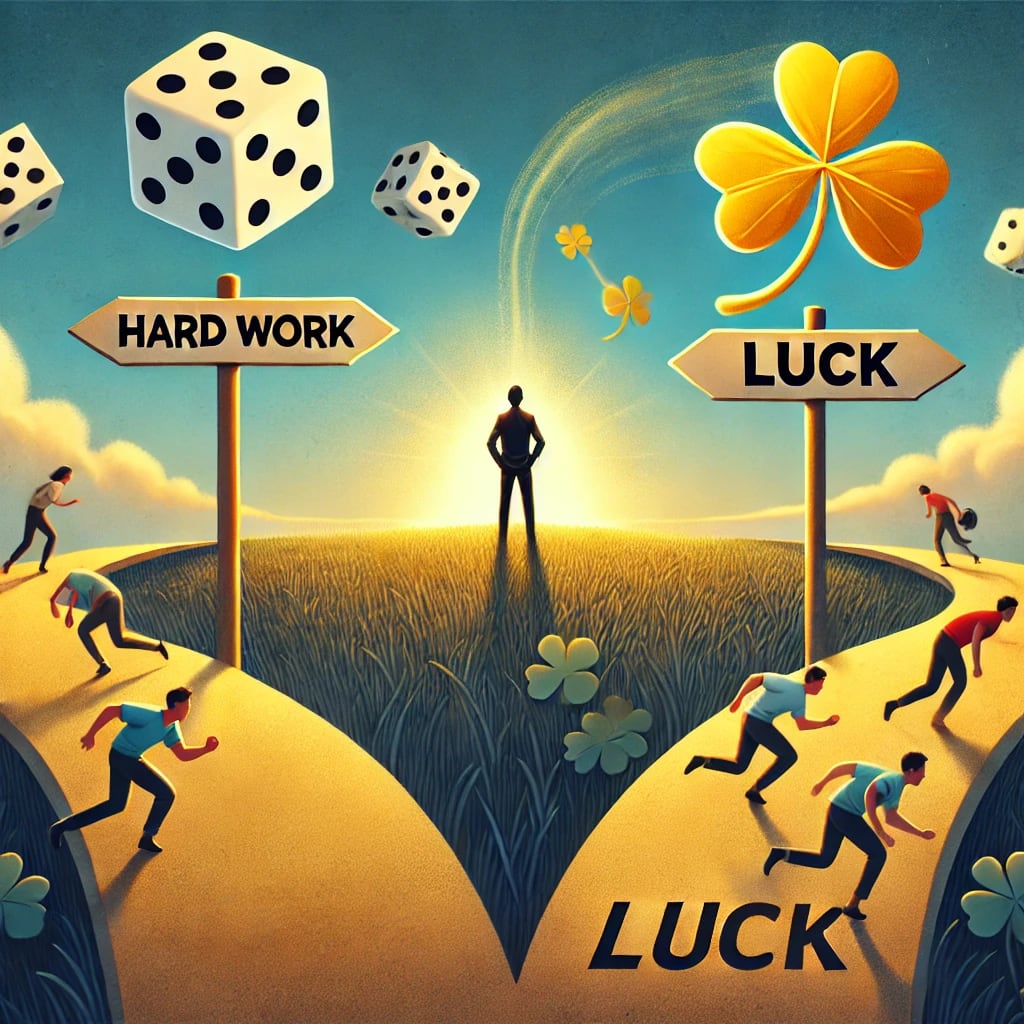
Introduction: The Myth of “Pure Hard Work
“Work hard, and you’ll succeed.”
“Success is all about discipline and effort.”
“If you didn’t make it, you just didn’t try hard enough.”
We’ve all heard these statements. We’ve been taught that success is the direct result of talent, perseverance, and relentless hard work.
But if that were true, then why do some people work incredibly hard and never achieve their dreams, while others seem to stumble into success effortlessly?
The uncomfortable truth is: Luck plays a much bigger role in success than we like to admit.
This doesn’t mean hard work doesn’t matter—it does. But ignoring the role of luck is like ignoring gravity while trying to fly. Instead of pretending luck doesn’t exist, let’s explore how chance shapes our lives, how science proves it, and—most importantly—how we can increase our own luck.
⸻
1. The Science of Luck: How Randomness Shapes Success
If success were purely about effort, the hardest-working people would always be the richest, most famous, and most powerful. Yet, reality shows otherwise.
The “Matthew Effect” – The Rich Get Richer
Sociologists have a term for this: The Matthew Effect (coined by Robert Merton). It’s the idea that early advantages snowball into greater success, while disadvantages create barriers that are hard to break.
✅ Example: Two musicians start out equally talented. One gets a lucky break (a viral video, an endorsement, a key introduction). This leads to more opportunities, while the other struggles to be noticed. Ten years later, one is a superstar, and the other is still playing small gigs.
✅ The takeaway? Small advantages early on can create huge differences in long-term success.
⸻
2. The “Birth Lottery”: The Uncontrollable Factors of Success
The circumstances of your birth—something you have zero control over—can dictate much of your future.
🔹 Where You’re Born: Being born in a stable, developed country gives you access to better education, healthcare, and opportunities.
🔹 When You’re Born: Studies show that economic conditions at birth influence lifetime earnings. For example, people entering the job market during a recession earn less money throughout their careers than those who enter during economic booms.
🔹 Who You’re Born To: Wealthy parents can afford better education, connections, and financial safety nets—giving their children a massive head start.
Is it fair? No. Is it real? Absolutely.
⸻
3. The Role of Randomness in Careers
Even in careers that reward hard work, luck still plays a role.
🎭 Hollywood: Many actors are incredibly talented, but only a few get the lucky break that launches their careers.
⚽ Sports: Hundreds of talented athletes compete, but one chance encounter with a scout can change everything.
💡 Tech Entrepreneurs: Steve Jobs met Steve Wozniak by chance. Bill Gates happened to have access to a computer lab as a teen—something incredibly rare at the time.
In each case, luck was a defining factor in their rise to success.
⸻
4. If Luck Matters So Much, Does Hard Work Even Matter?
Yes. Hard work is still crucial—but it works best when combined with leveraging opportunities and creating your own luck.
Here’s how:
🔥 1. Maximize Your Exposure to Luck
Success often comes from unexpected opportunities—but you have to be in the right place to receive them.
✅ Meet new people. Every opportunity is connected to someone you haven’t met yet.
✅ Try new things. The more projects, hobbies, and experiences you engage in, the higher the chance one will lead to something big.
✅ Be visible. Share your work online, go to events, put yourself out there.
Luck favors those who increase their surface area of opportunity.
⸻
🔥 2. Take Advantage of Small Wins
Many people ignore small opportunities, waiting for something big and obvious to come along. But success compounds over time.
✅ A small gig might lead to a better one.
✅ A tiny social media post might catch the right person’s attention.
✅ A casual conversation could lead to a job offer.
Most “lucky breaks” happen because someone took a chance on something small.
⸻
🔥 3. Learn to Fail Fast and Move On
If you aren’t lucky at first, keep going.
✅ The more you try, the more chances you give luck to find you.
✅ Failures help you learn what works and what doesn’t.
✅ Thomas Edison famously tested 1,000 prototypes before inventing the light bulb.
In short: The more lottery tickets you buy, the higher the chance of winning.
⸻
🔥 4. Develop the “Luck Mindset”
Some people seem to be naturally “lucky.” But is it really luck—or how they perceive and react to opportunities?
Psychologists have found that lucky people do a few things differently:
✔️ They expect good things to happen. This makes them more open to spotting opportunities.
✔️ They turn bad luck into good luck. Instead of dwelling on failures, they find a way to benefit from setbacks.
✔️ They take risks. They step out of their comfort zones more often—creating more chances for luck to strike.
⸻
5. The Truth About Success: It’s Both Hard Work AND Luck
❌ Saying “luck doesn’t matter” ignores reality.
❌ Saying “hard work doesn’t matter” is also false.
✅ The truth? Success happens when hard work and preparation meet opportunity and luck.
If you work hard but never take risks, never meet new people, and never put yourself in new situations, your odds of getting lucky stay low.
If you only rely on luck without effort, you won’t be ready when an opportunity finally comes.
The key? Work hard, stay open to opportunities, and increase your chances of getting lucky.
Because at the end of the day… luck is just opportunity meeting preparation.
⸻
Final Thoughts: How to Make Luck Work for You
Instead of ignoring luck, use it to your advantage.
🚀 Be in more places. The more exposure you have, the more opportunities come your way.
🚀 Say yes to more things. You never know what will lead to your breakthrough.
🚀 Accept setbacks as part of the journey. Every failure brings you closer to the next chance.
The world is unpredictable, and luck is real—but you can still stack the odds in your favor.
And maybe, just maybe, that one lucky break is right around the corner.
About the Creator
Ahmet Kıvanç Demirkıran
As a technology and innovation enthusiast, I aim to bring fresh perspectives to my readers, drawing from my experience.
Keep reading
More stories from Ahmet Kıvanç Demirkıran and writers in Longevity and other communities.
🦁 The Animal in Us: How Humans and Animals Are More Alike Than We Think
Introduction: Are We Really So Different? Look into the eyes of a wolf, and you might see determination. Watch a mother elephant, and you’ll witness deep, unconditional love. Observe a chimpanzee using tools, and suddenly, intelligence doesn’t seem so uniquely human anymore.
By Ahmet Kıvanç Demirkıran11 months ago in Longevity
Day 4 of Quitting
If this is how sobriety feels, maybe it’s better to go through life a little buzzed… this, along with other hits like, I want to kill myself, I wish I was dead, and I’m going to throw myself off a bridge have been the only thoughts on rotation these past few days. I promise myself that if, in a month, I still feel like this (‘this’ meaning despondent, full of rage, and simultaneously numb) I can go back to smoking. Until mid-February though? Nicotine is off the table.
By sleepy drafts10 days ago in Longevity
Global Nepheline Market Size and Forecast 2025–2033
Introduction The global nepheline market is steadily gaining attention as industries seek more efficient, sustainable, and cost-effective raw materials. According to Renub Research, the global nepheline market is expected to grow from US$ 179.25 million in 2024 to US$ 230.63 million by 2033, registering a compound annual growth rate (CAGR) of 2.84% from 2025 to 2033. This growth reflects the increasing use of nepheline in glass, ceramics, and refractory applications, as well as a broader industrial shift toward energy-efficient and environmentally responsible production processes.
By Aaina Oberoi5 days ago in Longevity



Comments
There are no comments for this story
Be the first to respond and start the conversation.