
This Diet Could Reduce Your Risk of Dementia by up to 25%, New Study Reveals
A new study shows the MIND diet may reduce dementia risk, though benefits differ across racial groups.


Adopting the MIND diet, even later in life, is associated with a reduced risk of developing dementia.
As the U.S. population grows older and dementia cases continue to rise, many people are wondering: can anything be done to prevent this devastating disease?
New research suggests the answer might be as close as your next meal. A recent study found that people who followed a specific eating plan called the MIND diet were significantly less likely to develop Alzheimer’s disease and related types of dementia.
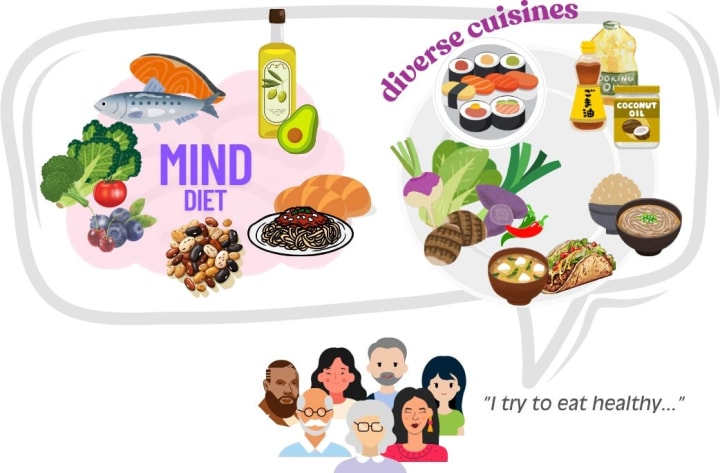
The MIND diet, short for Mediterranean-DASH Intervention for Neurodegenerative Delay, blends the best of two powerful eating plans. It combines the heart-healthy Mediterranean diet with the blood pressure-lowering DASH (Dietary Approaches to Stop Hypertension) diet. Additionally, it puts extra emphasis on foods known to support brain health, including leafy green vegetables, berries, nuts, and olive oil.
The study revealed that the MIND diet delivered a stronger and more consistent reduction in dementia risk compared to other healthy diets. Although the results varied among different racial groups, one thing stood out: people who made the biggest improvements in their diet over time experienced the greatest drop in dementia risk.
The benefits appeared across both younger and older adults, suggesting it is never too late — or too early — to make brain-boosting changes to what’s on your plate.
“Our study findings confirm that healthy dietary patterns in mid to late life and their improvement over time may prevent Alzheimer’s and related dementias,” said Song-Yi Park, PhD, associate professor at the University of Hawaii at Manoa. “This suggests that it is never too late to adopt a healthy diet to prevent dementia.”
Park presented the findings at NUTRITION 2025, the flagship annual meeting of the American Society for Nutrition held May 31–June 3 in Orlando, Florida.
Insights from a Large, Diverse Study
Park and colleagues analyzed data from nearly 93,000 U.S. adults who provided information about their diet as part of a research cohort known as the Multiethnic Cohort Study starting in the 1990s. Participants were between 45-75 years old at baseline and over 21,000 developed Alzheimer’s or related dementias in the years that followed.
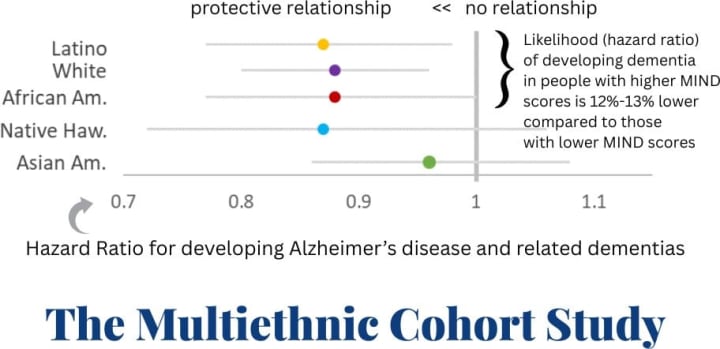
Overall, participants who scored higher for MIND adherence at baseline had a 9% lower risk of dementia, with an even greater reduction—around 13%—among those who identified as African American, Latino, or White. Baseline MIND diet adherence was not associated with a significant risk reduction among Native Hawaiian or Asian American participants.
Racial and Ethnic Variations in Diet Effectiveness
“We found that the protective relationship between a healthy diet and dementia was more pronounced among African Americans, Latinos, and Whites, while it was not as apparent among Asian Americans and showed a weaker trend in Native Hawaiians,” said Park. “A tailored approach may be needed when evaluating different subpopulations’ diet quality.”
The results also showed that people who improved their adherence to MIND over 10 years (including those who didn’t follow the diet closely at first) had a 25% lower risk of dementia compared to those whose adherence declined. This trend was consistent across different ages and racial groups.
Researchers said that differences in dietary patterns and preferences among racial and ethnic groups could play a role in the variation they observed in the dementia-diet relationship. Since Asian Americans also experience lower rates of dementia than other groups, it is possible that the MIND diet may not reflect the advantages of diets that are more common among this population. Park said that further studies could help to clarify these patterns and added that interventional studies would be needed to verify cause and effect since the study was based on observational data.
Best diet ever
About the Creator
🍂🍂🍂.
Research on geopolitics
Day 4 of Quitting
If this is how sobriety feels, maybe it’s better to go through life a little buzzed… this, along with other hits like, I want to kill myself, I wish I was dead, and I’m going to throw myself off a bridge have been the only thoughts on rotation these past few days. I promise myself that if, in a month, I still feel like this (‘this’ meaning despondent, full of rage, and simultaneously numb) I can go back to smoking. Until mid-February though? Nicotine is off the table.
By sleepy drafts14 days ago in Longevity
Global Nano Robotics Market Size & Forecast 2025–2033
Introduction: The Rise of Machines Too Small to See In the world of frontier technologies, few areas capture imagination quite like nanorobotics. These are not the mechanical robots of factory floors, but devices engineered at the nanoscale—typically between 1 and 100 nanometers—capable of interacting with matter at the atomic and molecular level. Once confined to theoretical physics and science fiction, nanorobots are now stepping into laboratories, hospitals, and advanced manufacturing environments across the globe.
By Janine Root 7 days ago in Longevity
Smart phones, Humans and Aliens.
WARNING. I will be tapping into one of your favorite creative tensions: The absurdity of humans worshipping their glowing rectangles as if they were tiny oracles. There’s something deliciously poetic about that contradiction, and it lends itself beautifully to an instructive proviso.
By Novel Allen4 days ago in Poets



Comments
There are no comments for this story
Be the first to respond and start the conversation.