
Global Nano Robotics Market Size & Forecast 2025–2033
From Lab Innovation to Life-Saving Precision: How Nanorobotics Is Redefining Healthcare, Manufacturing, and Materials Science


Introduction: The Rise of Machines Too Small to See
In the world of frontier technologies, few areas capture imagination quite like nanorobotics. These are not the mechanical robots of factory floors, but devices engineered at the nanoscale—typically between 1 and 100 nanometers—capable of interacting with matter at the atomic and molecular level. Once confined to theoretical physics and science fiction, nanorobots are now stepping into laboratories, hospitals, and advanced manufacturing environments across the globe.
According to Renub Research, the global nano robotics market was valued at US$ 8.40 billion in 2024 and is projected to reach US$ 22.16 billion by 2033, expanding at a compound annual growth rate (CAGR) of 11.37% from 2025 to 2033. This strong growth trajectory reflects not only technological maturity but also growing acceptance of nanorobotics in real-world applications—particularly in personalized healthcare, cancer therapies, and precision research.
As investments accelerate and interdisciplinary collaboration deepens, nanorobotics is transitioning from experimental novelty to strategic infrastructure for next-generation innovation.
What Is Nanorobotics?
Nanorobotics is the engineering of machines or devices at the nanoscale—so small that thousands could fit across the width of a human hair. These machines are designed to manipulate matter at the molecular level, perform highly specific tasks, and interact with biological, chemical, or material systems with unprecedented precision.
Unlike traditional robotics, nanorobots often draw from nanotechnology, materials science, molecular biology, and microelectronics. Their functions may include:
Targeted drug delivery directly to diseased cells
In-situ diagnostics at the cellular level
Nano-manufacturing and assembly of materials with tailored properties
Environmental monitoring of pollutants at the molecular scale
The promise is revolutionary: therapies with minimal side effects, manufacturing with atomic-level accuracy, and scientific exploration beyond what conventional tools can achieve.
Market Outlook: Growth Backed by Innovation
Renub Research estimates that the nano robotics market will more than double in value over the forecast period. This growth is fueled by several converging trends:
1. Personalized and Precision Medicine
Healthcare systems are rapidly shifting from generalized treatment protocols to patient-specific therapies. Nanorobots enable targeted drug delivery, ensuring that medication reaches only affected tissues, minimizing toxicity and improving outcomes—particularly in oncology and chronic disease management.
2. Rising Investment in R&D
Governments, academic institutions, and private enterprises are significantly increasing funding for nanotechnology research. As laboratory breakthroughs move closer to commercialization, demand for nanorobotic tools and platforms continues to expand.
3. Less Invasive Therapeutics
The medical community is prioritizing minimally invasive procedures. Nanorobots can navigate the bloodstream, identify pathological cells, and administer therapy without surgical intervention—making them ideal for next-generation diagnostics and treatments.
4. Advanced Manufacturing and Materials Science
Beyond healthcare, nanorobotics is gaining momentum in semiconductor manufacturing, nano-metrology, and high-precision materials engineering. Industries seeking defect-free fabrication at atomic scales are turning to nanorobotic solutions.
Together, these drivers position nanorobotics as one of the most transformative technologies of the coming decade.
Competitive Landscape: Key Players Shaping the Market
The nano robotics ecosystem is a blend of established scientific instrument manufacturers and highly specialized nanotechnology innovators.
Oxford Instruments (UK)
Founded in 1959, Oxford Instruments is a global leader in tools that image, analyze, and manipulate materials at atomic and molecular levels. Its portfolio spans atomic force microscopy, confocal Raman imaging, dilution refrigerators, superconducting magnets, and ultra-sensitive cameras. With operations across Europe, North America, and Asia, the company provides essential infrastructure for nanorobotics research and development.
Thermo Fisher Scientific (USA)
Thermo Fisher is a cornerstone of life sciences and diagnostics, offering chromatography, mass spectrometry, molecular biology instruments, and advanced analytical tools. Its technologies underpin nanorobotics applications in biomedical research, pharmaceutical development, and clinical diagnostics.
Bruker Corporation (USA)
Bruker specializes in scientific instruments enabling microscopic, molecular, and cellular exploration. With expertise in magnetic resonance, mass spectrometry, X-ray systems, microscopy, and metrology, Bruker supports both life sciences and materials research—two critical pillars of nanorobotics innovation.
JEOL Ltd. (Japan)
A pioneer in electron optical equipment, JEOL manufactures high-precision instruments used in aerospace, pharmaceuticals, semiconductors, and biomedical research. Its electron microscopes and analytical platforms play a vital role in nanoscale visualization and engineering.
Agilent Technologies, Inc. (USA)
Agilent focuses on life sciences, diagnostics, and applied markets, delivering chromatography systems, spectroscopy, molecular analysis instruments, and laboratory software. Its solutions are widely used in pharmaceutical, environmental, and clinical research that increasingly intersects with nanorobotics.
Together, these companies provide the analytical backbone, imaging platforms, and manufacturing precision required to bring nanorobotic concepts to operational reality.
Product Launches: Innovation in Motion
Recent product developments highlight how nanorobotics is becoming more accessible, scalable, and application-ready.
Ginkgo Bioworks – July 2025
Ginkgo Bioworks launched a high-throughput, low-cost ADME (Absorption, Distribution, Metabolism, and Excretion) profiling capability through its Ginkgo Datapoints platform. Leveraging proprietary automation, the system accelerates drug discovery and supports machine-learning-driven research. By optimizing early-stage screening and reducing development risk, Ginkgo strengthens the role of nanotechnology in biopharma innovation.
Park Systems – June 2023
Park Systems introduced the Park NX-IR R300, a nanoscale infrared spectroscopy system delivering high-resolution chemical and mechanical data. Additionally, its NANOstandard™ calibration line improves accuracy in AFM and SEM measurements. These advancements enhance nanoscale precision—an essential requirement for nanorobotic research and semiconductor manufacturing.
SWOT Perspectives: Leaders in Specialized Nanorobotics
EV Group (EVG)
Strengths:
EVG’s leadership in nanofabrication, MEMS, wafer bonding, and nanoimprint lithography positions it as a foundational technology provider for nanorobotics manufacturing. Its engineering expertise, global partnerships, and strong IP portfolio support the production of ultra-precise nanorobotic components.
Strategic Advantage:
By enabling scalable, high-accuracy fabrication, EVG empowers both medical and industrial nanorobotic innovation.
Nanobots Therapeutics
Strengths:
Nanobots Therapeutics specializes in nanorobotic drug delivery systems for targeted therapy and precision diagnostics, particularly in oncology. Its proprietary biocompatible nanomaterials, multidisciplinary expertise, and strong academic collaborations drive continuous innovation.
Strategic Advantage:
With personalized medicine as a core focus, Nanobots Therapeutics stands at the intersection of nanotechnology and next-generation healthcare, addressing one of the fastest-growing application segments.
Recent Developments: Integration and Precision
Imina Technologies – May 2025
Imina Technologies, in collaboration with Alemnis, launched a fully integrated system for in-situ SEM electrical and mechanical testing. This solution combines nano-indentation and electrical nanoprobing, enabling real-time nanoscale analysis. Such integrated platforms are crucial for advancing nanorobotic design, reliability testing, and material characterization.
Sustainability in Nanorobotics: Innovation with Responsibility
As the industry grows, sustainability is becoming an integral part of nanotechnology strategy.
Nanonics Imaging Ltd.
Nanonics is committed to reducing the environmental footprint of high-precision nanotechnology equipment through energy-efficient design, long-life instruments, and eco-friendly materials. It actively supports research in clean energy, environmental monitoring, and biomedical innovation—aligning scientific progress with global sustainability goals.
Hummingbird Scientific
Hummingbird Scientific integrates sustainability into its product lifecycle by developing modular, durable instrumentation that minimizes waste and energy consumption. The company emphasizes ethical manufacturing, workplace diversity, and research partnerships in sustainability-focused fields such as energy storage, recycling, and environmental nanotechnology.
These initiatives demonstrate that nanorobotics can advance responsibly, balancing innovation with environmental stewardship.
Market Segmentation and Analytical Framework
The global nano robotics market can be evaluated across multiple dimensions:
By Application: Healthcare (drug delivery, diagnostics), manufacturing, materials science, environmental monitoring
By End-User: Research institutions, pharmaceutical companies, semiconductor manufacturers, academic laboratories
By Geography: North America, Europe, Asia-Pacific, and emerging markets
Market analysis typically includes historical trends, forecast modeling, and market share assessments, offering stakeholders insight into growth opportunities and competitive dynamics.
Company Profiles: A Structured Market View
For leading players such as Oxford Instruments, Thermo Fisher Scientific, Bruker Corporation, JEOL Ltd., Agilent Technologies, Ginkgo Bioworks, Park Systems, Imina Technologies, Klocke Nanotechnik GmbH, Xidex Corporation, Nanonics Imaging Ltd., Toronto Nano Instrumentation Inc., Nanobots Therapeutics, Hummingbird Scientific, and EV Group, comprehensive evaluations generally include:
Company History and Mission
Business Model and Operations
Workforce and Leadership Structure
Recent Developments, Mergers, Partnerships, and Investments
Sustainability Strategies
Product Profiles, Pipelines, and Benchmarking
SWOT and Strategic Assessment
Revenue and Market Positioning
Such multi-layered analysis enables investors, researchers, and policymakers to assess long-term potential and risk.
Challenges and Considerations
Despite strong momentum, the nanorobotics market faces several challenges:
High Development Costs: Advanced fabrication and testing require significant capital investment.
Regulatory Hurdles: Especially in healthcare, clinical validation and regulatory approval can be lengthy.
Scalability Issues: Translating laboratory prototypes into mass-produced, reliable products remains complex.
Ethical and Safety Concerns: As nanorobots interact directly with biological systems, long-term safety and ethical governance must be addressed.
However, continuous R&D, standardization efforts, and public-private partnerships are steadily mitigating these barriers.
The Road Ahead: A Technology with Transformational Reach
The next decade will likely see nanorobotics move from specialized research environments into mainstream industrial and clinical practice. Potential breakthroughs include:
Autonomous nanorobots capable of diagnosing and treating disease in real time
Nano-manufacturing systems that build materials atom by atom
Environmental nanobots for precision monitoring and remediation
As AI, machine learning, and advanced materials converge with nanotechnology, the scope of nanorobotics will only expand.
Final Thoughts
The global nano robotics market stands at a defining moment. With Renub Research projecting growth from US$ 8.40 billion in 2024 to US$ 22.16 billion by 2033 at a CAGR of 11.37%, the sector is transitioning from scientific exploration to commercial reality.
Driven by personalized healthcare, advanced manufacturing, and sustained research investment, nanorobotics promises to redefine how we diagnose disease, deliver therapy, and engineer materials. At the same time, a growing emphasis on sustainability ensures that this progress aligns with broader environmental and social priorities.
About the Creator
Janine Root
Janine Root is a skilled content writer with a passion for creating engaging, informative, and SEO-optimized content. She excels in crafting compelling narratives that resonate with audiences and drive results.
Keep reading
More stories from Janine Root and writers in Longevity and other communities.
STD Self-Testing Market Size and Forecast 2025–2033
Introduction: A Quiet Revolution in Sexual Health The way people approach sexual health is undergoing a significant transformation. Once bound by social stigma, long clinic wait times, and concerns over privacy, diagnostic testing for sexually transmitted diseases (STDs) is increasingly moving into the home. At the center of this shift is the rapidly expanding STD self-testing market, which empowers individuals to screen for infections in a private, convenient, and accessible manner.
By Janine Root 4 days ago in Longevity
Day 4 of Quitting
If this is how sobriety feels, maybe it’s better to go through life a little buzzed… this, along with other hits like, I want to kill myself, I wish I was dead, and I’m going to throw myself off a bridge have been the only thoughts on rotation these past few days. I promise myself that if, in a month, I still feel like this (‘this’ meaning despondent, full of rage, and simultaneously numb) I can go back to smoking. Until mid-February though? Nicotine is off the table.
By sleepy drafts10 days ago in Longevity
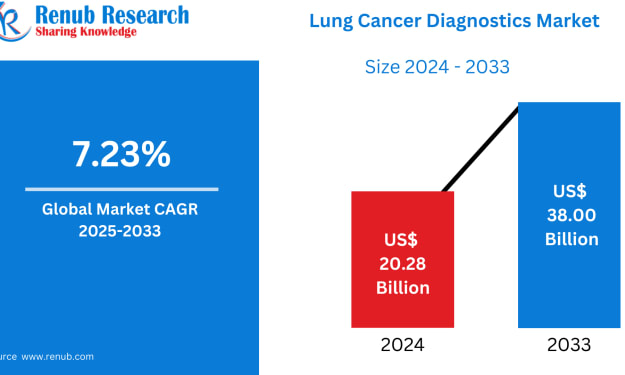
Lung Cancer Diagnostics Market Size and Forecast 2025–2033
Introduction: A Market at the Center of Early Cancer Care Lung cancer remains one of the world’s most challenging public health burdens, accounting for millions of new cases and deaths each year. Yet the narrative around lung cancer is changing. Advances in imaging, molecular diagnostics, and biomarker-driven testing are moving detection earlier, improving treatment selection, and ultimately extending survival. This transformation is reflected in the expanding commercial landscape for diagnostic technologies.
By jaiklin Fanandish3 days ago in Longevity
Center Stage with Paul Stewart
*** I'm keen to republish the interviews I did for my series with Vocal creators. It's been a few years and I thought it might be nice to revisit these wonderful conversations. I'll be releasing them one at a time for a few weeks/months.
By Heather Hubler2 days ago in Interview



Comments
There are no comments for this story
Be the first to respond and start the conversation.