
The 10 Lifestyle Habits That Have Kept My Body Fat Low for 4 Years
How I maintain a low body-fat percentage while still enjoying life


In mid-2019, I achieved what for me was “body goals”: an athletic physique with a low-fat percentage.
How I got there is a story for another day. I want to share today how I’ve kept my leanness for four years (and how I plan to maintain these results for the years to come).
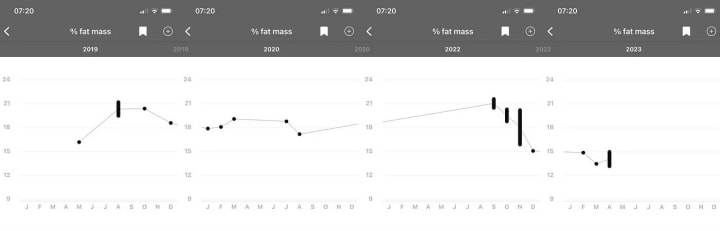
The graph above shows my body fat percentage from May 2019 (when I signed up for the gym, just after getting to the weight I wanted) to April 2023.
As you can see, despite its natural, life-related fluctuations, it has remained low and has lowered even further recently as I’ve adopted a certified dietist’s nutrition plan to help me curve my sugar cravings.
The Inspiration Behind the Habits and Two Important Caveats
To maintain my results, I’ve followed ten lifestyle habits. They’re the result of years of reading books, listening to podcasts, and watching videos centering on health, fat loss, and weight maintenance. Some examples are:
- The Huberman Lab podcast, where Standford professor Andrew Huberman thoroughly explains the most recent scientific findings on fat loss, exercise performance, hair loss — anything related to health, so his audience can optimize their results.
- Dr. David Sinclair’s Lifespan and Dr. Michael Greger’s How Not To Die. Although these books aren’t specifically aimed at losing weight and keeping it off, they’ve been invaluable in helping me adopt the healthy, lifelong habits that keep me on track.
- Tom Bilyeu’s youtube channel, where he shares his incredibly insightful conversations with experts in many fields, ranging from productivity to health.
Now, though many of the tips offered by these invaluable sources have worked for me, others haven’t. Exercising while fasting or doing long bouts of intermittent fasting — two well-known and well-researched tips to enhance and maintain fat loss — have shot my stress hormones through the roof, making it impossible to sleep or adhere to a healthy meal plan.
In other words, the habits I’ll be sharing might or might not work for you. My hope is that they’ll inspire you to try something new, something that might help you maintain your desired fat percentage while still enjoying life.
One last important note: Though my body fat percentage has never been lower, I’ve always been skinny. This means I can comfortably live with a very low-fat percentage without harming my health. For instance, my menstrual cycle has remained completely regular throughout the process, which doesn’t happen for many people when they go below 20% body fat.
This is a reminder to consult your doctor before trying to lose fat or maintain a fat percentage that might be unhealthy for you.
With that out of the way, here are the lifestyle habits that have helped me maintain a low body-fat percentage for four years.

#1. Walking as Much as Possible and Always More Than a Set Minimum
Walking regularly is the easiest way to lose fat and keep it off forever. While it helps you burn more calories, it doesn’t stress your body like other types of cardio, and it rarely heightens your hunger.
When losing weight, walking helps you burn more calories than you consume.
When maintaining weight loss, walking allows you to eat more — my preferred benefit as it makes life more enjoyable — while improving your blood sugar levels and overall fitness and health.
This is why I walk as much as possible every day:
- If I need to go to the grocery store or the gym, I walk (they’re only 15 minutes away on foot).
- If I have a 5-minute break between meetings, I walk — even if it’s in my living room. If at the office, you can apply my husband’s strategy, which is to have a quick lunch so that he can fit in a 20-minute walk around the block during his break.
- If I want to meet up with friends, we either walk around the block or go trekking.
- If I want to read or watch something on my phone, I pace around my living room while consuming whatever I want.
The last example may sound weird and extreme, but I consider it my secret weapon for getting at least 10,000 steps daily, my set minimum. Though it took some getting used to, mastering the art of “read-walking” or “watch-walking” has allowed me to fit in almost two hours of walking on even my busiest days.
Now, a 10,000-step goal is as helpful as a 2,000-one if that’s all you can commit to. What matters is that you make a more conscious effort to walk throughout the day. This will keep your energy expenditure high while improving your health.
#2. Sticking to Resistance Training for Life
Resistance training is essential to keep your muscles from wasting away. As they consume more calories than fat tissue, our bodies get rid of them when they notice they’re not being used.
That’s why regularly pushing your muscles is vital for achieving and maintaining a low-fat percentage. Otherwise, even if you’re keeping your desired weight, you’ll lose muscle and might end up thin but with a higher-than-desired fat percentage.
Moreover, if you quit training after getting your “dream bod,” your calorie expenditure will lower, and it’ll be easy to regain fat.
In my case, I focused on bodyweight exercises at home while I was losing weight and then signed up for my gym to maintain and even enhance my results. That said, many people sign up for the gym as soon as they want to lose fat. I didn’t because, back then, I preferred to work out at home.
Four years ago, though, I signed up for my gym and now do all my resistance training there. But I know it isn’t necessary. What matters is to keep training to maintain your hard-earned results.
Another thing: Many fitness YouTubers recommend exercising around 4 to 5 times per week, but remember that the goal is to make it sustainable. For me, training more than 3 days per week is unbearable, so I’ve stuck to this number and still have seen amazing results.
#3. Practicing “Light” Intermittent Fasting
As I mentioned before, more mainstream forms of intermittent fasting, like the 16:8 protocol, didn’t work for me.
For many months, I adhered to an 8-hour eating window, believing I was boosting my fat loss results and improving my overall health. But every night, I’d wake up at 3 AM. Heart racing, I’d spend at least forty minutes in my living room, trying to calm myself to go back to sleep.
Then I learned that my sleeping problems — which were also wreaking havoc on my professional and personal lives — might be related to the bodily stress intermittent fasting was causing to my body.
After returning to how I usually ate for a few weeks, I began sleeping normally again (yay!).
That said, I do believe intermittent fasting is a great tool for achieving and maintaining weight loss as it reduces the risk of overeating. This is why I’ve been practicing a “light” version for a couple of years.
By “light,” I mean that it’s more relaxed. Instead of fasting for 16 hours, I shoot for anything between 12 and 14 hours. I have breakfast between 9–11 AM and dinner at around 8 PM (I live in Spain, where dinners are often late). This helps me sleep well while limiting the risk of overindulging early in the morning or late at night.
#4. Daily Calorie Tracking With a Weekly Overview
Tracking calories is a no-go for many. It can seriously harm some people’s relationship with food.
For me, though, calorie counting has been life-changing. I feel more in control of what I eat and more relaxed when I indulge. If my meals from Monday to Thursday have been nutritionally and calorically on point, I’ll be okay with letting loose on Friday.
The key for me is to track calories daily but with a weekly overview. In other words, I use a calorie tracking app to register what I eat every day, but instead of making sure I’m within “budget” on every given day, I make sure that my weekly food intake is what’s under the ideal number.
For instance, if I need to eat 2,000 calories daily to maintain my current body composition (not my actual number), that’s 14,000 calories per week. So, even if I eat 4,000 calories in one day, I won’t beat myself up for it. I’ll just know that I have to do around four 1,500-calorie days to avoid a weekly surplus.
For those who don’t want or can’t track calories: On his youtube channel, celebrity trainer Magnus Lygdbäck offers the following tip for keeping your meals on point:
- 85% of your meals should be nutritionally and calorically on point (a fistful of protein, two of fiber-rich veggies, and one of slow carbs like sweet potato or quinoa).
- The rest of the meals (15%) are for enjoying life.
#5. Prioritizing Protein in Every Meal
Muscle needs protein to thrive. And though the World Health Organization recommends eating around 0,8 grams of protein per kg of weight, physically active people (according to the sources mentioned above) should shoot for 1.6 to 2.2 grams per kg.
Moreover, it is considered a best practice to distribute the total protein you need daily between meals so your body has a steady supply of amino acids.
This is why I prioritize protein in every meal. I divide the total amount I need daily into three and ensure I hit that target in every meal. Some meals might have more, others less, but I make protein the show's star.
For instance:
- If I have a quinoa bowl with legumes and veg, I add a chia pudding made with soy milk for dessert to achieve my protein goal.
- If I have two eggs for breakfast, I have a whole-grain toast with cottage cheese on the side.
- If I’m having pasta, I opt for the red lentil option as it’s loaded with protein. Combined with the veg, tomato sauce, and parmesan cheese, I know I’ll comfortably hit my protein goal.
Prioritizing protein in every meal will keep your muscles strong and help you keep your fat percentage low, as its satiating effects will keep you from overeating.
#6. Making Every Meal a Hunger-Crushing Combo (HCC)
My intense sugar cravings have been the biggest obstacle I’ve had to overcome to keep my nutrition — mostly — on point.
In the past, I’d forego real food to make space for a sugary treat. I didn’t want to get a boatload of calories on top of the sugar I’d just consumed (stupid, I know).
But calories aren’t everything. By choosing sugary treats over real food, I deprived myself of healthy macro and micronutrients, which are pivotal to achieving and maintaining a lean physique.
Moreover, eating sugar or simple carbs is a vicious cycle. Consuming them spikes our blood sugar levels (why we feel so energetic afterward), only to plunge a few minutes or hours later (why we feel so lethargic). And because our blood sugar levels then lower so much, our body desperately tells us we need more sugar to thrive.
These highs and lows make it incredibly difficult to control our sugar cravings.
This is why my dietitian encouraged me to eat protein, healthy fats, and fiber in every meal, what Youtuber and registered dietitian Abbey Sharp calls the Hunger Crushing Combo (HCC). Eating these three macronutrients together helps balance our blood sugar levels, drastically reducing our sugar cravings.
Now, instead of just eating cookies for lunch, I’ll first have some animal or plant-based protein, at least a cup or two of veggies (for the fiber), and some nuts or healthy oils. Then and only then, I’ll have whatever cookies I want (usually way less than before).
Now, instead of just eating a banana (which is already way better than a cookie since it has fiber), I’ll pair it with yogurt (protein and fat), some nuts (more fats and protein), and other low-sugar fruits like strawberries (fiber). With some cinnamon on top, this has become one of my favorite desserts.
#7. Having “Smart” Dessert Every Day
Some people can live without dessert. Not me. One of the first rules I set for myself when I began my fitness journey was to make it enjoyable. If this was going to be my new lifestyle, I needed it to bring me joy.
Luckily, my dietitian told me I could keep having dessert. She told me it’s best to work with my body instead of against it by letting myself have regular desserts.
The caveat is that they have to be “smart.”Now, smart doesn’t mean it has to be fruit or yogurt, though they’ve become staples in my diet. Smart is whatever quenches your sugar cravings without causing overeating.
Smart is whatever you like enough to feel satisfied but not enough that you’ll binge.
In my case, smart means lemon sorbet. Its acidic-yet-sugary taste makes me moan with pleasure while feeling like enough after a few spoonfuls, helping me maintain my nutrition calorically on point without total deprivation.
Another example for me is dark chocolate. Its milk counterpart drives me insane; control goes out the window. But not with dark chocolate. Combined with mint tea, it sends a pleasurable chill up my spine, but its bitterness keeps me from having more than half an ounce.
One important note: I still eat binge-worthy desserts (cookies, dulce de leche ice cream, milk chocolate, …), but I try limiting them to once or twice weekly. And even then, as my “smart” desserts control my inner sugar monster, I no longer over-indulge.
#8. Having Breaks Between Meals
Giving yourself between 3 to 4 hours between meals is a great habit to adopt for two main reasons:
- It forces you to avoid grazing, which helps you avoid excessive calories. Every little something you consume between meals adds up.
- It helps your body activate the Migrating Motor Complex (MMC), a system of electrical waves that moves throughout your small intestine to allow it to get rid of unwanted bacteria, microbes, or any food waste. This system only activates if we haven’t eaten for a while (around 113 to 230 minutes, depending on the person). So, if you’re eating all the time, you increase your risk of having bacterial overgrowth in your small intestine.
For me, adopting this habit was challenging at first. Hunger made repeated unwanted visits.
What finally got me to stop grazing between meals was making my meals more filling through protein and the hunger-crushing combo.
#9. Prioritizing Greens When Going Out or Traveling
I enjoy tracking calories except when I go out or travel. It’s tough to guess how much of anything is in your dish, and frankly… It’s just annoying.
When going out or traveling, I want to switch my numbers-loving brain off.
However, although healthy and normal, this mindset can be a one-way ticket to undoing your hard work. It can be demoralizing to return from a trip only to realize you’ve regained all the fat and lost a lot of the muscle you’d been working on for months.
This is why I now keep a simple rule when going out or traveling: prioritizing greens.
Besides ensuring I have protein and that my meals are a hunger-crushing combo (these two now come naturally to me), I focus on having lots of greens, preferably before anything else.
Last Saturday, for example, I went to a pizza place with friends, and my husband and I shared a big chicken salad and a pizza. Before, I would’ve scarfed down a pizza no-questions-asked. But now that I’m more mindful, I ensure I get my greens before anything else, which makes it so that I’m full with half as much pizza as before.
Another excellent benefit of keeping this rule is that all the fiber you get will help you avoid constipation. Win-win.
#10. Reading About the Benefits of a Healthy Lifestyle
This last point may seem weird, but it’s been extremely helpful for me.
Whenever I feel unmotivated to exercise, I return to the dozens of articles I’ve read on the importance of moving our bodies. Being reminded of how necessary exercise is to maintain a lean physique and how beneficial it is for our brains, hearts, lungs, and gut gets me out of bed and dressed to go to the gym.
Whenever I’m on the verge of going crazy with food, I return to the dozens of videos I’ve watched about how food is the foundation of health. This quiets the urges and forces me to focus again on how much I’m taking care of my present and future body by making healthy food choices.
An easy way to start with this point is to google the benefits of whatever healthy food you’re having. This makes the experience more enjoyable — you feel fantastic for taking care of your body — and makes it more likely that you’ll have it again.
Tying It All Together
The reason I’ve maintained a low body fat percentage in the past four years boils down to this simple truth: I’ve made it a lifestyle.
In the past, whenever I tried to lose weight, I created healthy eating and exercise goals that I never stuck to. After all, they were just temporary fixes. I wanted to get my “dream bod” and continue eating sugary treats and leading a sedentary life.
But that’s not how it works.
To be a writer, you need a writer’s lifestyle. To be an athlete, you need an athlete’s lifestyle. And to have a lean physique, you need the lifestyle that gets you there, which, for me, means that I:
- Walk at least 10,000 steps every day in whatever moment I find.
- Do resistance training three times per week.
- Keep my eating window to 10 to 12 hours only.
- Track my calories daily to ensure that I’m not exceeding the weekly number of calories I need to maintain my current physique.
- Prioritize protein in every meal.
- Ensure every meal has protein, healthy fats, and fiber.
- Have desserts that satisfy my sugar tooth but don’t lead me to a binge.
- Have 3 to 4-hour breaks between meals.
- Prioritize greens when going out or traveling.
- Read about the benefits of my lifestyle to keep me motivated.
Whether these habits work for you or not, I hope you view this process as a permanent change in how you live.
About the Creator
Isabella
Hi there! I'm Isabella a passionate blogger with a love for storytelling.Visit my blog - https://lifehubstyle.com/
Day 4 of Quitting
If this is how sobriety feels, maybe it’s better to go through life a little buzzed… this, along with other hits like, I want to kill myself, I wish I was dead, and I’m going to throw myself off a bridge have been the only thoughts on rotation these past few days. I promise myself that if, in a month, I still feel like this (‘this’ meaning despondent, full of rage, and simultaneously numb) I can go back to smoking. Until mid-February though? Nicotine is off the table.
By sleepy drafts13 days ago in Longevity
The 20-Year Advantage: What Decades of Consistency Actually Look Like
You can spot them from across the gym floor. Not because they're lifting the heaviest weights or running the fastest. But because something about them doesn't add up. The numbers don't match the appearance. An 80-year-old woman with the posture and muscle definition of someone in their fifties. A 90-year-old man who moves with the ease of someone half his age.
By Destiny S. Harris7 days ago in Longevity


Comments
There are no comments for this story
Be the first to respond and start the conversation.