
🚀 The 1% Rule: How Tiny Improvements Lead to Massive Success
The Science of Small Steps and How They Create Big Wins

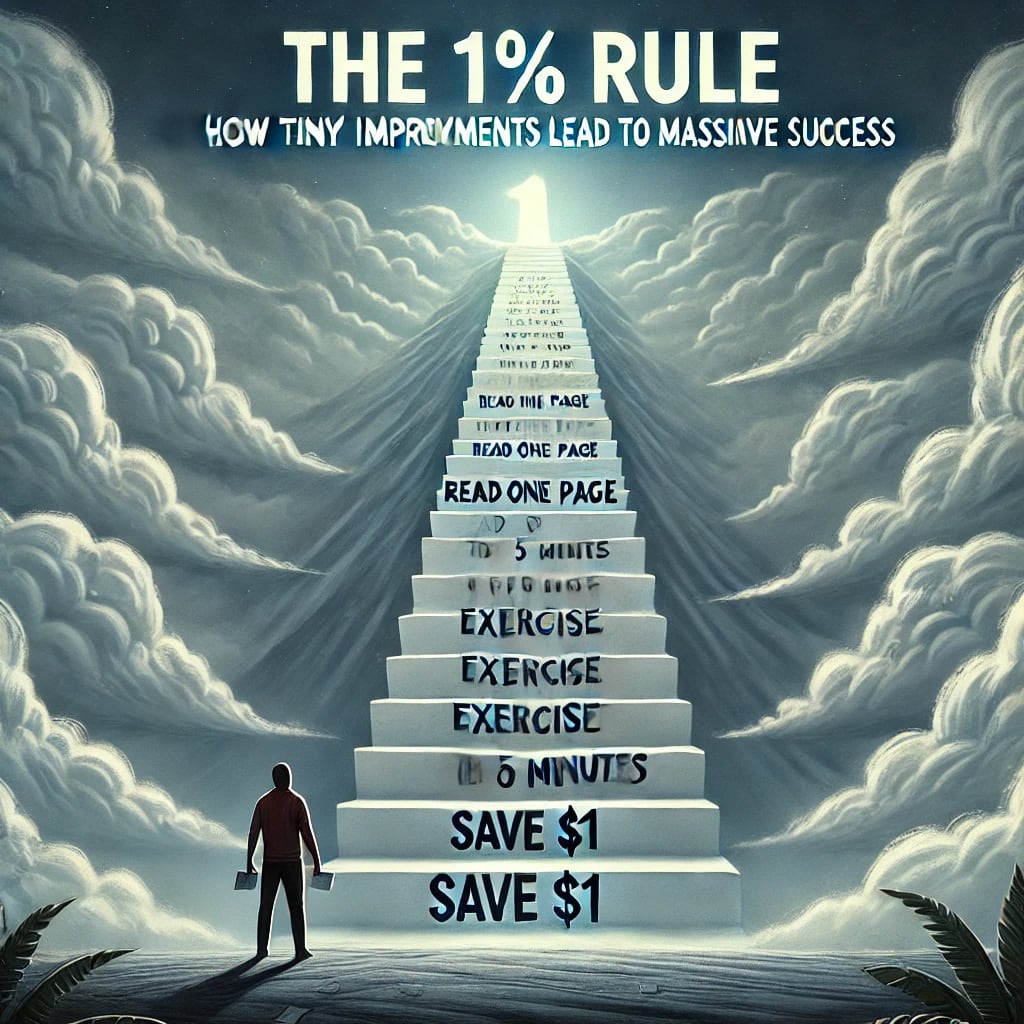
Introduction: The Power of Tiny Wins
We all dream of big success, major transformations, and breakthrough moments. But what if the secret to extraordinary success wasn’t in one massive action—but in tiny, consistent improvements over time?
Imagine this: if you get just 1% better each day, in one year, you won’t be just slightly better—you’ll be 37 times better. That’s the power of compounding progress.
Most people fail because they focus on drastic changes that feel overwhelming.
The smartest people succeed because they understand that small wins add up.
This is the 1% rule—the idea that tiny, continuous improvements lead to massive results.
This article will show you:
✅ Why small improvements matter more than big leaps
✅ The science behind how small habits create exponential success
✅ Real-life examples of the 1% rule in action
✅ How you can apply this strategy to your life—starting today
Let’s break it down.
1. Why Small Improvements Matter More Than Big Leaps
Most people believe that success comes from huge efforts, major risks, and sudden breakthroughs.
But in reality, the most successful people aren’t the ones who work the hardest all at once—they’re the ones who improve just a little bit, every single day.
📌 The Math of Tiny Gains:
If you improve by just 1% per day, after one year, you’ll be 37 times better.
If you get 1% worse every day, after a year, you’ll decline to almost zero.
This means that every small choice you make either builds you up or breaks you down.
🔹 Example:
Reading 5 pages a day turns into 6 books a year.
Doing 10 push-ups a day turns into over 3,500 push-ups in a year.
Saving $1 per day turns into $365 in a year—but when invested, it grows even bigger.
💡 Lesson? Big wins come from small, consistent actions.
2. The Science Behind the 1% Rule
Your brain and body love small, gradual changes.
📌 Why? Because they’re easy to sustain.
When you try to make big, drastic changes, your brain resists because it feels overwhelming. That’s why:
❌ Crash diets fail—they’re unsustainable.
❌ Extreme workout plans don’t last—they feel exhausting.
❌ Most New Year’s resolutions die out by February—they’re too ambitious.
But small changes? Your brain barely notices them, so they feel effortless.
🔹 The Power of Habit Stacking:
Attach a small habit to something you already do.
Example: “After I brush my teeth, I will do 5 squats.”
Soon, the habit becomes automatic, and you naturally start doing more.
🔹 The Compound Effect of Consistency:
Just like money compounds in a savings account, so do habits.
The more often you repeat small actions, the easier and more powerful they become.
💡 Lesson? Focus on tiny, effortless changes that grow over time.
3. Real-Life Examples of the 1% Rule in Action
Let’s look at real-world success stories that prove the power of small improvements.
✅ The British Cycling Team
For nearly 100 years, British cyclists were terrible. They had won only one Olympic gold medal in a century.
Then, in 2003, they hired Dave Brailsford, who introduced the 1% improvement strategy.
Instead of focusing on one big fix, he made hundreds of tiny improvements:
🚴 Improved bike seat comfort by 1%.
🚴 Changed riders’ sleep habits by 1%.
🚴 Adjusted training methods by 1%.
The result?
🔥 Five Tour de France wins in six years.
🔥 66 Olympic and Paralympic medals.
🔥 A complete dominance of the sport.
✅ Toyota and the “Kaizen” Mindset
Toyota became one of the biggest car companies in the world by using a strategy called Kaizen—which means “continuous small improvements”.
They didn’t try to create the perfect car overnight.
Instead, they focused on making every single process just a little bit better.
Over time, those tiny tweaks added up—until Toyota became the gold standard of efficiency and reliability in the car industry.
💡 Lesson? You don’t need to be great all at once—you just need to keep improving.
4. How to Apply the 1% Rule to Your Life (Starting Today!)
🚀 Want to use the 1% rule to build unstoppable success? Start here:
✅ 1. Choose One Small Habit
Pick something so small that you can’t fail.
💡 Example: Instead of saying “I’ll start running 5 miles,” start by walking for 5 minutes.
✅ 2. Make It Daily and Easy
Small habits should feel effortless—so simple that you can do them even on your worst day.
💡 Example: Read one paragraph of a book.
✅ 3. Track Your Progress
Use a habit tracker, calendar, or notes app to see your small wins add up.
✅ 4. Focus on the System, Not the Goal
Don’t just aim for "losing weight"—focus on "eating 1% healthier today."
Don’t just aim for "writing a book"—focus on "writing 50 words today."
Don’t just aim for "being rich"—focus on "saving $1 today."
Over time, these small actions will compound into something huge.
💡 Lesson? Success isn’t about giant leaps—it’s about tiny, daily progress.
Final Thoughts: Why Small Wins Create Big Success
The 1% rule isn’t magic—it’s just math, psychology, and consistency.
🔥 Success is built one small step at a time.
🔥 Failure happens when small bad habits add up.
So ask yourself:
💡 What is one small thing I can do today that will make me better tomorrow?
Because at the end of the day…
🚀 Small wins create big results.
About the Creator
Ahmet Kıvanç Demirkıran
As a technology and innovation enthusiast, I aim to bring fresh perspectives to my readers, drawing from my experience.
Keep reading
More stories from Ahmet Kıvanç Demirkıran and writers in Longevity and other communities.
Day 4 of Quitting
If this is how sobriety feels, maybe it’s better to go through life a little buzzed… this, along with other hits like, I want to kill myself, I wish I was dead, and I’m going to throw myself off a bridge have been the only thoughts on rotation these past few days. I promise myself that if, in a month, I still feel like this (‘this’ meaning despondent, full of rage, and simultaneously numb) I can go back to smoking. Until mid-February though? Nicotine is off the table.
By sleepy drafts10 days ago in Longevity
The Return of the Aircraft Carrier Truman Is Being Seen as a Snub to the Navy in the War of the Future
The return of the U.S. aircraft carrier USS Harry S. Truman to active deployment has sparked debate far beyond naval circles. While some see it as a show of enduring American naval power, others interpret the move as a symbolic snub—particularly in the context of how modern warfare is rapidly evolving. In an era dominated by drones, cyber warfare, hypersonic missiles, and artificial intelligence, the decision to once again lean heavily on a traditional aircraft carrier has raised uncomfortable questions about whether the Navy is preparing for the wars of tomorrow or clinging to the strategies of yesterday. A Floating Symbol of 20th-Century Power For decades, aircraft carriers have been the ultimate symbol of U.S. military dominance. These massive floating airbases project power thousands of miles from American shores and allow the U.S. to strike almost anywhere in the world. The Truman, like other Nimitz-class carriers, represents this legacy—housing nearly 5,000 sailors, dozens of fighter jets, and unmatched logistical capability. However, critics argue that what once made carriers indispensable now makes them vulnerable. Their sheer size, cost, and visibility turn them into high-value targets in a battlefield increasingly defined by precision strikes and long-range weapons. The “War of the Future” Looks Very Different Modern conflict is no longer limited to sea, land, and air. Cyber attacks can cripple infrastructure without a single shot fired. Drones can swarm targets at a fraction of the cost of traditional aircraft. Hypersonic missiles can reach targets faster than current defenses can respond. In this context, sending a massive carrier strike group into contested waters can appear less like a strategic necessity and more like a risky gamble. Critics argue that the return of the Truman reflects an outdated mindset—one that prioritizes visible force projection over adaptability and technological evolution. A Snub to Naval Innovation? Many analysts and serving officers believe the Navy’s future lies in distributed lethality—smaller, more agile platforms networked together, harder to detect and cheaper to replace. Unmanned surface vessels, autonomous submarines, and land-based missile systems are increasingly viewed as the backbone of next-generation naval warfare. Against this backdrop, recommitting to a traditional carrier is seen by some as sidelining innovation. It sends a message that, despite years of discussion about transformation, the Navy still defaults to familiar tools when tensions rise. This perception has led to frustration among those advocating for faster modernization. They argue that resources devoted to maintaining and protecting carriers like the Truman could instead accelerate investment in emerging technologies that are more relevant to future conflicts. The Strategic Signal to Allies and Rivals Supporters of the decision counter that the Truman’s return is not about nostalgia—it’s about deterrence. Aircraft carriers remain powerful political tools. Their presence reassures allies, signals commitment, and demonstrates readiness in a way few other assets can. Yet even here, the message is mixed. To technologically advanced rivals, the deployment may signal predictability rather than strength. Adversaries have spent years developing strategies specifically designed to neutralize carriers, including anti-ship ballistic missiles and advanced surveillance systems. Cost Versus Capability The financial reality cannot be ignored. A single carrier strike group costs billions of dollars to build, maintain, and operate. In contrast, drone fleets and missile systems can be produced and deployed at a much lower cost, often with greater strategic flexibility. Critics argue that continuing to rely on carriers drains resources from areas where the Navy needs to grow most urgently. In a future conflict defined by speed, dispersion, and digital dominance, the cost-benefit equation of aircraft carriers looks increasingly questionable. Why the Carrier Still Matters—For Now Despite the criticism, aircraft carriers are not obsolete—yet. They remain unmatched in their ability to sustain prolonged air operations without relying on foreign bases. In regions where access is limited or politically sensitive, carriers still provide options no other platform can. The real issue, many experts say, is not the existence of carriers like the Truman, but over-reliance on them. Using them as one component of a broader, more flexible strategy may still make sense. Treating them as the centerpiece of future war planning may not. A Turning Point for Naval Strategy The return of the USS Harry S. Truman highlights a deeper tension within modern military thinking. It represents a crossroads between tradition and transformation, between proven power and emerging threats. Whether history views this moment as a wise assertion of strength or a missed opportunity for innovation will depend on what comes next. If the Navy pairs legacy platforms with bold technological change, the carrier’s return may be justified. If not, it risks becoming a powerful symbol—not of dominance, but of reluctance to adapt in a rapidly changing world.
By Fiazahmedbrohi 5 days ago in Longevity
Miss Persephone's Manual to a Seemingly Ordinary Life
Miss Persephone was found at the dining table, her blue eyes swollen, her tears arriving and retreating like the tides of the ocean. Earlier that day, her family had visited her in the retirement home where she had lived for eight years. It was her eightieth birthday.
By Imola Tóth2 days ago in Fiction




Comments
There are no comments for this story
Be the first to respond and start the conversation.