
Natural vs. Synthetic Supplements: Which One is Right for You?
Comparing Natural and Synthetic Supplements: Benefits, Risks, and the Best Choice for Your Health


Synthetic supplements have always invited criticism from skeptics, who are bothered about its side effects. Whereas natural supplements have been looked down upon for not bringing that balanced approach. You will always find these two concepts clashing against one another for the ideal spot.
But that doesn't solve the problem for you, as you need to rely on a supplement to get your daily dose of essentials. Natural supplements are great as they compensate for your dietary needs with naturally occurring food items. Whereas, Synthetic supplements are lab-made versions of vitamins, minerals, or nutrients, rather than being directly sourced from natural foods.
Even though both the solutions seem like viable options, as you dig deeper, you will realize they both have their own baggage. So to declare the fair winner, you have to scrutinize what they bring to the table.
Understanding Supplements
Humans invented the concept of supplements once they realized their dietary options lacked in compensating for the essential protein, vitamin and mineral intake. It brought a convenient way to bridge nutritional gaps and support overall health without relying solely on whole foods.
What Are Supplements?
Supplements come in various forms like tablets, capsules, powders, and liquids, and are known to boost your overall health and immunity. Sometimes a supplement is even consumed to address a specific deficiency or just as a safety measure to ensure a healthy body.
There are also supplements like Daily Longevity Blend by LifeFuel that are a testament to years of research and are capable of giving you the required energy boost. It can also help you with your sleep quality and even slow down the aging process.
Why Do People Take Supplements?
The reason people take supplements is simple. It is to compensate for what they have missed out in their daily diet. Apart from filling up the nutritional gaps there are various other reasons like to boost immunity, improve digestion, or support heart, brain, and joint health. Along with that, supplements are now capable of maintaining energy and helping with the overall aging process.
But as we discuss the many advantages of a supplement, it is only natural to wonder whether plant-based or natural supplements are not good enough. Do they fail to compensate for our daily needs?
Natural Supplements
Natural supplements are the vitamins, minerals, amino acids, herbal extracts, plant protein, and animal protein that we get from nature. It is a collection of all those essential elements that are essential to the human body. Unlike synthetic supplements, they are not processed or are restricted to certain dosages per day. They are found in nature and is what your daily meal consists of.
Types of Natural Supplements
There are various types of natural supplements that are available in nature. Every one of them adds to the nutritional quotient of your dish.
- Vitamins & Minerals: Leafy greens, fruits, seeds, and dairy
- Omega-3 Fatty Acids: Fish oil, flaxseeds, and chia seeds
- Herbal Supplements: Turmeric (for inflammation), Ashwagandha (for stress relief), etc.
- Amino Acids & Protein: Animal sources like bone or broth, egg white, pea, quinoa, etc.
Benefits Of Natural Supplements
Depending on a natural supplement is easier as it doesn't involve you fetching any external source for your daily intake. You will be able to compensate for the same in your daily diet. Moreover, as compared to synthetic supplements, it has fewer flavors and added preservatives. Along with that since they come from whole food sources, the body recognizes and absorbs them more efficiently.
Potential Drawbacks Of Natural Supplements
It is tedious to determine the correct dosage for an individual when it comes to the consumption of natural supplements. There is hardly a way that accurately guess your vitamin or mineral consumption for the given portion.
Plus, as they are naturally absorbent, it takes a much longer time for natural supplements to show their true potential.
Synthetic Supplements
A synthetic supplement is all that a natural supplement is, but it comes from a man-made source and is defined by its dosage. There are multiple sources through which you can acquire a synthetic supplement owing to the growing competition amongst the brands. They are designed to mimic the structure and function of natural nutrients, but are not as naturally absorbent.
Types of Synthetic Supplements
Synthetic supplements are created in laboratories and usually have years of research backing up their fundamental construction. They are often produced using chemical synthesis, fermentation, or bioengineering. Like its natural counterpart, it has various types and forms keeping a diverse user base.
- Synthetic Vitamins, Ascorbic Acid (Vitamin C), Retinyl Acetate (Vitamin A), Vitamin B12, Folic Acid (Synthetic Folate).
- Synthetic Minerals
- Synthetic Amino Acids & Proteins
- Synthetic Omega-3 Fatty Acids
- Synthetic Antioxidants and others.
Benefits Of Synthetic Supplements
Regardless of your location, you can get a hands on your desired supplement anywhere on the planet. They are abundantly accessible and provide a budget-friendly option for individuals needing high-dose vitamins and minerals.
They come with a set of instructions for dosage separately, making sure you always consume the intended amount. It is a lifesaver, especially for people who are vegan, vegetarian, or gluten-free. Most importantly, it is always easier to consume a pill or powder than to plan an entire diet.
Potential Drawbacks Of Synthetic Supplements
Opting for synthetic supplements is a great choice, but it comes with its issues which can play a major deciding factor for many consumers.
- They are not naturally absorbent so it might take a while for your body to adjust to the dosage.
- Excessive intake of supplements can escalate into a major health catastrophe, which is never really a point of concern with natural supplements.
- Some synthetic vitamins and minerals can cause digestive issues, nausea, or allergic reactions.
- There are multiple brands in the market that provide the same solutions so making an informed choice becomes difficult.
- Moreover, synthetic supplements contain artificial colors, preservatives, and binding agents which can be harmful to the human body.
Key Differences Between Natural And Synthetic Supplements
The ultimate decision lies within you to decide your mode of consumption. But its always better to make an informed choice by understanding the key offerings of all the components in question.
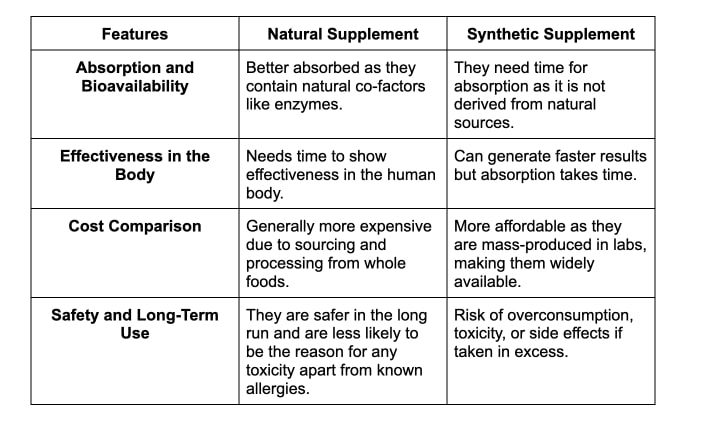
Myths and Misconceptions About Supplements
A natural supplement might feel like a better option in the long run, but this does not take anything away from synthetic supplements.
- While natural supplements contain co-factors that aid absorption, some synthetic supplements are formulated for better stability and bioavailability.
- Synthetic supplements are only harmful if you do not follow the intended dosage. When taken in recommended doses, synthetic supplements are safe and widely used to prevent deficiencies.
- It is critical to remember that a synthetic supplement is not a replacement to a balanced diet. Supplements are meant to complement, not replace, a balanced diet.
- We need to let go of the concept that more supplements can facilitate good health. Instead, it's essential to understand our body's specific needs and take the right dosage accordingly.
Conclusion
Choosing between natural and synthetic supplements depends on individual needs, dietary preferences, and health goals. Natural supplements ensure better absorption, whereas synthetic supplements offer convenience. However, the key to good health is not about choosing one over the other but finding the right balance. The idea is to understand your body’s specific needs and consume supplements accordingly.
About the Creator
Vijay Singh Khatri
Graduate in Computer Science Engineering, specialized in Digital Marketing. I am very fond of writing tech articles.
Keep reading
More stories from Vijay Singh Khatri and writers in Longevity and other communities.
How I Fixed My Sleep with a Small Lifestyle Change
If you're reading this late at night, sleep deprived, tossing and turning in bed, then trust me, I've been there. For years, I struggled with poor sleep. The kind where you go to bed on time but wake up feeling like you barely slept. I tried sleep teas, eye masks, blackout curtains, calming apps, you name it. But nothing truly worked until I made one simple lifestyle change that changed everything.
By Vijay Singh Khatri5 months ago in Longevity
Day 4 of Quitting
If this is how sobriety feels, maybe it’s better to go through life a little buzzed… this, along with other hits like, I want to kill myself, I wish I was dead, and I’m going to throw myself off a bridge have been the only thoughts on rotation these past few days. I promise myself that if, in a month, I still feel like this (‘this’ meaning despondent, full of rage, and simultaneously numb) I can go back to smoking. Until mid-February though? Nicotine is off the table.
By sleepy drafts12 days ago in Longevity
Forget Burj Khalifa and Shanghai Tower: Saudi Arabia Now Readies a Bold 1km-Tall Skyscraper
Saudi Arabia is once again turning heads in the world of architecture and urban development, this time with a plan that could redefine the global skyline. Forget the Burj Khalifa in Dubai or Shanghai Tower in China—both marvels of modern engineering. The Kingdom is reportedly preparing to construct a skyscraper that will soar an astonishing 1,000 meters (1 km) into the sky, setting a new benchmark for ambition and innovation. The announcement comes amid Saudi Arabia’s Vision 2030 initiative, a sweeping plan to diversify the country’s economy, reduce its dependence on oil, and establish itself as a hub for tourism, technology, and global investment. Building the world’s tallest skyscraper is both a symbol of national pride and a statement of intent, signaling Saudi Arabia’s desire to compete with other global metropolises in terms of architectural prowess and urban sophistication. The proposed tower, still in its early conceptual stages, promises to be a landmark on multiple fronts. Engineers and architects are reportedly exploring cutting-edge construction techniques, including ultra-lightweight materials, reinforced steel frameworks, and innovative wind-resistance systems. At 1 kilometer tall, the building will require a foundation capable of supporting immense weight while withstanding seismic activity and extreme weather conditions. The project is expected to push the boundaries of engineering much like the Burj Khalifa did when it was completed in 2010. Beyond engineering, the skyscraper is intended to be a multipurpose vertical city. Early designs suggest a combination of luxury residences, office spaces, hotels, observation decks, and entertainment facilities. Developers envision it as not just a building but a destination, capable of attracting tourists from around the globe while providing state-of-the-art amenities for residents and businesses. The concept of a self-contained vertical city is increasingly popular in mega-cities around the world, and Saudi Arabia aims to demonstrate that such ambition is possible in its own backyard. However, the challenges are significant. Constructing a 1 km skyscraper involves tackling wind forces that increase dramatically at higher altitudes, ensuring the safety and comfort of elevators over unprecedented heights, and creating systems to supply water, electricity, and emergency services efficiently. The logistics of construction, from transporting materials to coordinating thousands of workers, will require meticulous planning and the latest in project management technologies. Experts say that every detail, from the shape of the tower to its façade design, will be critical in ensuring that it is both structurally sound and visually iconic. Financial considerations are equally important. Mega-projects of this scale often require tens of billions of dollars in investment. Saudi Arabia has a track record of funding large-scale developments, from the futuristic city of NEOM to massive cultural and tourism projects. Yet, the economic viability of the skyscraper will depend on its ability to attract tenants, visitors, and businesses over the long term. Analysts suggest that incorporating mixed-use features and tourist attractions is key to making the investment sustainable. Culturally, the skyscraper represents a shift in perception for Saudi Arabia. Historically known for its conservative approach to urban development, the Kingdom is embracing bold, globally visible projects to enhance its soft power and showcase modernization. Such landmark buildings are more than infrastructure—they are symbols of ambition, progress, and technological prowess. If completed, the 1 km tower could redefine the city skyline, drawing comparisons not only to Dubai or Shanghai but to other global centers of innovation. Critics, however, have raised environmental concerns. The construction and maintenance of a super-tall skyscraper have significant energy demands and ecological footprints. Questions around sustainability, water use, and energy efficiency will be under scrutiny, particularly as Saudi Arabia positions itself as a player in renewable energy and environmental innovation. Integrating green technology, smart energy systems, and sustainable urban design will be crucial to ensuring that the project aligns with global expectations of responsible development. Despite these challenges, excitement is palpable. Architects, engineers, and urban planners worldwide are watching Saudi Arabia’s ambitions with keen interest. The project is expected to attract international expertise, foster innovation in construction technologies, and inspire a new generation of skyscraper designs. Beyond its physical stature, the tower promises to be a symbol of Saudi Arabia’s future—a bold statement that blends tradition with futuristic ambition. In a world where cities compete for global attention through landmarks and architecture, Saudi Arabia’s 1 km skyscraper could be the next iconic symbol. It reflects a country striving to diversify its economy, assert its presence on the global stage, and redefine what is possible in urban design. From the Burj Khalifa to the Shanghai Tower, the race for the sky has been ongoing—but Saudi Arabia may soon take it to an entirely new level.
By Fiaz Ahmed Brohi5 days ago in Longevity


Comments
There are no comments for this story
Be the first to respond and start the conversation.