
Global Atherectomy Devices Market Size and Forecast 2025–2033
Minimally Invasive Innovation Drives the Future of Vascular Care

Introduction
The global healthcare industry is witnessing a steady shift toward minimally invasive procedures, and atherectomy devices are playing a crucial role in this transformation. These specialized medical tools are designed to remove plaque from arteries, restoring blood flow in patients suffering from conditions such as coronary artery disease (CAD) and peripheral artery disease (PAD). With cardiovascular diseases remaining one of the leading causes of death worldwide, the demand for effective, less invasive treatment options continues to rise.
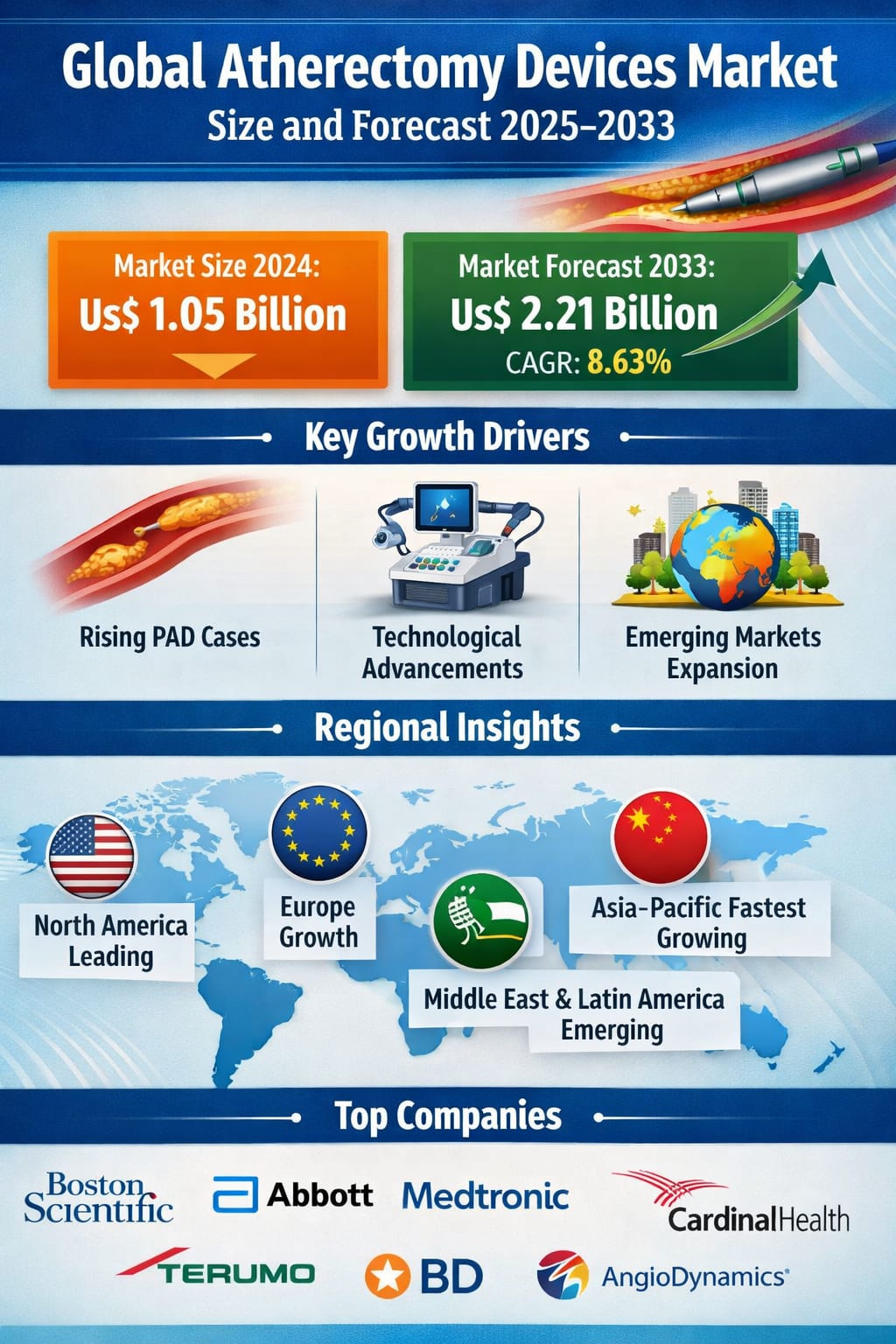
According to Renub Research, the Atherectomy Devices Market is expected to reach US$ 2.21 billion by 2033, up from US$ 1.05 billion in 2024, growing at a CAGR of 8.63% from 2025 to 2033. This impressive growth reflects a combination of demographic shifts, technological advancements, expanding healthcare infrastructure, and increasing awareness of advanced vascular treatments.
As healthcare systems across the globe focus on improving patient outcomes while reducing hospital stays and procedural risks, atherectomy devices are increasingly viewed as a valuable alternative or complement to traditional treatments such as balloon angioplasty and stenting. The coming decade is expected to further cement their role in modern vascular care.
What Are Atherectomy Devices and Why They Matter
Atherectomy devices are specialized medical instruments used to remove atherosclerotic plaque from blood vessels. Unlike angioplasty, which compresses plaque against the artery walls, atherectomy physically removes or vaporizes the blockage. This approach can be particularly beneficial in complex or heavily calcified lesions where traditional methods may be less effective.
There are several types of atherectomy systems in clinical use today, including directional, rotational, orbital, and laser atherectomy devices. Each works through a different mechanism—cutting, grinding, sanding, or vaporizing plaque—to restore arterial patency. These devices are widely used in cardiovascular, neurovascular, and peripheral vascular applications.
One of the biggest advantages of atherectomy is its minimally invasive nature. Patients often experience shorter recovery times, reduced procedural trauma, and improved blood flow outcomes. For individuals who are not ideal candidates for stents or balloon angioplasty, atherectomy offers a critical alternative that can significantly improve quality of life.
Key Market Drivers Fueling Growth
Rising Burden of Peripheral Artery Disease (PAD)
One of the most powerful growth drivers for the atherectomy devices market is the increasing prevalence of peripheral artery disease worldwide. Aging populations, along with rising rates of diabetes, obesity, smoking, and sedentary lifestyles, are significantly increasing the number of patients suffering from PAD.
PAD often leads to symptoms such as leg pain, fatigue while walking, and in severe cases, critical limb ischemia. Atherectomy devices provide a minimally invasive way to remove plaque and restore blood flow, making them a preferred option in many vascular interventions. As the global burden of PAD continues to rise, so does the demand for effective treatment solutions—placing atherectomy devices in a strong growth position.
Technological Advancements in Device Design
Innovation is another major force shaping the atherectomy devices market. Modern systems are becoming more precise, safer, and easier for physicians to use. Improvements in rotational, orbital, and laser atherectomy technologies have enhanced plaque removal efficiency while minimizing damage to healthy vessel tissue.
The integration of advanced imaging techniques such as intravascular ultrasound (IVUS) and optical coherence tomography (OCT) allows clinicians to visualize arterial blockages in real time, improving procedural accuracy and outcomes. These technological enhancements not only boost physician confidence but also contribute to wider adoption across hospitals and specialty clinics.
A notable example of ongoing innovation is AngioDynamics’ Auryon Atherectomy System, which received expanded 510(k) clearance in August 2022 to include arterial thrombectomy, highlighting how companies are continuously broadening the clinical applications of their devices.
Shift Toward Minimally Invasive Procedures
Healthcare systems worldwide are increasingly prioritizing minimally invasive treatments due to their benefits, including reduced hospital stays, lower complication rates, and faster patient recovery. Atherectomy fits perfectly into this trend, offering an effective solution for complex vascular cases without the need for open surgery.
As patient awareness grows and healthcare providers seek cost-effective, outcome-driven treatments, atherectomy procedures are expected to see wider adoption, further accelerating market growth.
Expansion of Healthcare Infrastructure in Emerging Markets
Emerging economies in Asia-Pacific, Latin America, and the Middle East are investing heavily in healthcare infrastructure. Improved access to advanced medical technologies, rising disposable incomes, and increasing awareness of cardiovascular diseases are creating new opportunities for atherectomy device manufacturers.
Favorable government initiatives, expanding insurance coverage, and growing numbers of specialized cardiac and vascular centers are also contributing to higher adoption rates in these regions, making emerging markets a key growth engine for the industry.
Challenges Facing the Market
Shortage of Skilled Operators
Despite its strong growth outlook, the atherectomy devices market faces a significant challenge: the lack of adequately trained specialists. Atherectomy procedures require high levels of technical expertise, especially when using advanced systems such as laser or rotational devices.
Training healthcare professionals is both time-consuming and expensive, and in many developing or underserved regions, access to skilled operators remains limited. This skills gap can slow adoption rates and restrict the widespread use of atherectomy technologies.
High Cost of Devices and Procedures
Another major barrier is cost. Atherectomy systems are technologically advanced and expensive to manufacture, which translates into higher procurement costs for hospitals and clinics. Additionally, the overall cost of the procedure—including device usage, hospital fees, and specialist care—can be prohibitive for many patients, particularly in regions with limited reimbursement support.
While the clinical benefits are clear, affordability remains a critical factor influencing market penetration, especially in low- and middle-income countries.
Regional Market Insights
North America: Market Leader
North America, particularly the United States, dominates the global atherectomy devices market. The region benefits from a well-established healthcare infrastructure, high adoption of advanced medical technologies, and a strong focus on minimally invasive procedures.
The U.S. market is driven largely by an aging population and the high prevalence of cardiovascular diseases such as PAD and atherosclerosis. With millions of adults affected by high cholesterol, diabetes, and obesity, the demand for effective vascular interventions continues to grow. Atherectomy devices, offering a minimally invasive and effective solution, are well-positioned to benefit from these trends.
Europe: Strong Second Position
Europe holds a significant share of the global market, supported by rising cardiovascular disease incidence and strong healthcare systems in countries such as Germany, France, and the United Kingdom. Favorable reimbursement policies and ongoing technological adoption are encouraging hospitals and clinics to incorporate atherectomy procedures into standard vascular care.
Germany, in particular, stands out due to its advanced medical infrastructure, aging population, and increasing focus on minimally invasive treatments.
Asia-Pacific: Fastest Growing Region
The Asia-Pacific region is expected to witness the fastest growth over the forecast period. Countries such as China, India, Japan, and South Korea are experiencing rapid improvements in healthcare infrastructure, growing awareness of cardiovascular health, and increasing access to advanced medical treatments.
India’s market, for example, is being driven by a large patient population, rising incidence of PAD and other cardiovascular conditions, and expanding adoption of minimally invasive procedures. Government initiatives and private healthcare investments are further strengthening the region’s growth prospects.
Middle East, Africa, and Latin America: Emerging Opportunities
Markets in Saudi Arabia, the UAE, Brazil, Mexico, and South Africa are also showing promising growth. Increased healthcare spending, modernization of medical facilities, and rising awareness of advanced treatment options are supporting the adoption of atherectomy devices in these regions.
Saudi Arabia, in particular, is investing heavily in healthcare modernization, which is expected to boost demand for advanced vascular treatment technologies, including atherectomy systems.
Market Segmentation Overview
By Product Type:
Directional
Rotational
Orbital
Laser
By Application:
Cardiovascular
Neurovascular
Peripheral Vascular
By End User:
Hospitals
Ambulatory Care Services
Medical Research Institutes
This diverse segmentation highlights the broad applicability of atherectomy devices across different clinical settings and medical specialties.
Competitive Landscape: Key Players
The global atherectomy devices market is highly competitive, with several major players focusing on innovation, strategic partnerships, and product portfolio expansion. Key companies include:
Boston Scientific Corporation
Abbott Laboratories
Medtronic plc
Cardinal Health
Terumo Corporation
Integer Holdings Corporation
Becton, Dickinson and Company
AngioDynamics Inc.
These companies are actively investing in research and development, launching new products, and expanding their global footprint to capture a larger share of this growing market.
Future Outlook
Looking ahead, the atherectomy devices market is poised for sustained growth through 2033. The combination of rising cardiovascular disease prevalence, continuous technological innovation, and expanding access to healthcare in emerging markets creates a strong foundation for long-term expansion.
While challenges such as high costs and the need for skilled operators remain, ongoing training initiatives, improved reimbursement frameworks, and technological simplification of devices are expected to gradually reduce these barriers.
Final Thoughts
The global atherectomy devices market is entering a transformative phase. With Renub Research projecting growth from US$ 1.05 billion in 2024 to US$ 2.21 billion by 2033, the industry is clearly on an upward trajectory. Driven by the global shift toward minimally invasive procedures, rising PAD cases, and rapid technological advancements, atherectomy devices are becoming an essential part of modern vascular care.
As healthcare systems continue to prioritize patient outcomes, efficiency, and innovation, atherectomy technologies are set to play an increasingly important role in shaping the future of cardiovascular and peripheral vascular treatment worldwide.
About the Creator
Keep reading
More stories from shibansh kumar and writers in Longevity and other communities.
United States Thermoplastic Polyurethane Market Size and Forecast 2026–2034
Market Overview The United States Thermoplastic Polyurethane (TPU) Market is positioned for steady and sustained growth over the forecast period from 2026 to 2034. According to Renub Research, the market is projected to expand from US$ 816.27 million in 2025 to US$ 1,418.20 million by 2034, registering a compound annual growth rate (CAGR) of 6.33%.
By shibansh kumar11 days ago in Longevity




Comments
There are no comments for this story
Be the first to respond and start the conversation.