
Radio Signal Discovered at the Center of the Milky Way Could Put Einstein’s Relativity to the Test
Potential pulsar near Sagittarius A* offers unprecedented opportunity to study gravity under extreme conditions

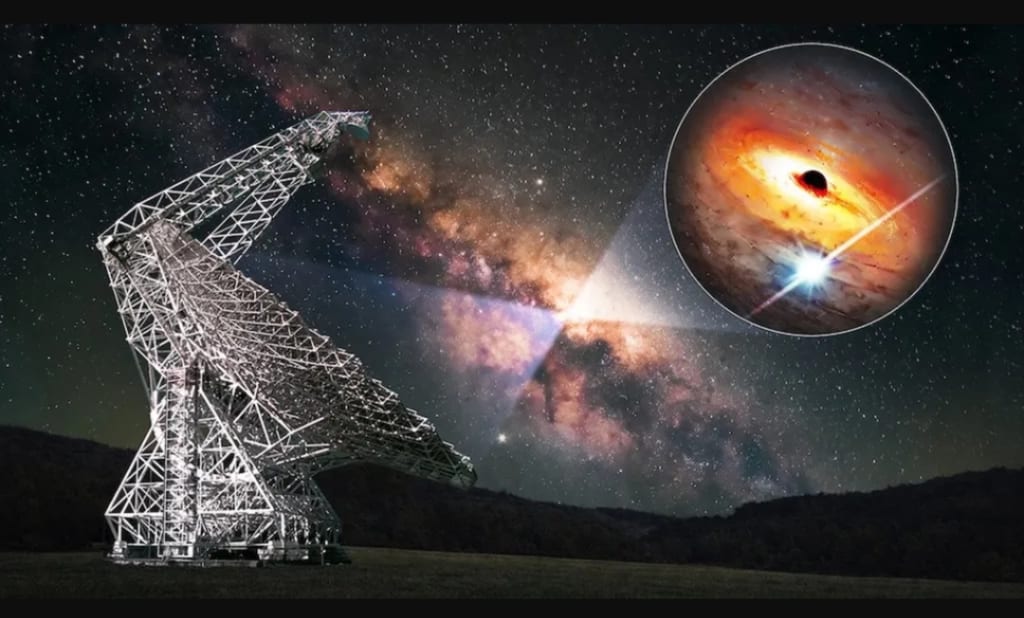
Astronomers have recently detected a radio signal emanating from the heart of the Milky Way galaxy, which preliminary analyses suggest may originate from a pulsar, a rapidly rotating neutron star, in close proximity to the galaxy’s supermassive black hole, Sagittarius A*. If confirmed, this discovery could provide scientists with a unique laboratory to test Albert Einstein’s general theory of relativity in one of the most extreme environments in the universe.
The discovery was announced on February 9, 2026, in The Astrophysical Journal by a team led by Karen I. Perez, a postdoctoral researcher at the SETI Institute. The signal was identified through the Breakthrough Listen Galactic Center Survey, a comprehensive project aimed at detecting radio emissions from the densely populated central regions of the Milky Way. The survey is one of the most sensitive ever conducted for this region of space.
Nature of the Signal
The observed radio emission exhibits characteristics consistent with a pulsar, which is the dense remnant of a massive star that has undergone a supernova explosion. Pulsars are known for emitting highly regular beams of radio waves, which sweep across space as the star rotates, analogous to the beam of a lighthouse.
What makes this potential pulsar particularly significant is its proximity to Sagittarius A*, a black hole approximately 4 million times the mass of the Sun. The extreme gravitational forces in this region result in a pronounced warping of space-time, creating conditions under which the effects predicted by general relativity can be tested with unprecedented precision.
If the radio source is indeed a pulsar, its consistent and highly accurate pulses could serve as a natural cosmic clock, allowing scientists to measure the minute alterations in pulse timing caused by the black hole’s gravitational field.
Significance for Testing General Relativity
Einstein’s general theory of relativity, formulated in 1915, describes gravity as the curvature of space-time produced by mass. While the theory has been validated through multiple observations, including light bending around the Sun and gravitational wave detections, it has yet to be rigorously tested in the extreme gravitational environment near a supermassive black hole.
A pulsar orbiting close to Sagittarius A* offers a unique opportunity to study gravitational time dilation and space-time distortions with exceptional precision. As the pulsar’s radio pulses traverse the warped region around the black hole, they are expected to experience delays and deflections in accordance with relativistic predictions. By measuring these effects, astronomers can conduct one of the most precise tests of Einstein’s theory to date.
According to Slavko Bogdanov, a co-author of the study from Columbia University’s Astrophysics Laboratory, the observed timing variations could reveal subtle deviations from theoretical predictions, potentially shedding light on aspects of gravity that remain poorly understood.
The Breakthrough Listen Survey
The discovery was made possible by the Breakthrough Listen Galactic Center Survey, an initiative initially designed to search for extraterrestrial intelligence through the detection of unusual radio signals. While the survey’s primary goal is the search for alien transmissions, its high sensitivity and comprehensive coverage also allow for the identification of astrophysical phenomena, including pulsars, black holes, and neutron stars.
Importantly, the Breakthrough Listen project has released its data publicly, enabling researchers worldwide to independently analyze the findings and verify the presence of the pulsar. The team emphasizes that further observations are required to confirm the nature of the signal and its precise location relative to the black hole.
Pulsars and Their Scientific Importance
Pulsars are stellar remnants composed of extremely dense matter, often with a mass exceeding that of the Sun compressed into a sphere only about 20 kilometers in diameter. Their rapid rotation and stable emission patterns make them highly precise astronomical clocks, ideal for probing the properties of space-time.
Historically, pulsars have been used to confirm general relativity under less extreme conditions, such as in binary star systems. However, no pulsar has yet been observed in such close proximity to a supermassive black hole, making this candidate source particularly valuable for experimental tests of gravitational physics.
Implications for Physics and Astronomy
If confirmed, the pulsar could enable scientists to conduct measurements of gravitational time dilation, orbital precession, and other relativistic effects in a region of space dominated by extreme gravity. Such observations could also reveal potential deviations from general relativity, offering insights into the limitations of Einstein’s theory and guiding the development of new models of gravity that incorporate quantum mechanics.
Furthermore, studying a pulsar near Sagittarius A* could provide critical information about the population of neutron stars in the galactic center and the dynamics of stars in close orbit around supermassive black holes. This could, in turn, improve our understanding of stellar evolution and black hole interactions in dense galactic environments.
Challenges and Next Steps
Despite the excitement surrounding the discovery, astronomers remain cautious. The radio emission could originate from other astrophysical sources, including flaring activity or unusual compact objects near the galactic center. Confirming the signal as a pulsar will require follow-up observations using radio telescopes globally, along with detailed analysis of its timing and spectral properties.
Should subsequent measurements verify the presence of a pulsar, it would represent a groundbreaking opportunity to explore gravity under conditions previously accessible only through theoretical models.
Conclusion
The detection of a radio signal near the Milky Way’s central black hole has the potential to become a milestone in astrophysics, offering a natural laboratory to test the predictions of general relativity in the most extreme gravitational environment accessible to observation. If confirmed as a pulsar, this discovery would allow scientists to measure subtle distortions of space-time with remarkable precision, potentially revealing new aspects of gravity and contributing to the ongoing quest to unify general relativity with quantum mechanics.
The findings also underscore the continued importance of high-sensitivity surveys like Breakthrough Listen, which not only advance the search for extraterrestrial intelligence but also provide critical insights into fundamental astrophysical phenomena. In the coming years, further observations of this signal could transform our understanding of both the structure of our galaxy and the nature of gravity itself.
About the Creator
Asad Ali
I'm Asad Ali, a passionate blogger with 3 years of experience creating engaging and informative content across various niches. I specialize in crafting SEO-friendly articles that drive traffic and deliver value to readers.
Why Your Brain Feels Tired Even After 8 Hours of Sleep
Introduction You go to bed on time. You sleep for eight hours or more. Yet when you wake up, your brain feels slow, heavy, and exhausted. Concentrating feels hard. Simple tasks feel overwhelming. This confusing feeling makes many people wonder: If I slept enough, why does my brain still feel tired?
By Adil Ali Khan4 days ago in Longevity




Comments
There are no comments for this story
Be the first to respond and start the conversation.