
United States Thermoplastic Polyurethane Market Size and Forecast 2026–2034
Flexible Strength Driving the Next Phase of Advanced Manufacturing in America

Market Overview
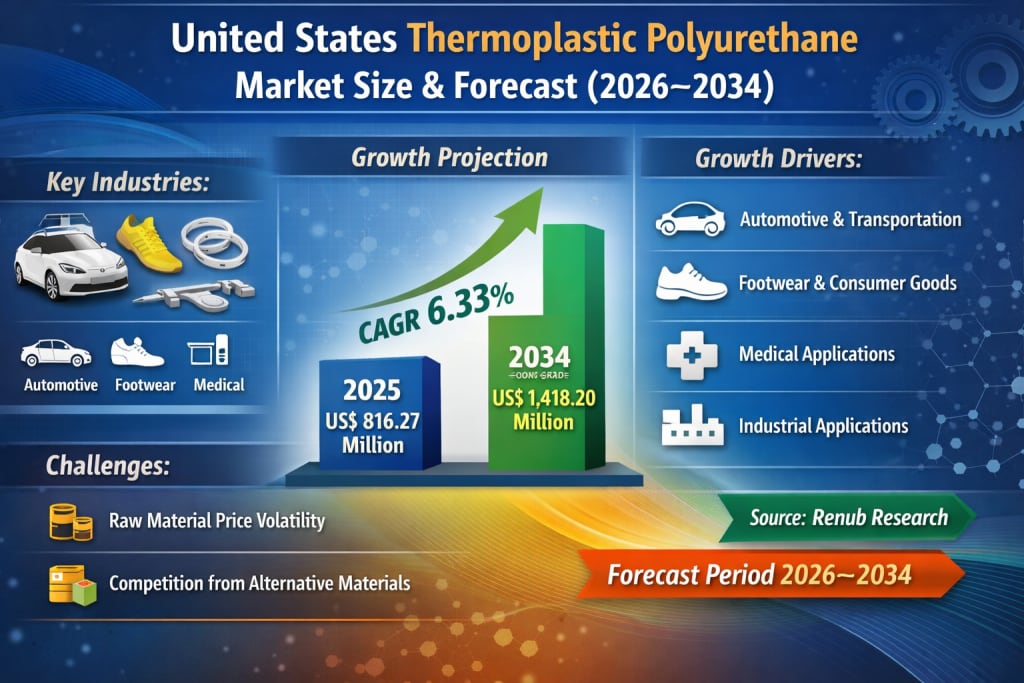
The United States Thermoplastic Polyurethane (TPU) Market is positioned for steady and sustained growth over the forecast period from 2026 to 2034. According to Renub Research, the market is projected to expand from US$ 816.27 million in 2025 to US$ 1,418.20 million by 2034, registering a compound annual growth rate (CAGR) of 6.33%.
This growth reflects the rising importance of TPU as a high-performance polymer that bridges the gap between rubber-like flexibility and plastic-like strength. Increasing adoption across automotive, footwear, electronics, medical devices, construction, and industrial manufacturing continues to strengthen the market’s long-term outlook in the United States.
Outlook of the United States Thermoplastic Polyurethane Market
Thermoplastic polyurethane is an elastic polymer known for combining durability, flexibility, and resilience. It offers excellent abrasion resistance, impact strength, elasticity, and resistance to oils, chemicals, and weathering. One of TPU’s most significant advantages is its compatibility with conventional thermoplastic processing methods, including injection molding, extrusion, and blow molding.
These characteristics have made TPU a preferred material across a wide range of applications such as automotive components, footwear soles, industrial hoses, cables, films, protective coatings, medical devices, and consumer electronics accessories. In the U.S., the demand for high-performance and lightweight materials continues to rise, particularly as industries pursue efficiency, durability, and advanced design flexibility.
The versatility of TPU aligns well with evolving manufacturing needs, sustainability initiatives, and technological advancements, positioning it as a critical material in modern American industries.
United States Thermoplastic Polyurethane Market Growth Drivers
Expanding Applications in Automotive and Transportation
The automotive and transportation sector remains a primary growth engine for the U.S. TPU market. Automakers increasingly rely on TPU for both interior and exterior components due to its superior durability, flexibility, and abrasion resistance. As the industry focuses on reducing vehicle weight to improve fuel efficiency and lower emissions, TPU serves as an effective alternative to heavier rubber and traditional plastics.
TPU’s resistance to oils, chemicals, and temperature fluctuations makes it ideal for hoses, seals, cable jacketing, protective films, and vibration-dampening components. The accelerating shift toward electric vehicles further boosts demand, as manufacturers seek materials that combine lightweight properties with mechanical strength and long service life.
Continuous innovation in automotive design and material science ensures sustained TPU consumption across conventional and electric vehicle platforms.
Rising Demand from Footwear and Consumer Goods
The footwear and consumer goods industries play a vital role in supporting TPU market growth in the United States. TPU is widely used in athletic and casual footwear soles due to its excellent elasticity, shock absorption, and design versatility. Consumers increasingly favor footwear that balances comfort, durability, and visual appeal, all of which TPU delivers effectively.
In consumer electronics and lifestyle products, TPU is commonly used for protective cases, wearable accessories, and flexible components. The growing demand for premium sportswear, fitness gear, and durable personal accessories continues to support TPU adoption. Improvements in coloring techniques, molding precision, and surface finishes further enhance its appeal in consumer-centric applications.
Growth in Medical and Industrial Applications
Medical and industrial applications represent another strong growth pillar for the U.S. TPU market. Medical-grade TPU is valued for its biocompatibility, flexibility, resistance to sterilization processes, and mechanical strength. It is widely used in catheters, tubing, wound dressings, medical device housings, and skin-contact components.
In industrial settings, TPU is utilized in conveyor belts, seals, wear-resistant linings, hoses, and protective coatings. Rising healthcare expenditure, an aging population, and increased automation in manufacturing drive demand for reliable, high-performance materials. Strict regulatory requirements further reinforce TPU’s position as a preferred material for specialty and high-value applications.
Challenges in the United States Thermoplastic Polyurethane Market
Price Volatility of Raw Materials
Raw material price volatility remains one of the most significant challenges facing the U.S. TPU market. TPU production relies heavily on petrochemical-based feedstocks, which are sensitive to fluctuations in crude oil prices and supply chain disruptions. Sudden cost increases can compress profit margins for manufacturers and create pricing uncertainty for end users.
Smaller producers are particularly vulnerable, as they often lack the scale needed to absorb cost fluctuations. This volatility complicates long-term planning, supply contracts, and investment decisions, making cost efficiency and strategic sourcing critical priorities.
Competition from Alternative Materials
TPU also faces competition from alternative materials such as thermoplastic elastomers, silicone, and advanced rubber compounds. In certain applications, these substitutes offer comparable performance at potentially lower costs. Additionally, rising interest in bio-based and recyclable polymers adds competitive pressure on conventional TPU products.
End-use industries increasingly evaluate materials based on sustainability credentials, cost efficiency, and application-specific performance. To remain competitive, TPU manufacturers must continue innovating in formulation, recyclability, and environmental performance.
United States Polyester Thermoplastic Polyurethane Market
Polyester-based TPU holds a strong position in the U.S. market due to its high strength, abrasion resistance, and chemical durability. It is widely used in industrial belts, hoses, coatings, and heavy-duty footwear components. These materials perform reliably in demanding environments where mechanical stress and exposure to oils or chemicals are common.
Despite some sensitivity to moisture, ongoing improvements in formulation and processing techniques have enhanced the flexibility and heat resistance of polyester TPU, supporting its continued growth across industrial and automotive applications.
United States Polyols Thermoplastic Polyurethane Market
Polyols-based TPU is known for its adaptability, flexibility, and hydrolysis resistance. These properties make it suitable for applications requiring repeated bending, stretching, and low-temperature performance. The growing use of soft-touch materials and flexible components across U.S. industries supports steady demand for polyols TPU.
Continuous innovation and expanding applications in high-value sectors further strengthen the importance of this segment within the broader TPU market.
United States Thermoplastic Polyurethane Extruded Products Market
Extruded TPU products represent a significant share of total TPU consumption in the United States. These products include tubes, films, sheets, and profiles used across manufacturing, automotive, medical, and consumer goods industries. TPU’s impact resistance, flexibility, and ease of processing make it ideal for continuous extrusion and customized designs.
Rising demand from automation, medical devices, and protective films continues to drive growth in this segment.
United States Construction Thermoplastic Polyurethane Market
In the construction sector, TPU is increasingly used in sealants, coatings, membranes, and adhesives. Its resistance to abrasion, UV exposure, and chemicals makes it suitable for demanding building applications. TPU-based adhesives provide strong bonding and reinforcement, supporting structural durability and longevity in modern construction projects.
United States Medical Thermoplastic Polyurethane Market
The U.S. medical TPU market is expanding steadily due to rising healthcare investments and demand for high-performance, biocompatible materials. TPU’s flexibility, strength, and sterilization compatibility make it a preferred choice for medical tubing, catheters, wound care products, and device housings. The ability to meet strict quality and regulatory standards further supports market growth.
United States Automotive Thermoplastic Polyurethane Industry
Automotive applications remain a cornerstone of TPU demand in the U.S. market. TPU is extensively used in interior trims, cable jacketing, seals, hoses, and protective coatings. Its durability and resistance to oils, abrasion, and temperature variation make it well suited for both conventional and electric vehicles. As vehicle designs continue to evolve, TPU adoption is expected to rise further.
Regional Market Insights
California leads TPU demand due to strong automotive, electronics, footwear, and medical device industries. Sustainability regulations and technology-driven manufacturing promote adoption of lightweight and recyclable materials.
New York’s TPU market benefits from robust healthcare, consumer goods, and manufacturing sectors, with significant demand for medical tubing and protective materials.
Washington’s TPU demand is supported by industrial production, electronics, and advanced manufacturing, emphasizing durability and precision.
New Jersey’s market is strengthened by its chemical, pharmaceutical, and specialty manufacturing base, supported by efficient logistics and access to major markets.
Market Segmentation
By Type:
Polyester, Polyether, Polycaprolactone
By Raw Material:
Polyols, Diisocyanate, Diols
By Application:
Extruded Products, Injection Molded Products, Adhesives, Others
By End Use:
Construction, Automotive, Footwear, Medical, Electrical & Electronics, Heavy Engineering, Others
By Top States:
California, Texas, New York, Florida, Illinois, Pennsylvania, Ohio, Georgia, New Jersey, Washington, North Carolina, Massachusetts, Virginia, Michigan, Maryland, Colorado, Tennessee, Indiana, Arizona, Minnesota, Wisconsin, Missouri, Connecticut, South Carolina, Oregon, Louisiana, Alabama, Kentucky, Rest of United States
Competitive Landscape
The U.S. thermoplastic polyurethane market is moderately competitive, with key players focusing on innovation, capacity expansion, and application-specific product development. Major companies covered with five viewpoints (overview, key person, recent developments, SWOT, and revenue analysis) include:
American Polyfilm Inc.
Coim Group
Covestro AG
Kuraray Co. Ltd.
Mitsui Chemicals Inc.
Sumei Chemical Co. Ltd.
Epaflex Polyurethanes Spa
Hexpol AB
Huntsman International LLC
BASF SE
Final Thoughts
The United States Thermoplastic Polyurethane Market is on a clear growth trajectory through 2034, supported by expanding applications, material innovation, and rising demand for lightweight, durable, and flexible solutions. While challenges such as raw material price volatility and competition from alternative materials persist, TPU’s versatility and performance advantages position it strongly for long-term success.
With steady investments in automotive electrification, medical technology, industrial automation, and sustainable construction, TPU is set to remain a cornerstone material in advanced U.S. manufacturing for years to come.
About the Creator
Keep reading
More stories from shibansh kumar and writers in Longevity and other communities.
United States Cannabis Market Size & Forecast 2026–2034
Introduction The United States cannabis market is entering a decisive growth phase, transforming from a once-restricted industry into one of the country’s most dynamic and commercially promising sectors. According to Renub Research–based projections, the U.S. cannabis market is expected to expand from USD 11.73 billion in 2025 to USD 40.41 billion by 2034, registering a strong compound annual growth rate (CAGR) of 14.73% between 2026 and 2034.
By shibansh kumar4 days ago in Trader
Day 4 of Quitting
If this is how sobriety feels, maybe it’s better to go through life a little buzzed… this, along with other hits like, I want to kill myself, I wish I was dead, and I’m going to throw myself off a bridge have been the only thoughts on rotation these past few days. I promise myself that if, in a month, I still feel like this (‘this’ meaning despondent, full of rage, and simultaneously numb) I can go back to smoking. Until mid-February though? Nicotine is off the table.
By sleepy drafts29 days ago in Longevity
How ‘Exercise Snacking’ Can Help You Get Fitter
For many people, the biggest obstacle to staying fit is time. Busy work schedules, family commitments, and long commutes often make it difficult to dedicate an hour to the gym. But a growing body of research suggests that fitness does not always require long workout sessions. Instead, short bursts of movement throughout the day—known as “exercise snacking”—can significantly improve health and fitness.
By Fiaz Ahmed 4 days ago in Longevity



Comments
There are no comments for this story
Be the first to respond and start the conversation.