
The Heart of the Machine: What ASUS’s Insane New Graphics Card is Really About
I’d saved up for months, mowing lawns and returning soda cans for the deposit

I remember the first graphics card I ever bought with my own money. I’d saved up for months, mowing lawns and returning soda cans for the deposit. It came in a plain brown box, a chunky piece of beige plastic and a tiny fan that sounded like a hairdryer falling down a flight of stairs. I plugged it in, my hands shaking, and booted up a game. The world on the screen shifted from a blurry mess of pixels to something… recognizable. Something magical.
It wasn’t about the specs on the box. It was about the door it opened.
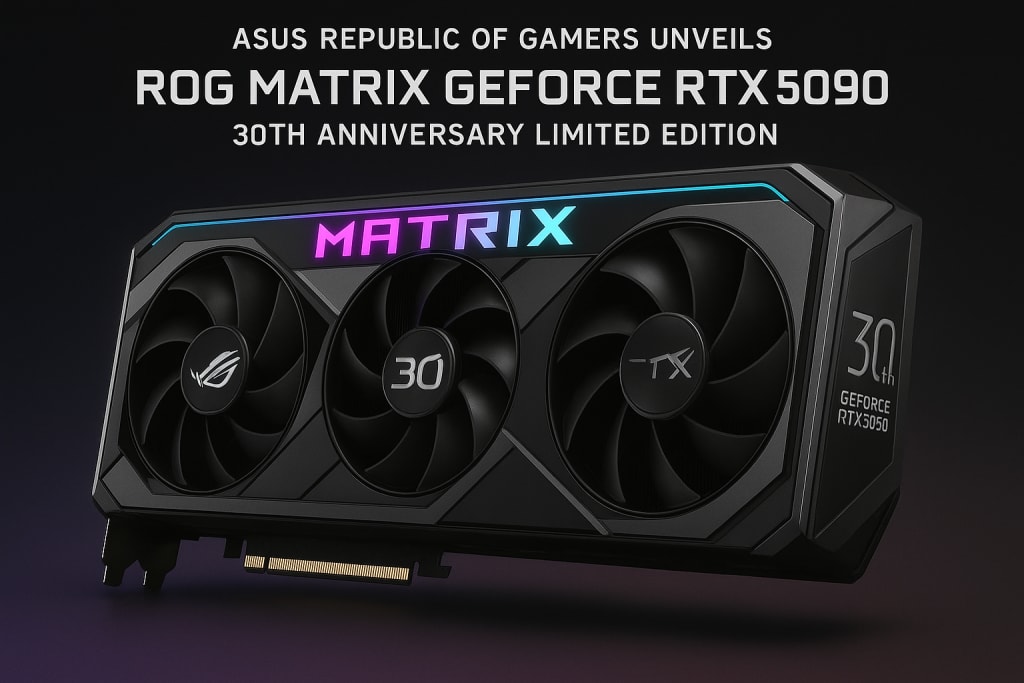
This memory comes rushing back every time I see a company launch a new piece of hardware, especially one that pushes the boundaries of what seems possible. This week, that feeling hit me like a freight train when I saw the announcement. It’s a mouthful, but it’s a landmark: the ASUS Republic of Gamers Unveils ROG Matrix GeForce RTX 5090 30th Anniversary Limited Edition.
Let’s be real for a second. For most of us, this card will be a distant dream, a piece of hardware porn we ogle in YouTube videos. It’s a limited edition halo product, meaning it’s built not for the masses, but to make a statement. To plant a flag on the summit of the technological mountain and scream, “This is what we can do!”
But looking past the price tag and the exclusivity, this thing is a story. It’s a love letter to thirty years of pushing pixels, to the community that cheered them on, and a fascinating glimpse into the future of where our machines are headed. Let's pull up a chair and talk about what this announcement actually means, not just for the lucky few who will own one, but for all of us who love this stuff.
More Than a Number: The Weight of 30 Years
An anniversary isn’t just a marketing date. For a company like ASUS ROG, born from the passion of gamers, it’s a moment to reflect. Thirty years ago, gaming on a PC was a niche, finicky hobby. You were often your own tech support, fiddling with IRQ conflicts and boot disks just to get a game to run.
ROG, the Republic of Gamers, emerged as a beacon for that crowd. They weren’t just selling parts; they were building gear for a tribe. This 30th Anniversary Limited Edition is the physical embodiment of that journey. It’s their victory lap. The press release mentions special branding, a unique design language that harks back to their legacy while screaming into the future. It’s a collector’s item, a piece of history. Think of it like a concept car at an auto show. You might not drive it home, but the technology in its curves and engine will trickle down to the models you can afford in a few years.
Under the Hood: Where Engineering Becomes Art
So, what makes this particular GeForce RTX 5090 so special? It’s not just that it’s using NVIDIA’s next-gen beast of a GPU (which, by all rumors, is going to be a monster). It’s what ASUS’s engineers have done to it. They’ve taken the blueprint and asked, “What if we tried to build the absolute perfect version of this?”
The answer, it seems, is liquid metal. And not just any liquid metal cooling.
The star of the show is what they’re calling the "Infinity Loop Cooling System." Now, most high-end cards use a mix of heat pipes and fans. Some enthusiasts like me go the whole hog and install custom water blocks that hook up to a massive radiator. It’s effective, but it’s a hassle. A tangled mess of tubes, pumps, and fittings that can turn your PC build into a weekend-long anxiety attack.
ASUS’s solution is breathtakingly elegant. They’ve built a fully self-contained, all-in-one liquid cooling system directly onto the graphics card itself. It’s not a separate accessory; it’s part of the card’s DNA. A perfect loop of coolant whisks heat away from the brain of the card to a radiator that’s seamlessly integrated into the shroud, where fans then exhaust it. It’s a closed ecosystem of cool.
But they didn’t stop there. They’re using liquid metal thermal compound. If you’ve ever built a PC, you know about thermal paste—that gray gunk you put between your CPU and its cooler to help heat transfer. Liquid metal is the high-stakes, high-reward version of that. It’s notoriously difficult to work with (it’s electrically conductive, so a single spill can fry your expensive hardware), but it transfers heat dramatically better than any paste.
ASUS is applying it at the factory, perfectly, taking that risk away from us. This isn’t just about achieving record-breaking overclocks for leaderboard bragging rights. It’s about silence and longevity. A cooler card doesn’t just perform better; its components degrade slower. It’s an investment in the machine’s soul. This kind of innovation, born from the relentless pursuit of perfection for a Limited Edition product, is what eventually leads to better cooling solutions for all their cards down the line.
A Story You Can Actually See: The Design Philosophy
This card isn’t just a slab of circuit board. The designers have woven the anniversary theme into its very shell. The press material talks about a "Fusion" design, melging sand-blasted aluminum with polished mirrors. It’s meant to represent the past and future colliding.
Imagine this thing mounted in your case. It’s not just a component; it’s a centerpiece. A conversation starter. It has a customizable AniMe Matrix LED display on the side—a signature ROG feature that lets you put animations, system stats, or even memes on the card itself. For a 30th Anniversary model, you can bet the pre-loaded animations will be a nod to three decades of gaming history. It’s a tiny, brilliant screen that turns the card’s own vanity into a functional, fun toy.
This touches on something vital in today’s tech world: the experience. We don’t just buy a tool; we buy an artifact. We want our devices to have personality, to reflect our own passion. This card has personality in spades.
But What Does It Actually Do? Beyond the Benchmarks
Let’s step out of the realm of specs and into our living rooms. Why does any of this matter to someone who will never own this specific card?
Imagine you’re a game developer, five years from now. You’re designing a vast, open world filled with incredibly complex AI, ray-traced lighting that behaves exactly like real light, and textures so detailed you can see the individual threads on a character’s jacket. You’re dreaming big because you know the hardware is coming to meet you. Flagship cards like this one are the target. They are the proof that the technology can not only exist but run in someone’s home. They pull the entire industry forward.
Or imagine you’re a digital artist or a video editor. That same raw power that renders a game’s frame can render a 3D animation or apply a complex filter to an 8K video timeline. What used to take hours can now take minutes. That’s not just convenience; that’s creative freedom. It removes the technical barrier between the idea in your head and the finished product on the screen.
For the average gamer, the trickle-down effect is the real prize. The cooling technology pioneered on the ROG Matrix GeForce RTX 5090 will eventually find its way into more affordable TUF Gaming or even dual-fan ROG Strix models. The relentless pursuit of a perfect power delivery system means more stable and efficient performance for cards across the stack. This halo product is the R&D lab for the components you and I will be able to buy next year.
The Human in the Machine
There’s an undeniable melancholy to a product like this. It’s a monument to excess in a world where many are struggling. It’s easy to look at it and see a symbol of a hobby becoming unaffordable, of a community being priced out.
I get that. I feel that tension too.
But I also choose to see it another way. I see the ASUS Republic of Gamers Unveils ROG Matrix GeForce RTX 5090 30th Anniversary Limited Edition not as a product for sale, but as a piece of art. It’s the Sistine Chapel ceiling of graphics cards. You don’t look at the ceiling and get angry that you can’t own it; you marvel at the fact that human beings could create something so magnificent.
This card is a testament to human passion, ingenuity, and the sheer, unadulterated joy of creating something extraordinary for the sake of it. It’s the culmination of thirty years of a company listening to its most hardcore fans—the overclockers, the modders, the dreamers—and saying, “You asked for the impossible. Here it is.”
It’s a reminder that the heart of gaming isn’t found in the silicon or the liquid metal. It’s found in that feeling I had as a teenager, staring at a newly transformed screen. It’s the wonder, the escape, the stories, and the community. This card, in all its glorious, impossible excess, is simply a tribute to that feeling. It’s a promise that the doors to new worlds are still opening, wider and more breathtakingly beautiful than ever before.
And that’s a promise worth celebrating.
About the Creator
John Arthor
seasoned researcher and AI specialist with a proven track record of success in natural language processing & machine learning. With a deep understanding of cutting-edge AI technologies.
Keep reading
More stories from John Arthor and writers in Lifehack and other communities.
I’ve Never Seen a GPU Quite Like This: A Story of Hope, Heart, and a Little Blue Card
I have a confession to make. I’m a creature of habit, especially when it comes to the tech I let into my life. For what feels like an eternity, building a gaming PC has been a binary choice, a ritual performed with the same two sacred texts: the red book and the green book. You know the ones. You pick a side, you swear allegiance, and you build your rig accordingly. It’s been this way for so long that the very idea of a third option felt less like a possibility and more like a fairy tale—a nice story, but not something you’d ever actually plan your build around.
By John Arthor5 months ago in Lifehack
Absolutely 100% Free Stuff With No Shipping Costs
In a world where everything seems to come with a price tag—including “free” offers that sneak in unexpected shipping fees—it can feel impossible to get truly free items. But with the right strategies, resources, and platforms, it is completely possible to score legitimate, 100% free stuff with no shipping costs or hidden charges. Whether you're looking to save money, reduce waste, or simply love the thrill of discovering freebies, this guide will walk you through the best ways to find authentic no-cost items online and in your local community.
By Master Binz5 days ago in Lifehack
Complete Guide to Wi-Fi Password Recovery & Protection
Understanding Wi-Fi Security Forgetting your Wi-Fi password is a common frustration in our connected world. This comprehensive guide explores legitimate methods to recover lost Wi-Fi credentials while emphasizing network security best practices. Whether you're a homeowner locked out of your network or an IT professional assisting users, this article provides ethical solutions while reinforcing the importance of protecting wireless networks from unauthorized access.
By Alexander Hoffmann3 days ago in Lifehack
Silver Screen Magic with Mae West
American actress and singer Mae West became a popular film actress during the Great Depression. She started entertaining in vaudeville, then performed on Broadway, and finally went to Hollywood. She signed up with Paramount Pictures and made her debut in the 1932 film “Night After Night.” She also starred in musicals, comedies, and crime dramas. The American Film Institute named her one of the best classic Hollywood actresses.
By Rasma Raisters5 days ago in Geeks


Comments
There are no comments for this story
Be the first to respond and start the conversation.