
I’ve Never Seen a GPU Quite Like This: A Story of Hope, Heart, and a Little Blue Card
I’m a creature of habit, especially when it comes to the tech I let into my life.

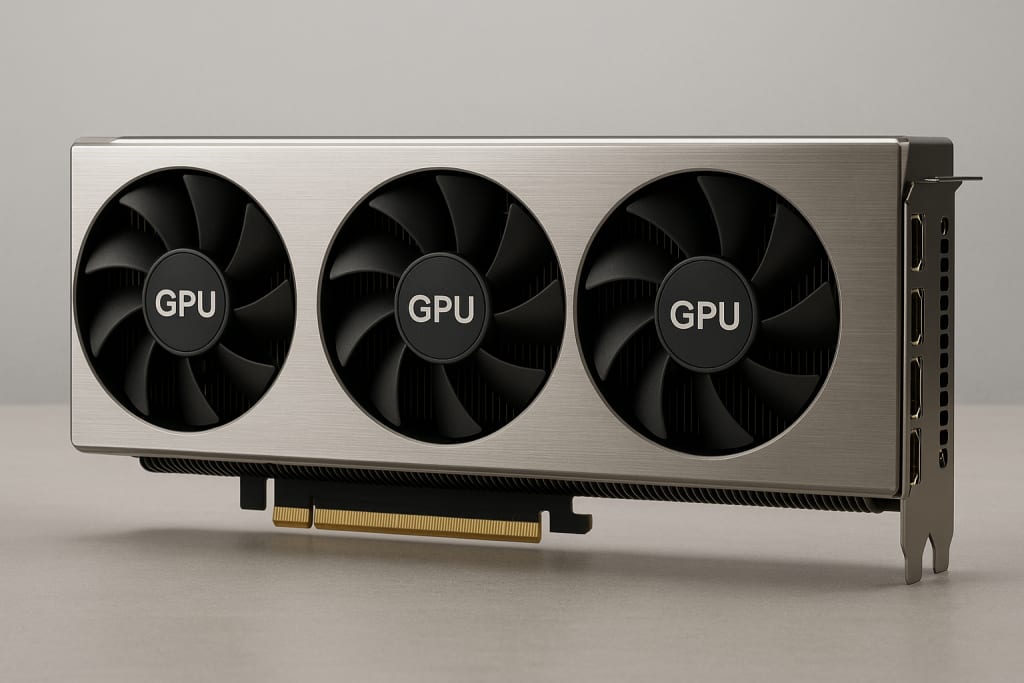
I have a confession to make. I’m a creature of habit, especially when it comes to the tech I let into my life. For what feels like an eternity, building a gaming PC has been a binary choice, a ritual performed with the same two sacred texts: the red book and the green book. You know the ones. You pick a side, you swear allegiance, and you build your rig accordingly. It’s been this way for so long that the very idea of a third option felt less like a possibility and more like a fairy tale—a nice story, but not something you’d ever actually plan your build around.
Then, something shifted. A new storyteller entered the room, one with a deep, familiar voice but a completely new tale to tell about graphics cards. And after spending some real, meaningful time with it, I can tell you, with all the sincerity I can muster: I’ve never seen a GPU quite like this.
This isn’t just another review about frame rates and thermal throttling. This is a story about what happens when a giant decides to play a different game entirely. This is about Intel’s Arc, and specifically, their latest endeavor. It’s a story that feels less like a corporate product launch and more like a passionate project from a team that genuinely wants to shake things up. And honestly? The tech world desperately needs it.
The Two-Headed Giant and the Wide-Eyed Newcomer
Let’s rewind a little. For decades, the GPU (Graphics Processing Unit) landscape has been a duel. On one side, you had the relentless, performance-obsessed gladiator, Nvidia. On the other, the value-driven, scrappy challenger, AMD. Their battle has given us incredible innovation, but it has also created a certain… predictability. Every generation, the conversation is the same: who has the crown for the absolute fastest card? Who has the best price-to-performance ratio in the mid-range? It’s a spec sheet arms race, and we, the consumers, are often just the spectators, our wallets trembling at the outcome.
Then, Intel knocked on the door. Not as a curious neighbor, but as a titan of industry with decades of experience in making the brains of computers, now wanting to build its own muscles. Their first foray, the Arc A-series, was… rocky. It was the classic story of a brilliant mind trying to learn a new language. The hardware had potential, but the software—the drivers, the magic that tells the hardware how to talk to your games—was stumbling over its words. Early adopters faced issues. Some games ran beautifully; others were a mess. It was a beta test masquerading as a final product, and many wrote Intel off immediately.
But here’s the thing about giants: they can afford to be patient. They can learn. And that’s where our story takes a turn. Instead of pulling the plug, Intel’s team dug in. They listened, they learned, and they poured an astonishing amount of effort into that software. Driver update after driver update rolled out, not just with bug fixes, but with monumental performance gains. Games that ran poorly at launch were suddenly running smoothly. It was one of the most impressive post-launch turnarounds I’ve ever witnessed in tech. It showed a level of commitment and humility you don’t often see.
This sets the stage for their latest act. While everyone was waiting for the next chapter in the red vs. green saga, Intel was quietly writing a whole different book.
More Than Just Silicon: The Soul of the Machine
So, what makes this new GPU so different? It’s not necessarily about it having the highest number on a benchmark chart (though its performance is genuinely impressive for its class). It’s about the philosophy baked into its very core. I’ve never seen a GPU quite like this because it feels like it was designed by people who actually use PCs, not just people who build them in a sterile lab.
Let’s talk about something mundane but magical: the video.
For most hardcore gamers, video encoding is an afterthought. It’s a checkbox on a spec sheet. “AV1 encode? Yeah, sure, that’s nice.” But for anyone who has ever tried to stream a game to Twitch, record a high-quality clip for YouTube, or even just edit a family vacation video, it’s everything. Video files are enormous, and compressing them without them looking like a pixelated mess has always required either a ton of computing power or dedicated hardware.
Nvidia’s NVENC encoder has been the gold standard for years. It’s fantastic. AMD has been playing catch-up. But Intel? They looked at the problem and decided to not just meet the standard, but to redefine it for the next generation. They built an AV1 encoder right into the heart of their Arc GPUs.
AV1 isn’t just incremental improvement; it’s a generational leap. It’s a new, open-source video format that delivers shockingly high quality at much smaller file sizes. Think of it like this: if the old H.264 format was a standard garden hose, and the newer HEVC was a slightly more efficient hose, AV1 is a pressure washer that does a better job with half the water.
Having this hardware dedicated on a consumer-level GPU is a game-changer. It means a streamer can broadcast a higher-quality image without needing a monstrous internet upload speed. It means a video editor can export files in half the time, or with much smaller sizes for easier sharing, without any loss in clarity. Intel didn’t just include this tech to check a box; they made it a centerpiece. They’re empowering creators in a way that feels genuinely thoughtful. It’s a feature built not for winning synthetic benchmarks, but for improving real-world workflows. And that ethos permeates the entire card.
A Conversation, Not a Monologue
This different approach extends to how the card communicates with you. I’ve spent countless hours tweaking settings in other GPU control panels. They’re often clunky, technical, and intimidating—a maze of sliders and jargon that assumes you have a degree in computer engineering.
Intel’s Arc Control software is the opposite. I’ve never seen a GPU interface quite like this. It feels modern, intuitive, and, dare I say, friendly. It’s a single, clean overlay that gives you everything you need: performance metrics, driver updates, game libraries, and even built-in streaming tools. It’s not an obligation; it’s a useful dashboard. It feels like the software team and the hardware team were actually talking to each other, with the shared goal of making the user’s experience better, not just making the numbers look good on a chart.
This might sound like a small thing, but it’s profoundly important. It lowers the barrier to entry. It makes PC gaming and content creation feel more accessible. It acknowledges that not everyone who buys a GPU is an expert overclocker; some people just want things to work well and look good with a minimal amount of fuss.
The Ripple Effect: Why This Matters for Everyone
You might be reading this and thinking, “That’s cool, but I’m a hardcore gamer. I just want the most frames per second for my dollar. Why should I care?”
This is why: healthy competition is the tide that lifts all boats. For years, the duel at the top meant that the best innovation was often reserved for the most expensive, halo products. The mid-range and budget segments frequently got hand-me-downs—older architectures rebranded and sold as new.
Intel’s genuine entry as a third contender changes the entire calculus. They are competing aggressively on price, offering features like AV1 encoding that were previously unavailable in these price brackets. This forces the other two to respond. It forces them to innovate faster, to offer more value, to lower their prices. When there are three players fighting for your attention, you win. Every single time.
This GPU isn’t just a product; it’s a statement. It’s a declaration that there is room for a different philosophy—one that values the entire user experience, from the moment you unbox the card to the moment you finish editing your video or finally hit that winning shot in your game, and everything in between.
A Personal Reflection in a Digital World
I remember building my first PC. It was equal parts exhilarating and terrifying. I was so worried about buying the “wrong” part, about making a costly mistake in a world that felt governed by opaque rules and fierce brand loyalties. The landscape today feels similar, but with a new, exciting variable.
Seeing a company like Intel pour so much heart into a product category that has been dominated by two giants is incredibly refreshing. It’s a reminder that innovation isn’t always about being the biggest, the fastest, or the most powerful. Sometimes, it’s about being the smartest, the most thoughtful, or the most accessible. It’s about looking at the same problem everyone else is trying to solve and asking a completely different question.
Instead of just asking, “How do we make this game run faster?” they also asked, “How do we make your stream look better? How do we make your creative projects finish quicker? How do we make the software a pleasure to use?”
That’s the heart of it. That’s why I keep coming back to that thought: I’ve never seen a GPU quite like this. It feels like it has a personality. It has a point of view. It’s not just a component; it’s an advocate for the user.
The Takeaway: What Does This Mean For You?
So, where does this leave us? Should you run out and buy one right now? Maybe, maybe not. The right GPU for you depends entirely on your needs, your budget, and your games.
But here’s the actionable takeaway, the thought I want to leave you with: Look beyond the throne.
For the next generation of PC builders, gamers, and creators, the most exciting developments might not be happening at the very top of the mountain, where the two kings are dueling. The real revolution, the one that will genuinely change your daily experience, might be happening on the slopes below. It’s in the thoughtful, feature-packed, and aggressively priced offerings from the newcomer who is trying harder than anyone else to earn your trust.
The next time you’re considering an upgrade, don’t just ask which card is the absolute fastest. Ask which card offers the best overall experience. Which one gives you features you’ll actually use? Which one respects your time and your intelligence with great software? Which one feels like it was built for you?
Look for the one that does something different. Look for the one that makes you pause, tilt your head, and say, “Huh. I’ve never seen a GPU quite like this.”
Because that feeling? That’s the sound of the future knocking. And it’s a future where we all have more choice, better value, and more innovative tools to play and create with. And that’s a future worth getting excited about.
About the Creator
John Arthor
seasoned researcher and AI specialist with a proven track record of success in natural language processing & machine learning. With a deep understanding of cutting-edge AI technologies.
Keep reading
More stories from John Arthor and writers in Lifehack and other communities.
More Than Just Trailers: The Heartbeat of Hype at gamescom Opening Night Live 2025
You know that feeling? The one you get around the holidays, where the air is practically buzzing with anticipation? That’s what my living room felt like last night. The snacks were strategically placed, the controller was charging for a late-night reaction session, and my phone was buzzing non-stop in a group chat with friends scattered across the country. We were all tuned into the same digital campfire: gamescom Opening Night Live 2025: Everything Announced (Updating Live).
By John Arthor5 months ago in Lifehack
The Burnout Generation: Why I’m Rejecting Hustle Culture for My Mental Health
I used to believe that grinding—24/7, no breaks, no excuses—was the only way to succeed. Coffee in one hand, deadlines in the other, my brain constantly buzzing, my chest tight, my mind refusing to rest.
By Anie Liban6 days ago in Lifehack



Comments
There are no comments for this story
Be the first to respond and start the conversation.