
The Art of Time Management: A Key to a Balanced Life
In today’s fast-paced world, where distractions are just a click away and responsibilities seem endless, effective time management has become more than just a desirable skill—it is a necessity

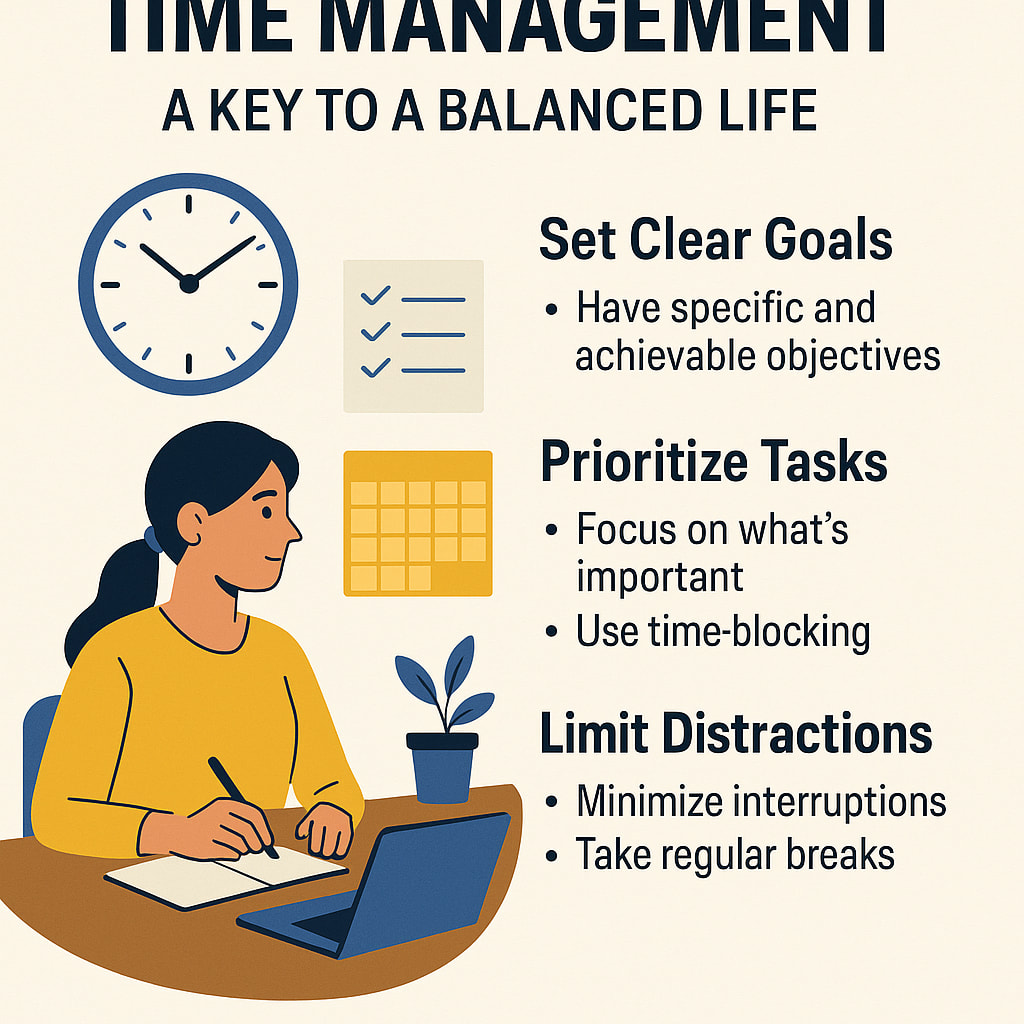
In today’s fast-paced world, where distractions are just a click away and responsibilities seem endless, effective time management has become more than just a desirable skill—it is a necessity. Whether you are a student juggling studies and part-time work, a professional managing deadlines, or a homemaker trying to maintain household harmony, time management can significantly improve the quality of your daily life.
Why Time Management Matters
Time is a finite resource. There are 24 hours in a day for each of us, regardless of who we are or where we live. The difference lies in how we use them. Poor time management leads to stress, missed deadlines, and burnout, while good time management results in increased productivity, better work-life balance, and improved mental well-being.
When you learn how to manage your time well, you can:
Get more done in less time. Reduce stress and anxiety
Improve focus and decision-making
Have more free time for personal growth and relationships
Common Time-Wasting Habits
Many people don’t realize how much time they waste on activities that don’t add value to their lives. Here are some of the most common time-wasting habits:
Scrolling social media for hours
Constantly checking emails or messages
Watching TV or binge-watching shows without limits
Procrastinating on important tasks
Multitasking ineffectively
The first step toward improving your daily routine is recognizing these behaviors. Strategies for Managing Your Time Well 1. Set Clear Goals
Begin by setting specific, measurable, achievable, relevant, and time-bound (SMART) goals. Whether it’s finishing an assignment, exercising regularly, or learning a new skill, having clear goals gives you direction and motivation.
2. Make tasks a priority. Not all tasks are created equal. Using the Eisenhower Matrix, classify your responsibilities into four groups: Important and urgent Important but not urgent
Urgent but not important
Neither urgent nor important
Prioritize tasks that are both important and urgent. 3. Create a Daily Schedule
Plan your day in advance. Schedule specific time slots for your tasks and incorporate brief breaks during those times. You can use digital tools like Google Calendar or traditional planners to keep track.
4. Avoid Multitasking
While multitasking may seem productive, it often leads to lower quality work and mental fatigue. Better outcomes can be achieved by concentrating on a single task at a time. 5. Use Time-Blocking
This method involves dividing your day into blocks of time, each dedicated to a specific task or group of tasks. For example, you might block 9–11 AM for studying and 3–4 PM for exercise.
6. Learn to Say No
Don’t feel obligated to say yes to every request or invitation. Respect your time and energy. It's okay to decline something if it doesn't fit with your priorities. 7. Limit Distractions
Turn off unnecessary notifications, keep your phone away during work hours, and create a clutter-free workspace. A quiet and organized environment enhances concentration.
8. Take pauses Breaks help you stay refreshed and maintain productivity throughout the day. Try the Pomodoro Technique: work for 25 minutes, then take a 5-minute break. You should take a longer break after four cycles. 9. Review and Reflect
At the end of each day or week, review what you’ve accomplished. Reflect on what worked, what didn’t, and how you can improve your routine.
Beyond Productivity: Benefits Time management isn’t just about doing more; it’s about doing what matters most. With proper time management:
You gain a sense of control over your life.
You find time for hobbies and relaxation.
Your relationships improve because you're more present and less stressed.
You learn to be disciplined, which helps you succeed in school, at work, and in your personal development. Conclusion
Mastering the art of time management can transform your life. It empowers you to achieve your goals, reduce stress, and make time for what truly matters. It doesn’t require perfection, only consistency and awareness. Make a simple plan for your day, stay away from known distractions, and start small. Keep improving your methods. In the end, time well managed is life well lived.
About the Creator
Sabrina
A curious soul weaving words across emotions, ideas, and the world around us. Her writing seeks meaning in the everyday and beauty in the untold.
Waiting for Peach Blossoms
Hook Introduction Every year I sit in the doorway and watch the peach trees like they’re telling me a secret. The buds swell, the branches twist against the sky, and I catch myself doing the same thing I always do—waiting for peach blossoms and pretending I’m only interested in the flowers.
By abualyaanart3 days ago in Lifehack
How to Recover a Yahoo Account: The Ultimate Step-by-Step Guide for 2026
Losing access to your Yahoo account can feel like losing a digital key to your personal and professional life. With a history that includes some of the largest data breaches globally, securing and knowing how to recover your account is more critical than ever. Whether you’ve been locked out due to a forgotten password, a hacked account, or an old, inactive email address, this comprehensive guide walks you through every official method to regain access. We will cover explicit recovery techniques, essential protection strategies to prevent future lockouts, and answer the most frequently asked questions, all based on professional insights.
By Alexander Hoffmann3 days ago in Lifehack




Comments (1)
Hello, just wanna let you know that according to Vocal's Community Guidelines, we have to choose the AI-Generated tag before publishing when we use AI 😊