
Waiting for Peach Blossoms
Learning to See Beyond the Flowers

Hook Introduction
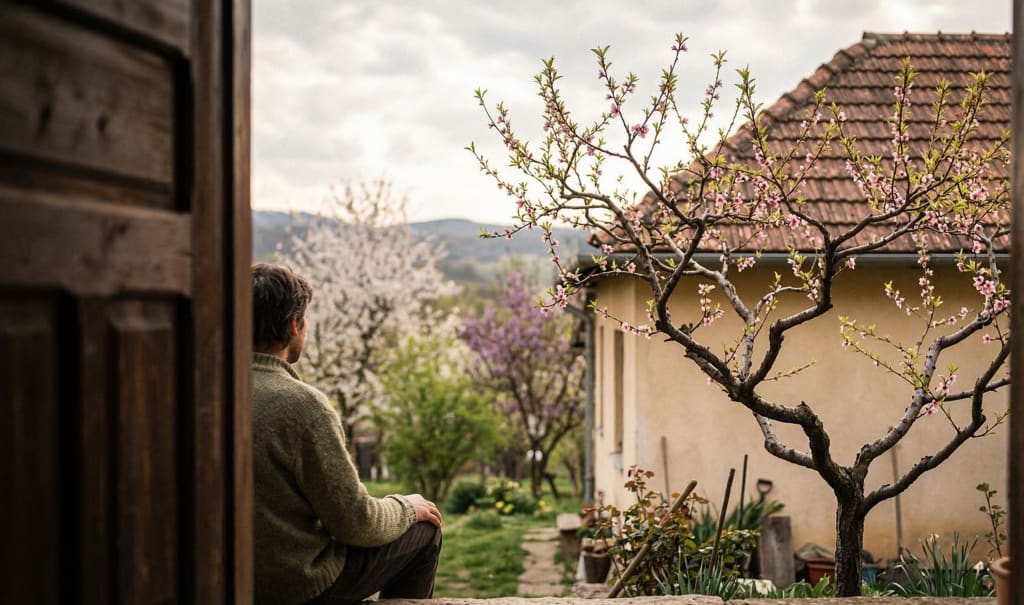
Every year I sit in the doorway and watch the peach trees like they’re telling me a secret. The buds swell, the branches twist against the sky, and I catch myself doing the same thing I always do—waiting for peach blossoms and pretending I’m only interested in the flowers.
But I’m not really waiting for petals. I’m waiting for late summer. For sticky hands and juice on my wrists and last year’s peach jam on toast. The blossoms are just the opening act, and once I realized that, the whole tree started to feel different to me.
I used to think blossoms were the point—the big show, the reason people wrote poems and took photos. Now I’m not so sure. Watching these peach trees has made me see how often we fall in love with appearances and forget the quiet work happening underneath.
How Peach Blossoms Look Plain but Change Everything
The buds arrive first, small and fuzzy, a soft pale green that barely catches your eye. They play off the red-tiled roof outside my doorway, each tiny bump a quiet promise. The branches twist into their own kind of choreography—contorting, angling, reaching—and still, nothing showy happens.
Then the flowers open. And this is where the peach tree refuses to behave. These blossoms aren’t the delicate, blushing stars you see on apple trees, with their soft, blurred petals that look like they’re made of watercolor.
They’re also not like apricot blossoms—those pale pink-white specks that cling to thin branches for a moment, then fall like confetti across the garden.
Or the plum flowers, throwing themselves into the season with full enthusiasm. Or the pear blossoms, whose sharp scent used to drive me back indoors as a kid. Or the dramatic cherry trees, all pink fireworks and photographs, or the double almond blossoms drooping like heavy earrings.
Peach blossoms, compared to all that, are almost stubbornly plain.
The “Ugly Duckling” Flower That Refuses to Impress
Up close, a peach blossom is hard and small. The pink is sharp-edged rather than soft. The petals don’t yield in that romantic, dreamy way. The leaves push out early, almost impatient and practical. The whole thing feels like it has somewhere to be.
It’s not the flower people write sonnets about. Standing in the doorway, I’ve caught myself thinking:
It’s unremarkable next to the cherries and plums.
It doesn’t float down like snow or perfume the entire yard.
It doesn’t demand attention—at all.
An ugly duckling among flowers. A worker, not a dreamer.
And I’ll be honest: for years I barely noticed it. While I was busy raving about other trees, this one was just quietly doing its job. It bothered me a little once I realized that. How many other “peach blossom moments” have I dismissed in my life because they didn’t look impressive at first glance?
That question has stayed with me longer than any petal ever has.
Waiting for the Fruit: Where the Real Magic Happens
The thing about a peach tree is that its beauty arrives out of sequence. You only understand the blossoms months later, when the fruit drops with a dull, satisfying thud on late summer afternoons.
By then, the showy cherries are long gone. The apricot confetti has blown away. The pear scent is just a memory. And the modest little peach has turned into something you can actually hold.
I think about that as I picture the fruit again:
Round and heavy in your hand
Yellow-orange flesh that gives way under your thumb
Red, stringy veins that cling stubbornly to the pit
Fuzz that glows golden-yellow with burnished red patches
Sometimes there’s still a hint of green, that last bit of resistance, before it finally softens and says, "Fine, I’m ready."
By late August or early September, on a good year, the peaches are so ripe they fall at the slightest breeze. The sound is quiet but strangely satisfying—small thuds across the garden. Bees gather around the fallen fruit, drunk on sugar, humming like they’ve got nowhere else to be. The scent doesn’t just hang in the air; it settles into it.
And that’s when the earlier plainness makes sense. The blossoms weren’t there to impress me. They were there to do a job.
I keep thinking about how easy it is to judge something at the “blossom stage.” A project, a habit, a relationship, even yourself. It doesn’t look special yet, so you assume it never will. But peach blossoms don’t owe us drama. They owe the tree fruit. And they deliver.
I’m still not sure I always know which parts of my own life are blossoms and which are fruit. It’s messier than that, obviously. But watching these trees each year has made me a little slower to dismiss the quiet, unremarkable beginnings—the ones that don’t photograph well and don’t impress anyone on social media.
So I sit in the doorway again, waiting for peach blossoms. Pretending I’m just watching the branches. Knowing I’m really waiting for the thud of fruit on warm soil months from now—and trying, very slowly, to respect the small, practical flowers that make that possible.
Conclusion
The frost might still return and wipe out the blossoms in a single cold night. It’s happened before. All that careful work undone, at least for a season.
But that risk is part of why I keep watching. The tree doesn’t hold back just because the weather might turn. It blooms anyway, plain and sturdy, doing what it’s meant to do.
There’s something stubbornly honest about that. And I’m starting to think that learning to appreciate peach blossoms—to really see them, not just endure them until the fruit arrives—is its own kind of practice in patience, trust, and quiet respect for work that doesn’t look beautiful yet.
About the Creator
abualyaanart
I write thoughtful, experience-driven stories about technology, digital life, and how modern tools quietly shape the way we think, work, and live.
I believe good technology should support life
Abualyaanart
Keep reading
More stories from abualyaanart and writers in Lifehack and other communities.
Boulder: Where Mountains Shape the Rhythm of Everyday Life
At the edge of the Rocky Mountains lies a city where the natural world is never far away. Boulder sits beneath dramatic sandstone formations known as the Flatirons, and their presence defines nearly everything about life here.
By House Doctor7 days ago in Lifehack
Soft Rugs for Bedroom Creating a Cozy and Comfortable Space
Every element in the room should contribute to a calm and inviting atmosphere. One of the easiest ways to enhance both comfort and style in a bedroom is by adding a soft rug. Soft rugs for bedroom spaces not only improve the appearance of the room but also create a warm and comfortable surface that makes daily routines more pleasant.
By Nandini Shukla5 days ago in Lifehack
Lycan Lore
As the students of my 10am mythology class take their seats, I decide to steer the day's curriculum away from Greek and dive into a Western European discourse on the misaligned beliefs of the Werewolf. A tale of truth or fiction. No one really knows.
By Lamar Wigginsabout 4 hours ago in Fiction




Comments
There are no comments for this story
Be the first to respond and start the conversation.