Latest Stories
Most recently published stories on Vocal.
Europe Draws a Red Line on Greenland After a Year of Trying to Pacify Trump. AI-Generated.
For nearly a year, European leaders walked a diplomatic tightrope. They tried calm language, quiet reassurance, and strategic patience as former U.S. President Donald Trump repeatedly revived his controversial interest in Greenland. What began as provocative rhetoric gradually evolved into something Europe could no longer ignore. Now, after months of behind-the-scenes diplomacy, Europe has drawn a clear red line on Greenland — signaling that compromise has its limits when sovereignty and regional security are at stake. This shift marks more than a response to one leader’s remarks. It reflects Europe’s growing determination to defend territorial integrity, manage Arctic competition, and assert strategic autonomy in an increasingly unpredictable geopolitical environment. How Greenland Became a Flashpoint Again Greenland, an autonomous territory within the Kingdom of Denmark, has long held strategic importance. Rich in rare earth minerals, located along key Arctic routes, and home to critical U.S. military infrastructure, the island sits at the crossroads of security, climate change, and great-power rivalry. Donald Trump’s original proposal in 2019 to “buy” Greenland was widely mocked in Europe. But as his political influence resurged, so did concerns that his renewed interest was not just symbolic. Over the past year, Trump’s rhetoric — framed around U.S. security, resource access, and countering China and Russia in the Arctic — became more persistent. European capitals initially chose restraint. Officials hoped that de-escalation, quiet diplomacy, and alliance solidarity would prevent the issue from spiraling into a transatlantic rift. A Year of European Pacification For much of the past year, Europe adopted a strategy of pacification rather than confrontation. Denmark emphasized its close defense cooperation with Washington. EU leaders reiterated NATO unity and the importance of Arctic stability. Diplomats avoided public criticism, choosing private channels instead. The goal was clear: prevent Trump’s Greenland narrative from becoming official U.S. policy while preserving transatlantic relations. However, this approach had limits. As Trump’s language grew sharper — hinting at leverage, pressure, or “strategic necessity” — European patience began to erode. What once sounded like political theater increasingly resembled a challenge to European sovereignty norms. Why Europe Finally Drew the Line Europe’s tougher stance did not emerge overnight. It was driven by several converging realities. 1. Sovereignty Is Non-Negotiable At the heart of Europe’s response is a firm principle: territorial sovereignty cannot be bargained away. Greenland is not a commodity, and its future cannot be dictated by external powers — regardless of alliance ties. European leaders made it clear that any attempt to apply pressure on Denmark or Greenland would cross a red line, undermining international law and democratic self-determination. 2. Arctic Competition Is Intensifying The Arctic is no longer a frozen backwater. Melting ice has opened new shipping routes and intensified competition over resources. Russia has militarized large parts of its Arctic territory, while China has declared itself a “near-Arctic state.” Against this backdrop, Europe fears that normalizing aggressive rhetoric over Greenland could set a dangerous precedent, encouraging other powers to challenge borders under the guise of security or economic necessity. 3. Europe’s Strategic Confidence Has Grown Compared to 2019, Europe today is less willing to absorb geopolitical shocks quietly. The war in Ukraine accelerated Europe’s defense integration and sharpened its sense of strategic responsibility. Standing firm on Greenland is part of a broader shift: Europe is signaling that being a U.S. ally does not mean surrendering political agency. Greenland’s Own Voice Matters One crucial difference between past debates and today is the prominence of Greenlandic leaders themselves. Officials in Nuuk have repeatedly emphasized that Greenland’s future will be decided by its people, not by foreign capitals. Calls for respect, partnership, and economic development — rather than transactional geopolitics — have resonated strongly in Europe. By drawing a red line, European leaders are also amplifying Greenland’s right to self-determination, reinforcing the idea that Arctic communities are stakeholders, not strategic prizes. What This Means for Transatlantic Relations Europe’s firmer stance does not signal a break with the United States. NATO cooperation in the Arctic remains strong, and U.S. military presence in Greenland continues with Danish consent. However, the message is unmistakable: allies must respect boundaries. European officials are increasingly willing to publicly disagree with Washington when core principles are threatened. This reflects a maturing alliance — one where unity does not require silence. In the long run, this clarity may actually strengthen transatlantic relations, reducing ambiguity and preventing future misunderstandings. A Signal Beyond Greenland Europe’s red line on Greenland sends a message far beyond the Arctic. It signals to Russia and China that Europe will defend its territorial order, even under pressure from powerful actors. It reassures smaller states that sovereignty remains a foundational norm. And it underscores that Europe is learning to balance diplomacy with firmness in an era of great-power competition. Conclusion: From Pacification to Principle After a year of cautious diplomacy, Europe has chosen principle over placation. The red line drawn around Greenland is not an act of hostility — it is an assertion of values. In a world where power politics are returning, Europe is making one thing clear: sovereignty is not negotiable, alliances are not blank checks, and Arctic stability requires respect — not rhetoric. Greenland may be vast and sparsely populated, but the message Europe is sending from its icy shores is unmistakably global.
By Muhammad Hassan18 days ago in Earth
"The Eye" Trailer – Bollywood Star Shruti Haasan Channels ‘Pet Sematary’ in Supernatural Thriller
Death isn’t always the end of the story in the trailer The Eye. Not to be confused with the Asian horror favorite of the same name (or its Jessica Alba-starring American remake), this British film looks like a new twist on the Pet Sematary mythos.
By Dena Falken Esq18 days ago in Geeks
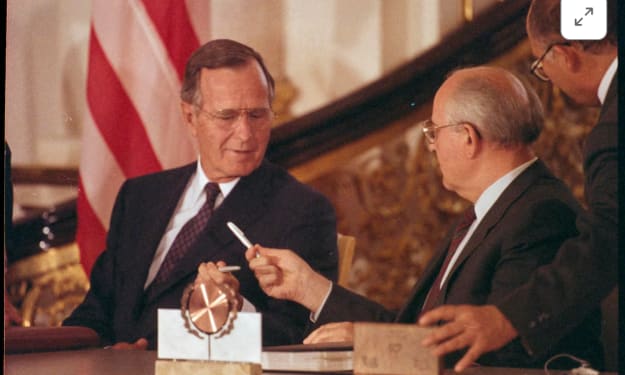
The Last Russia-US Nuclear Treaty Is About to Expire: What Happens Next. AI-Generated.
As the world moves closer to February 5, 2026, a major pillar of global security is quietly approaching its end. The New Strategic Arms Reduction Treaty (New START) — the last remaining nuclear arms control agreement between the United States and Russia — is set to expire. Its potential collapse marks a turning point not just for the two nuclear superpowers, but for the entire international system. For decades, nuclear treaties helped prevent unchecked arms races and reduced the risk of catastrophic conflict. With New START hanging by a thread, many are asking a critical question: what happens when the last safety net disappears? What Is New START and Why Does It Matter? New START was signed in 2010 and came into force in 2011. It placed legally binding limits on the strategic nuclear arsenals of the United States and Russia — the two countries that together possess nearly 90 percent of the world’s nuclear weapons. Under the treaty, each side agreed to limit itself to: 1,550 deployed nuclear warheads 700 deployed delivery systems, such as intercontinental ballistic missiles (ICBMs), submarine-launched ballistic missiles (SLBMs), and strategic bombers But New START was not just about numbers. Its real strength lay in transparency and verification. Regular data exchanges, on-site inspections, and notifications ensured both sides knew what the other was doing. This reduced suspicion, prevented misunderstandings, and lowered the risk of accidental escalation during times of tension. In an era marked by distrust, New START functioned as a stabilizing force. Why Is the Treaty in Trouble Now? The geopolitical environment that allowed New START to exist has drastically changed. Relations between Washington and Moscow are at one of their lowest points since the Cold War. Several factors have pushed arms control to the sidelines: The war in Ukraine has shattered diplomatic trust between Russia and the West. Russia suspended participation in treaty inspections, claiming security concerns and political pressure. The United States insists that meaningful arms control requires full compliance and verification. Broader disagreements over NATO, sanctions, and global influence have poisoned the negotiating atmosphere. Although both countries have occasionally signaled interest in restraint, no formal talks on a successor treaty have made meaningful progress. Why Hasn’t a New Treaty Been Negotiated? Arms control negotiations are complex even in good times. In today’s environment, they are especially difficult. Russia has argued that any future agreement must include other nuclear powers, particularly the United Kingdom and France. The U.S. rejects this, stating that it cannot negotiate limits on behalf of its allies. Meanwhile, China has refused to join trilateral talks, pointing out that its nuclear arsenal is far smaller than those of the U.S. and Russia. Beijing argues that expecting equal limits is unfair and strategically unrealistic. As a result, the world is facing a rare and dangerous moment: the possible end of all legally binding nuclear limits between the two largest nuclear powers. What Happens If New START Expires? If the treaty expires without extension or replacement, the immediate effects may not be visible — but the long-term consequences could be profound. 1. No Legal Constraints on Nuclear Weapons For the first time in over 50 years, there would be no binding limits on U.S. and Russian strategic nuclear arsenals. While neither side is expected to instantly build thousands of new warheads, the absence of rules opens the door to future expansion. This creates a strategic environment driven more by worst-case assumptions than mutual restraint. 2. Increased Risk of Miscalculation Without inspections and data sharing, uncertainty grows. When countries lack reliable information about each other’s capabilities, they tend to assume the worst. In times of crisis, this uncertainty can be deadly. History shows that misunderstandings — not intentions — often trigger conflict. 3. Damage to Global Non-Proliferation Efforts The collapse of New START would weaken the credibility of the Nuclear Non-Proliferation Treaty (NPT). Non-nuclear states may question why they should uphold their commitments if nuclear powers abandon restraint. This could encourage other countries to pursue nuclear capabilities, increasing global instability. 4. A New Arms Race Even without immediate buildup, the absence of limits could gradually lead to a new nuclear arms race — one driven by emerging technologies such as hypersonic missiles, advanced missile defenses, and space-based systems. Unlike the Cold War, this arms race would unfold in a multipolar world, making it even harder to control. Is There Any Hope for an Extension? There is still a narrow window for action. Russia has floated the idea of temporarily adhering to New START limits, provided the United States does the same. This would not be a full extension but could prevent immediate deterioration. Such a move would buy time — time for diplomacy, trust-building, and perhaps the groundwork for a future agreement. However, temporary measures are fragile and lack the enforceability of a formal treaty. What Comes After New START? If New START ends, the world enters uncharted nuclear territory. Future arms control may look very different from the treaties of the past. Instead of comprehensive agreements, we may see: Informal political commitments Partial or regional agreements Confidence-building measures without legal force While these alternatives are better than nothing, they lack the strength and reliability of binding treaties. A Defining Moment for Global Security The expiration of the last Russia-US nuclear treaty is more than a technical event. It is a symbol of a world moving away from cooperation and toward strategic rivalry. Whether this moment becomes the start of a dangerous new arms race — or a catalyst for reinventing arms control — depends on political will. History shows that dialogue is possible even in times of deep hostility. The question now is simple, yet urgent: Will the world choose restraint — or risk repeating the most dangerous mistakes of the past?
By Muhammad Hassan18 days ago in The Swamp
Australia Food Service Pasta Market: Menu Versatility, Dining-Out Culture & Cost-Effective Comfort Food. AI-Generated.
In 2024, Australia food service pasta market reached USD 60.0 Million in 2024. Looking ahead, the market is expected to grow steadily to USD 99.2 Million by 2033, exhibiting a compound annual growth rate (CAGR) of 5.32% during 2025–2033.
By Kevin Cooper18 days ago in Filthy
Philippines CT Scanners Market: Diagnostic Imaging Growth, Healthcare Modernisation & Technology Adoption. AI-Generated.
Philippines CT Scanners Market Overview The Philippines CT scanners market is experiencing strong growth as healthcare systems modernise, diagnostic imaging awareness increases, and technological advancements improve clinical outcomes. Computed Tomography (CT) scanners — essential radiology equipment that provides detailed cross-sectional images for disease diagnosis, trauma evaluation and treatment planning — are increasingly utilised across hospitals, diagnostic centres and specialty clinics nationwide. The Philippines CT scanners market size reached USD 196.65 Million in 2025. The market is projected to reach USD 355.98 Million by 2034, growing at a CAGR of 6.82% during 2026-2034. This expansion reflects rising healthcare demand, increased investment in medical infrastructure, and broader adoption of advanced imaging modalities that support early detection, personalised care and improved clinical workflows.
By Manisha Dixit18 days ago in Trader
Best Platforms to Outsource 2D Animation Services for Businesses. AI-Generated.
In today’s content-driven economy, 2D Animation has become one of the most effective ways for businesses to communicate ideas, explain products, and build emotional connections with their audience. From explainer videos and marketing campaigns to training content and social media storytelling, animated visuals consistently outperform static formats.
By Leo Johnson18 days ago in Writers
Japan Molecular Imaging Market Size & Forecast 2025–2033. AI-Generated.
Japan Molecular Imaging Market Overview The Japan Molecular Imaging Market is entering a phase of steady and technology-driven expansion, supported by demographic shifts, clinical innovation, and the nation’s strong commitment to precision medicine. According to Renub Research, the market reached US$ 366.82 million in 2024 and is projected to grow to US$ 523.91 million by 2033, registering a Compound Annual Growth Rate (CAGR) of 4.04% during 2025–2033.
By Marthan Sir18 days ago in Longevity
Philippines Agricultural Machinery Market: Mechanisation, Productivity & Sustainable Farming. AI-Generated.
Philippines Agricultural Machinery Market The Philippines agricultural machinery market is experiencing robust growth as farmers, agribusinesses and government stakeholders increasingly turn to mechanisation to boost productivity, reduce labour constraints and improve farm profitability. Agricultural machinery — including tractors, harvesters, planters, tillers, threshers, transplanters and irrigation equipment — plays a crucial role in modernising farming practices, enhancing operational efficiency and supporting food security objectives. The Philippines agricultural machinery market size reached USD 4,195.84 Million in 2025. The market is projected to reach USD 6,451.33 Million by 2034, growing at a CAGR of 4.90% during 2026-2034. This expansion underscores ongoing efforts to transform the country’s agriculture sector, increase mechanised cultivation and respond to evolving farm management needs.
By Manisha Dixit18 days ago in Trader