
Will Mild Hybrids Survive the EV Revolution? Impact on Europe Mild Hybrid Vehicles Market Growth
The European Union’s upcoming Euro 7 emission standards, set to be fully implemented for cars and vans around late 2026, are the single biggest driver for this technology.

The headlines are dominated by the electric vehicle (EV) revolution. Governments are setting bans on combustion engines, and Tesla sales figures are scrutinized like stock tickers. In this noise, a quiet revolution is happening under the hood of millions of European cars. The Europe mild hybrid vehicles market is not dying; it is evolving into the automotive industry's most critical survival tool.
As Europe marches toward a zero-emission future, the question arises: Will mild hybrids survive the EV revolution? The answer, backed by data, is a resounding yes. Far from being obsolete, Mild Hybrid Electric Vehicles (MHEVs) are serving as the essential bridge, balancing stringent emissions targets with consumer affordability.
In this deep dive, we analyze the latest market forecasts, the impact of Euro 7 regulations, and why this "bridge technology" might last longer than anyone expected.
What Do the Numbers Say About the Future of Mild Hybrids in Europe?
If MHEVs were destined for the scrap heap, the data would show a steep decline. Instead, it shows steady, resilient growth. According to the latest market analysis by the IMARC Group, the Europe mild hybrid vehicles market size is estimated at 600.5 Thousand Units in 2025.
Rather than shrinking in the face of EV adoption, the market is forecast to nearly double, reaching 1,091.9 Thousand Units by 2034. This represents a Compound Annual Growth Rate (CAGR) of 6.87% during the 2026-2034 period.
Interpreting the Data
This 6.87% growth signals a crucial trend:
- Resilience: Even as BEV market share grows, MHEVs are replacing traditional "pure" ICE vehicles.
- Volume: The increase in units suggests that for the next decade, a significant portion of the European fleet will still rely on combustion engines- albeit electrified ones.
- Market Maturity: The forecast through 2034 confirms that the industry views MHEV not just as a quick fix, but as a medium-term standard.
Why Are Automakers Rushing to Adopt 48-Volt Systems?
Unlike high-voltage full hybrids (HEVs) or plug-in hybrids (PHEVs), a 48V mild hybrid system is relatively simple and lightweight. It replaces the traditional starter motor with a Belt Integrated Starter Generator (BISG) and adds a compact lithium-ion battery.
The "Goldilocks" Solution
- Efficiency: It allows the engine to switch off while coasting (a feature known as "sailing") and restarts it instantly and seamlessly.
- Torque Fill: It provides a burst of electric torque at low speeds, masking the "turbo lag" often found in modern, downsized engines.
- Cost-Benefit: Experts estimate that MHEVs deliver roughly 70% of the real-world efficiency benefits of a full hybrid for only 30% of the manufacturing cost.
This cost efficiency is why the 48V capacity segment is outpacing older 12V systems and more complex high-voltage architectures in the mild hybrid space.
How Does Euro 7 Regulation Impact the Mild Hybrid Market?
The European Union’s upcoming Euro 7 emission standards, set to be fully implemented for cars and vans around late 2026, are the single biggest driver for this technology. Euro 7 is unique because it doesn't just drastically lower tailpipe limits; it introduces new parameters that make "pure" gas engines almost impossible to sell.
- Extended Compliance Durability: Euro 7 requires vehicles to remain within emission limits for 10 years or 200,000 kilometers, up from the previous 5 years/100,000 km. An unassisted gas engine degrades over time. An MHEV system reduces the strain on the engine, helping it maintain efficiency longer.
- Non-Exhaust Emissions: For the first time, regulations will limit brake particle emissions. Traditional braking creates dust. MHEVs use regenerative braking - where the electric motor slows the car to recharge the battery - significantly reducing the use of friction brakes and, consequently, brake dust. This feature alone makes MHEV tech essential for compliance.
BEV vs. MHEV: Which Offers Better Value for European Drivers?
For the average European consumer facing high inflation, fluctuating energy prices, and the removal of EV subsidies in countries like Germany, the choice often comes down to the Total Cost of Ownership (TCO).
Comparison Table: The European Powertrain Landscape
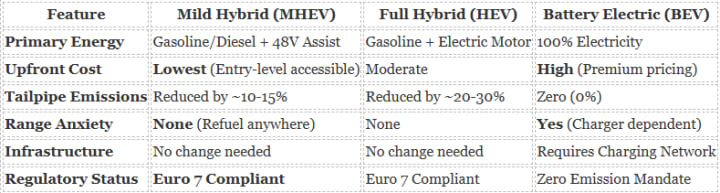
The Verdict: While BEVs are the superior choice for environmental impact, MHEVs currently win on affordability and convenience. They allow drivers to participate in the green transition without the "charging anxiety" or the high upfront price tag of a Tesla or VW ID series.
Is the Mild Hybrid Just a "Bridge Technology" or Here to Stay?
Critics often dismiss the mild hybrid as a "bridge technology," implying it is temporary and soon to collapse. While it is technically a bridge between the ICE past and the EV future, this bridge is exceptionally long and sturdy.
The "EV Fatigue" Factor Recent sales data from 2024 and 2025 have shown a cooling in BEV adoption rates in Europe. Early adopters have already bought their EVs, but the mass market is hesitant due to:
- Insufficient public charging infrastructure in rural areas.
- Higher insurance costs for EVs.
- Resale value concerns.
This market hesitation creates a vacuum that Mild Hybrids fill perfectly. The IMARC forecast extending to 2034 suggests that for the next decade, MHEVs will likely become the default internal combustion engine. In essence, the "standard car" of 2030 will not be a pure gas car, but a mild hybrid.
Which Segments Are Driving the Demand in Europe?
According to the IMARC segmentation data, the growth is not uniform across all categories.
- Vehicle Type: Passenger Cars: This segment remains the dominant force. From compact city hatchbacks in Rome to family SUVs in Munich, the 48V system is becoming standard equipment. Manufacturers are streamlining production: instead of offering a "gas" version and a "hybrid" version, the "gas" version is now a mild hybrid.
- Powertrain: The Diesel Survival: While Gasoline Mild Hybrids hold the major market share, Diesel Mild Hybrids remain crucial, particularly for the Commercial Vehicle sector. Delivery vans and long-haul trucks rely on diesel for torque and range. MHEV technology allows these commercial fleets to lower their carbon footprint and enter Low Emission Zones (LEZ) in cities where older diesels are banned.
Conclusion
So, will mild hybrids survive the EV revolution? They already are. The Europe mild hybrid vehicles market is not fighting the EV wave; it is surfing it. By offering a cost-effective, compliant, and familiar technology, MHEVs have secured the future of the internal combustion engine for one last, long generation.
For investors, automakers, and consumers, the path forward is clear. The destination is electric, but the journey there will be driven by the mild hybrid. With a projected market value growing at a CAGR of 6.87% through 2034, this technology is proving that sometimes, the best way to move forward is to upgrade what you already have.
Data Sources:
- IMARC Group: Europe Mild Hybrid Vehicles Market Size, Forecast 2034
- European Commission: Euro 7 Emission Standards Overview
About the Creator
Joey Moore
I'm Joey Moore, a seasoned Research Analyst with 5+ years of experience in market research. Expert in data analysis, strategic planning, and industry insights. Proven track record in delivering actionable reports.
Keep reading
More stories from Joey Moore and writers in Journal and other communities.
The Rise of Modular Construction in Brazil: How Modular Construction Adoption Compares Worldwide
Brazil is a nation defined by its rapid urbanization and bustling metropolises, yet its construction sector has historically relied on traditional, labor-intensive masonry. This is changing. The rise of modular construction in Brazil is signaling a pivotal shift in how the largest economy in South America builds its future. While the world watches nations like China and Sweden revolutionize building speeds, Brazil is carving its own path, fueled by a unique mix of urgent housing needs and infrastructure demands.
By Joey Moorea day ago in Journal
~ Fired ~
— Ai Intrusion ~ Are you Next ~ Is Ai Evolution after your job? — Few workplaces haven't been affected. Ai is in supermarkets, at doctors' offices, and even monitoring farms. I just can't think of anything this machine is not getting into, can you? For instance: Education ~ Law and Tech jobs will one day have a major influence or be taken over by these inanimate machines, with accuracy and vigor. From mechanics' diagnoses to a wide variety of everyday jobs, including fast food workers, with this input having the ability to cut their unnecessary work hours. I'm certain all of us have been touched by this with our short stories and colorful headings, have you? Even comments are very questionable 'Non-Robot' insertions.
By Jay Kantor5 days ago in Journal
How to Spend 3 Days in Trincomalee
Trincomalee remains the understated anchor of Sri Lanka’s northeast coast. Unlike the well-trodden southern beaches, "Trinco" offers a raw collision of maritime history, Chola-dynasty ruins, and world-class marine biodiversity. This three-day guide balances the town’s spiritual heritage with its wild, deep-water adventures.
By Jeewanthi Armstrong7 days ago in Journal
Self Help: Grifters' Gospel
On Self-Help, Snake Oil, and the Illusion of Change Psychology professionals and students can be imagined on two opposite sides of a line called self-help books: likely a larger group opposes pop-science and step-by-step manuals filled with talk of success, journaling, and not giving a f**k; others love them, but they aren’t many.
By Avocado Nunzella BSc (Psych) -- M.A.P 4 days ago in BookClub




Comments
There are no comments for this story
Be the first to respond and start the conversation.