
The Rise of Modular Construction in Brazil: How Modular Construction Adoption Compares Worldwide
Despite the slower growth rate compared to Asia, the internal pressure to adopt modular in Brazil is immense. The primary catalyst is urbanization.

Brazil is a nation defined by its rapid urbanization and bustling metropolises, yet its construction sector has historically relied on traditional, labor-intensive masonry. This is changing. The rise of modular construction in Brazil is signaling a pivotal shift in how the largest economy in South America builds its future. While the world watches nations like China and Sweden revolutionize building speeds, Brazil is carving its own path, fueled by a unique mix of urgent housing needs and infrastructure demands.
In this analysis, we explore the market's trajectory using the latest 2025 data, contrast it with global giants, and answer the critical questions investors and developers are asking.
What is the Current Size of the Modular Construction Market in Brazil?
To understand the potential, we must first look at the numbers. According to the latest market research from the IMARC Group, the Brazil modular construction market size reached USD 2.1 billion in 2025.
This figure represents a foundational shift in the industry. For decades, Brazilian civil engineering has been dominated by on-site concrete pouring and bricklaying. The move to a multibillion-dollar off-site industry indicates that major players are beginning to value efficiency over tradition.
Forecast and Growth Trajectory Looking ahead, the market is not expected to skyrocket overnight but rather to grow at a sustainable, steady pace. The IMARC Group forecasts the market to reach USD 3.1 billion by 2034, exhibiting a CAGR of 4.56% during the 2026-2034 period.
A 4.56% growth rate in a volatile economy like Brazil is significant. It suggests resilience. Unlike the "boom and bust" cycles of traditional real estate, the modular sector is being driven by structural necessities - specifically, the need to build faster and more efficiently in dense urban centers.
How Does Brazil’s Adoption Rate Compare to the Global Standard?
This is the most critical question for international observers. Is Brazil leading or following? Currently, Brazil is in the "Early Majority" phase of adoption, whereas markets in Asia and Europe are in "Late Majority" or "Maturity."
Globally, the modular construction market was valued at approximately USD 90.6 billion in 2024, with some estimates projecting it to USD 139.9 billion by 2033. The global growth rate sits between 4.9. significantly higher than Brazil's 4.56%.
Global vs. Brazil Comparison Table
The following chart illustrates the disparity and opportunity between Brazil and global leaders.
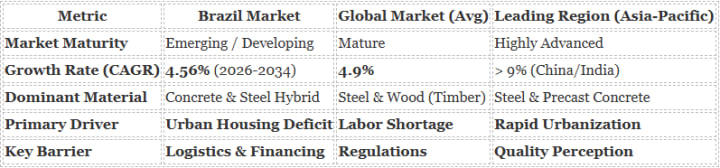
Analysis of the Gap: While countries like Singapore and the UK mandate modular construction (PPVC) for certain government land sales to boost productivity, Brazil relies on market forces. The Brazilian government has yet to enforce "off-site first" policies, which explains the slower adoption curve compared to the state-sponsored acceleration seen in China or Singapore.
What Are the Key Drivers Fueling Modular Growth in Brazilian Cities?
Despite the slower growth rate compared to Asia, the internal pressure to adopt modular in Brazil is immense. The primary catalyst is urbanization.
According to the CIA World Factbook and IMARC data, as of 2023, 87.8% of Brazil’s entire population lived in urban regions. This puts a massive strain on cities like São Paulo, Rio de Janeiro, and Belo Horizonte.
Need for Speed (Time-to-Market): Traditional construction projects in Brazil are notorious for delays. A typical masonry high-rise can take 24-36 months. Modular construction can reduce this timeline by 30% to 50%. For developers paying high interest rates on construction loans (often double-digit rates in Brazil), shaving a year off the construction schedule directly boosts ROI.
Cost Certainty in an Inflationary Economy: Brazil often struggles with inflation. In traditional construction, material costs can rise significantly during the 2-year build phase. Modular construction, where materials are purchased upfront and assembled in a factory, offers cost predictability. Developers know the price of the module before it leaves the factory floor.
Why Is Brazil’s Growth Slower Than Asia or North America?
If modular is faster and more predictable, why isn't the CAGR 10%? The adoption of modular construction in Brazil faces "Tropical" challenges that are unique to the region.
The Logistics Nightmare: Modular construction relies on transporting large, volumetric units (entire rooms or apartments) from factory to site.
- The Problem: Brazil’s road infrastructure is inconsistent. Moving wide loads requires expensive permits, escorts, and navigates roads often plagued by potholes.
- The Result: Logistics can eat up to 15-20% of the project budget, eroding the cost savings gained in the factory.
The "Culture of Concrete" (Cultural Resistance): There is a deep-rooted psychological barrier. Brazilian homebuyers equate "brick and cement" with security and value.
- The Perception: Drywall, steel framing, and modular builds are often unfairly associated with "temporary" housing or "American-style" cardboard houses.
- The Reality: Modern modular is often stronger than traditional builds, but changing consumer sentiment takes time.
The Financing Paradox: Banks in Brazil are accustomed to releasing funds based on physical progress on-site (measured/verified monthly).
- The Issue: In modular construction, 70% of the cost is incurred in the factory before the building reaches the site. Brazilian banks are still adapting their credit lines to finance "off-site" progress, creating a cash-flow squeeze for developers.
Which Sectors Are Leading the Charge in Brazil?
The IMARC report highlights that the market is expanding due to rising economic demands, but where exactly?
1. Residential (Affordable Housing): The "Minha Casa, Minha Vida" (social housing) program is the perfect candidate for modular. The repetition of units and the need for scale align perfectly with factory production. However, margins are tight, so only the most efficient modular factories can compete here.
2. Commercial and Retail: This is the hidden gem. Fast-food chains, banks, and pharmacies in Brazil are aggressively using modular.
If a bank wants to open 50 new branches across Brazil in 2026, they can manufacture 50 identical modules in São Paulo and ship them nationwide. The consistency of brand identity and speed of opening (revenue generation starts sooner) drives this segment.
3. Industrial Facilities Mining and energy companies operating in remote areas (like the Amazon or Pre-Salt oil fields) have long used modular for worker accommodation. This remains a steady, reliable income stream for the sector.
What Does the Future Hold for Brazilian Construction Technology?
The "Rise of Modular Construction in Brazil" is not a temporary trend; it is a structural evolution. By 2034, we expect the market to reach that USD 3.1 billion mark, but the nature of the market will change.
Technological Integration (ConTech) We will see a convergence of BIM (Building Information Modeling) and manufacturing. As Brazilian startups adopt better digital twins, the errors in manufacturing will drop, and the integration with on-site foundations will become seamless.
The Hybrid Future Brazil will likely perfect the "Hybrid Model." Instead of fully volumetric buildings (which are hard to ship), we will see more panelized systems (2D walls) and bathroom pods installed into traditional concrete structures. This compromise solves the logistics issue while keeping the speed benefits for the most complex parts of the build (kitchens/baths).
Conclusion
The rise of modular construction in Brazil serves as a fascinating case study of how global technology adapts to local realities. With a market size of USD 2.1 billion growing to USD 3.1 billion, the sector is healthy and expanding.
While it may not match the explosive speed of China's market due to logistical and cultural headwinds, Brazil offers a more grounded, resilient opportunity. For investors and construction professionals, the message is clear: The future of Brazilian construction is not just being built on the construction site - it’s being assembled in the factory.
Data Sources:
- IMARC Group: Brazil Modular Construction Market Size, Outlook 2034
- Demographic Data: CIA World Factbook (Urbanization stats)
About the Creator
Joey Moore
I'm Joey Moore, a seasoned Research Analyst with 5+ years of experience in market research. Expert in data analysis, strategic planning, and industry insights. Proven track record in delivering actionable reports.
Keep reading
More stories from Joey Moore and writers in Journal and other communities.
Germany Insurtech Market Report 2025: Resilience Amidst the European VC Funding Winter
If you strictly follow the headlines, the European startup scene appears frozen. Venture capital funding has retreated, valuations have reset, and the era of "free money" is officially over. However, headlines often miss the structural reality beneath the surface. In Germany, the continent's largest economy, the insurance technology sector is not just surviving; it is actively evolving.
By Joey Moorea day ago in Journal
~ Fired ~
— Ai Intrusion ~ Are you Next ~ Is Ai Evolution after your job? — Few workplaces haven't been affected. Ai is in supermarkets, at doctors' offices, and even monitoring farms. I just can't think of anything this machine is not getting into, can you? For instance: Education ~ Law and Tech jobs will one day have a major influence or be taken over by these inanimate machines, with accuracy and vigor. From mechanics' diagnoses to a wide variety of everyday jobs, including fast food workers, with this input having the ability to cut their unnecessary work hours. I'm certain all of us have been touched by this with our short stories and colorful headings, have you? Even comments are very questionable 'Non-Robot' insertions.
By Jay Kantor5 days ago in Journal
Feelings Never Die
It is Valentine's Day again, and it bought back memories that were over fifty years old. It bought me back to 1971, and I woke up and I knew my baby was due today. I was big and pregnant, and I felt like I was about to burst wide open. Imagine my surprise when the doctor told my I had a due date of February 14. I couldn't believe it, and since my baby was due today, I felt I could indulge myself a bit. I had gained a lot of weight, and chocolate was on the no-no list, but I had came to the end of this pregnancy, and I hoped it would be okay, after all I would deliver this baby today. So I walked across the street to the grocery story, and bought myself, a peppermint patty, covered in chocolate, my favorite. Me and my Valentine's baby would enjoy it together.
By Susan Paytonabout 9 hours ago in Fiction


Comments
There are no comments for this story
Be the first to respond and start the conversation.