
THE HIMBA PEOPLE
THE TRIBES THAT CAN SEE BETTER THAN ANYONE

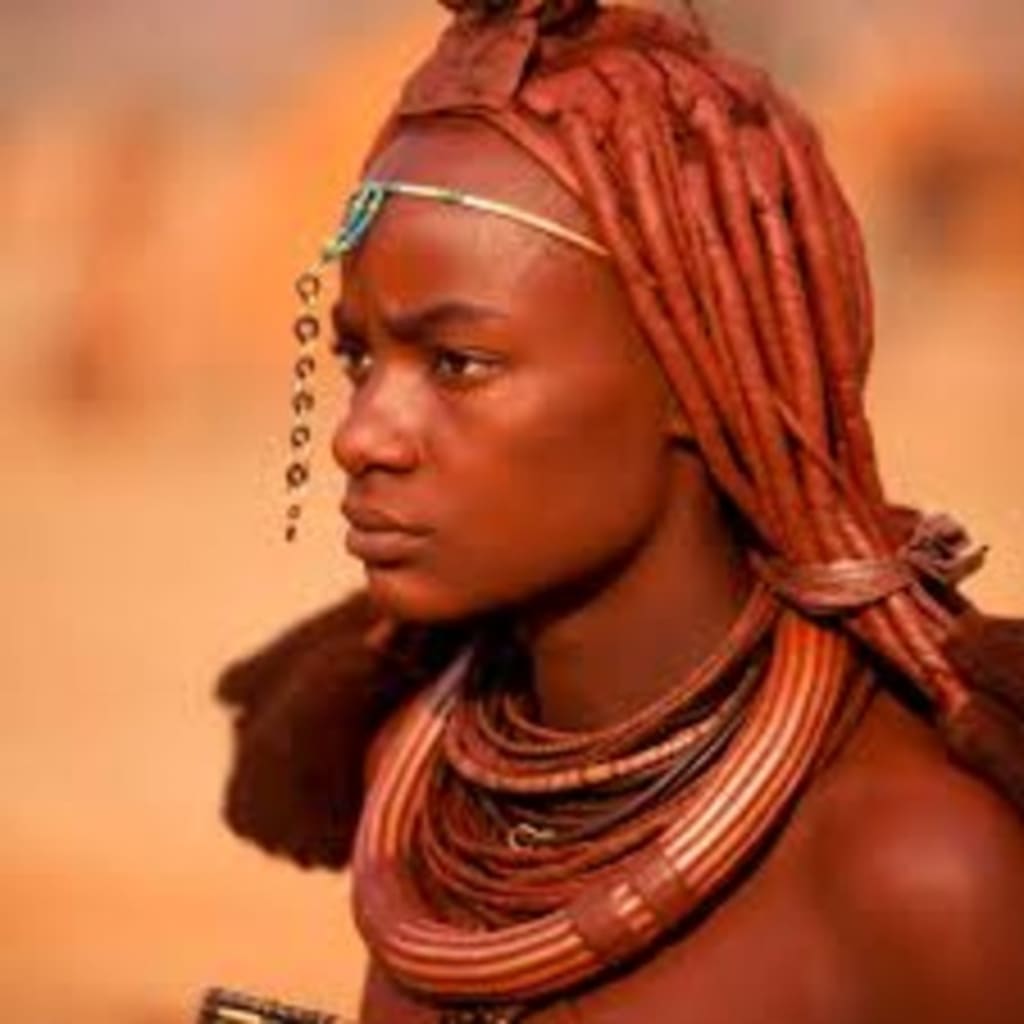
The Himba people are indigenous, semi-nomadic people who mostly reside in the Kunene Region of northern Namibia. The tribe has an estimated population of around 50,000 and mostly subsists on livestock farming, particularly breeding sheep and goats, though they also grow crops like millet and maize. These herders live very simple lives, far different from the modern lifestyles of those who live in urban cities. The tribe is comprised of smaller family communities, and members of these family villages dwell in circular wooden huts that were built to surround an “okuruwo”—a sacred fire the Himba people believe allows them to connect with the spirits of their ancestors. These homesteads also have specially built enclosures they refer to as “kraal,” in which they rear their cattle.
What really makes the Himba people of Namibia so distinctive from the perspective of Westerners is their appearance. They are known for covering their skin with red ochre pigment, which is a mixture of clay, sand, and ferric oxide. But another special thing that sets them apart from the rest of the world is the way they see and perceive things. You see, even when looking at the same object, people can see things very differently. In the case of the Himba people of Namibia, this truth applies not only figuratively but literally as well. And not only do they see things differently from most humans, they seem to do it better, too, as research shows that they can focus on details better and are also less susceptible to visual distractions.
This interesting finding compels us to ask this question: How is this possible? If we are all generally born with the same organs needed for seeing and perceiving, shouldn’t a traditional community like the Himba people see or perceive their surroundings no better than the rest of us do? According to scientists, the answer lies in the theory that vision and perception are not solely a matter of biology and neurology. This means that they can also be influenced by external factors such as environment and culture. In the case of the Himba people, these semi-nomadic people see and perceive the way they do because their minds have not been altered by modernization, which Jules Davidoff, a psychologist and professor at Goldsmiths, University of London, believes has significantly affected the visual focus and attention of those who belong to modern, urban societies. Davidoff conducted several studies and experiments on vision, perception, and attention with the Himba people as his main subjects, and the results of his research supported the supposition of several other scientists that modernization has changed the way we see, perceive, and pay attention to the things we look at. That is why people belonging to a traditional culture like that of the Himba people are less likely to commit errors in their perception of size and distance and are also less susceptible to getting distracted from their concentration.
Many of Davidoff’s earlier experiments involving the Himba people utilized the famous Ebbinghaus Illusion. Also known as the Titchener circles, this optical illusion concerns size perception and was first developed by renowned German psychologist Hermann Ebbinghaus before its use was popularized by British experimental psychologist Edward Titchener. The most famous version of this illusion involves circles arranged around each other in order to be compared by the subject looking at them. However, the first circle is surrounded by circles much larger than its size, while the second circle is surrounded by smaller ones. The positions of all the circles involved are supposed to make it appear that the main circle encircled by larger circles is smaller than the central circle contained by the small circles. For most Westerners, the optical illusion succeeds in tricking them into believing that the first central circle is smaller than the latter. However, when Davidoff showed the images to members of the Himba people, they weren’t as likely to fall for the same trick. According to an article he published with his colleagues in the Journal of Experimental Psychology in 2007, the illusion had a weak effect on the Himba people because of their bias towards local processing. This meant that when presented with an image featuring multiple objects, they tended to focus on the smaller details—which, in the case of the Ebbinghaus Illusion, were the main circles—rather than the complete picture. Because they ignored the context of what they saw—which was the image of two circles surrounded by large and small circles, respectively—the illusion failed to distort their perception.
Davidoff and his colleagues went on to test the Himba people’s local bias for focusing on fine details by asking their subjects to compare Navon figures. A Navon figure is used to compare local and global processing biases across race and culture. It features a large and recognizable shape or letter that is made up of repeated copies of a different and much smaller shape or letter. For example, a Navon figure could be a large letter T made up of copies of the letter S. In this case, the letter T is the global feature while the S is the local one. The result of the study, which was first published in 2013, revealed that the subjects from the Himba people of Namibia tend to focus on smaller details over the larger and overall image, which confirms that they are biased towards local processing. However, despite this perceptual bias, the Himba people are more flexible and have more control over their selective attention. This means that while they tend to notice the small details first, they can just as easily see the “big picture” if asked to do so. Further experiments showed not only the Himba people’s perceptual bias for small details and their flexible selective attention but also a reduced distractibility. Compared to Westerners living in urban cities, members of a remote culture such as the Himba are less affected by visual distractions. They can identify their target object better than others even when other moving objects are present to disrupt their focus. A possible explanation for why the Himba people can “see” and focus better than everyone else is their traditional and simple lifestyle. As herders, part of their everyday life involves identifying cattle. To be able to individuate dozens of animals, they have had to train their eyes to quickly spot distinctive features and markings on their sheep and goats from a distance.
Thank you so much for reading!
About the Creator
Richchik Bardhan
A MBBS student,Love to read and write about science facts and sometimes sci-fic too because Some sci-fic can later be proven into facts someday.....
Keep reading
More stories from Richchik Bardhan and writers in Journal and other communities.
LIFE AFTER DEATH
Hey guys, death is often considered the final frontier. Maybe not—there's really no way to avoid the one destination that all life has to reach. No matter how hard one tries to hold on to things like cars, houses, money, or even our bodies, death, to some degree, lurks and haunts us. Because death is the ultimate mystery, we always wonder what it really is and if there's some form of life even after death. It's really hard for me to fully comprehend. To understand that when you're dead, that's it—blackness, no more warmth, no more food—can be challenging. That's why so many people throughout the ages have tried to find answers about what death really is and if there's more life beyond it.
By Richchik Bardhanabout a year ago in Humans
Making Time for God: Daily Prayer in a Busy Life
Life is busy. Work, family, errands, and responsibilities often fill every corner of the day, leaving little space for reflection or prayer. Yet daily prayer is one of the most powerful tools a Catholic has for staying grounded, cultivating patience, and experiencing God’s presence in every moment. Finding ways to integrate prayer into a busy life is not about creating a rigid schedule; it is about building habits that allow moments of connection, however brief, to become transformative.
By Sound and Spirita day ago in Journal
Silver Screen Magic with Mae West
American actress and singer Mae West became a popular film actress during the Great Depression. She started entertaining in vaudeville, then performed on Broadway, and finally went to Hollywood. She signed up with Paramount Pictures and made her debut in the 1932 film “Night After Night.” She also starred in musicals, comedies, and crime dramas. The American Film Institute named her one of the best classic Hollywood actresses.
By Rasma Raisters6 days ago in Geeks



Comments
There are no comments for this story
Be the first to respond and start the conversation.