
Safe Negotiation, Importance of Genuine Price Fixing
Supply Chain Procurement

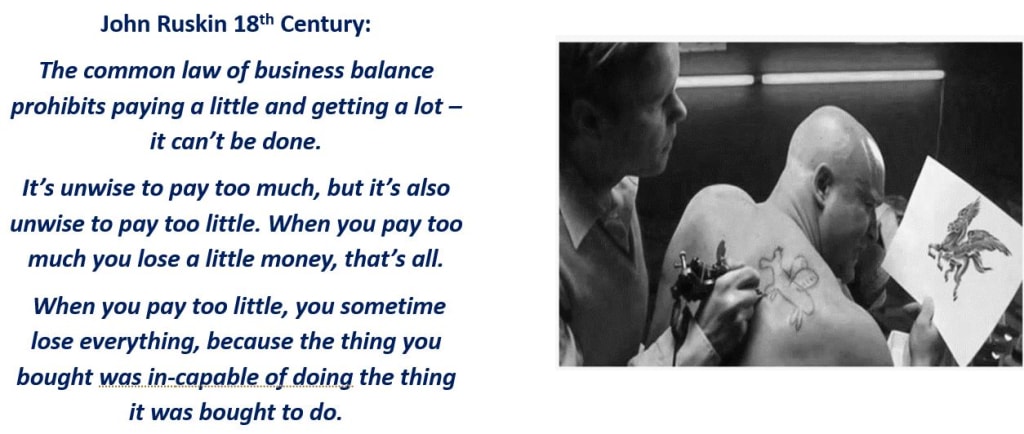
Law of business prohibits paying a little and getting more
There are several examples and experiences which show that negotiation is a psychological game with high stakes – a game we humans play against one another more than 10,000 times per year for the average person or sometimes against all known and unknown opponents.
As German social psychologist Thomas Mussweiler said that negotiations “typically involve a great deal of uncertainty on both sides.” It is difficult to assess the intrinsic value of something, and we instead use the most immediately available information, such as the opening offer of other side, to consider our response.
Price is what you pay, value is what you get. It’s unwise to pay too high or too little. Lack of knowledge and indolence on few instances, buyers tend to enter bargaining approach rather than well-planned negotiations.
As bargaining doesn’t require any preparation but negotiation does. Yes! Therefore, it’s the sole responsibility of buyers and category managers to acquire knowledge of those products and service markets and also to gather talents together while preparing for the negotiation.
From the recent procurement transformation initiatives, it’s significant that high-level professionalism in procurement and strategic negotiation is becoming critical for any business success.
Throughout the end-to-end process, defining safe price targets and supporting your products and service providers who are working at correct price level. At the end aiming to bring “win-win” ambiance for both are difficult but important at the same time.
“The common law of business balance prohibits paying a little and getting a lot – it can’t be done. If you deal with the lowest bidder, it is well to add something for the risk you run. And if you do that, you will have enough to pay for something better.” – John Ruskin 18th Century"
This statement by John Ruskin even suits to present and future frameworks. In a commercial market, either for product or for service trading methods, constant challenges are coming from competition and end customers’ realistic or nonrealistic business expectations. This is forcing procurement professionals to transfer their commercial conditions to their suppliers.
It's unwise to pay too much, but it’s also unwise to pay too little. When you pay too much you lose a little money, that’s all.
“When you pay too little, you sometime lose everything, because the thing you bought was incapable of doing the thing it was bought to do.” – John Ruskin
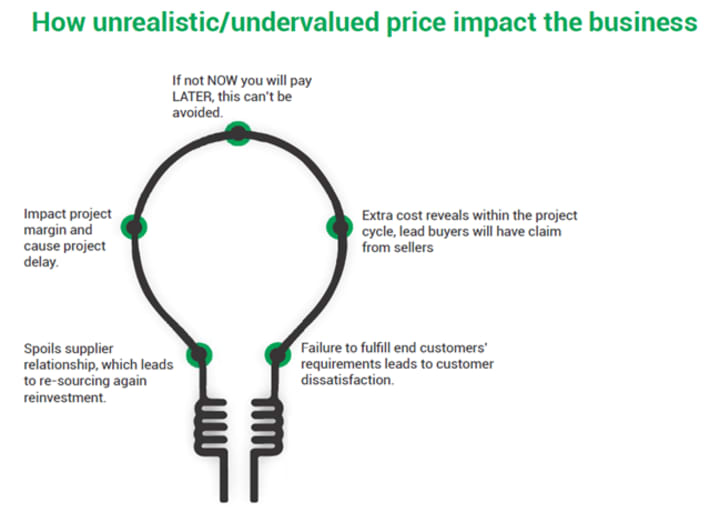
Therefore, any business will be impacted two ways if we miss this preparation step.
1. Non-competitiveness makes your company lose the business.
2. Make you undergo claim and spend over cost during execution/production.
Buyers commit mistakes to define undervalue for their procurement and seller’s decision to accept the price as it’s without analyzing the cost in detail jeopardizes the business. To mitigate this risk, understanding your “should cost” or “idle cost” is essential. It’s very important for either technical or nontechnical buyers to acquire knowledge on their categories they intend to buy. If they can’t, this knowledge can also be sourced from experts.
Some commonly used terminologies in the procurement world include cost model, price benchmarking, price estimation, should cost, co-designing to optimize the cost, being strict on just-enough buy etc... Detail study using internal or external experts are highly required before defining target to sellers. Having knowledge on should cost (idle cost) also helps buyers to know so-called rock-bottom price level.
Summary
There are many depraved reasons that sellers to accept buyers unrealistic and unethical commercial conditions, this kind of mistakes very often with small-mid size product and service providers. I always make sure my suppliers well aligned with our technical requirements and scope of work, also push for working sessions to optimize the offers. Then making sure rightly distributed back to back contractual conditions with dependable payments milestones. This is the practice makes every parties carryout profitable business without upsetting each other during order execution phase.
About the Creator
Sendil Arasu Vijaya Kumar
I attained bachelor degree in mechanical engineering and master degree in marketing management, having 21 Years of professional work experience. International exposure in Supply Chain Procurement domain. Author of "The Procurement Acumen"
Keep reading
More stories from Sendil Arasu Vijaya Kumar and writers in Journal and other communities.
Spotify Classic Rock/Metal Playlist
Why I Put This Playlist Together This playlist did not begin as a project, a brand, or a plan. It began the way most meaningful things do, quietly and without intention. I was talking about music, one song at a time, and over time those songs began to gather weight.
By Sound and Spirit6 days ago in Journal
Silver Screen Magic with Mae West
American actress and singer Mae West became a popular film actress during the Great Depression. She started entertaining in vaudeville, then performed on Broadway, and finally went to Hollywood. She signed up with Paramount Pictures and made her debut in the 1932 film “Night After Night.” She also starred in musicals, comedies, and crime dramas. The American Film Institute named her one of the best classic Hollywood actresses.
By Rasma Raisters6 days ago in Geeks


Comments
There are no comments for this story
Be the first to respond and start the conversation.