
Supplier Relationship Management (SRM) and How It Matters?
Supply Chain Procurement

As an old proverb states “Good fences makes good neighbors.” If we extend this logic to buyer-supplier relationship, we could say “good partnerships lead to good business outcomes.”
In order to make the most of good partnerships, procurement teams need to take a high-level view to understand various aspects of sourcing rather than viewing the relationship solely via a periscope.
As companies continue to consolidate, classifying their supplier base and understanding strategic supplier relationships can play a vital role to sustain growth and cost management target. In this business world, a healthy supplier relationship is an important indicator of success. When you start forming connections with your suppliers, you will unlock many hidden values in your supplier base. These connections must be cultivated on a regular basis, and they should extend far beyond the finalization of a deal.
Maintaining a healthy relationship between the buyer and seller, with a clear two-way communication can create a platform for resolving conflicts. Working towards continual improvement will lead to an additional value in your supplier relationships.
Also, taking an extra care when sourcing suppliers is a vital aspect to consider. Selecting strategic suppliers is the foundation of the successful supply chain management. Choose business that meet your needs and are willing to work with you to build a healthy organic relationship.
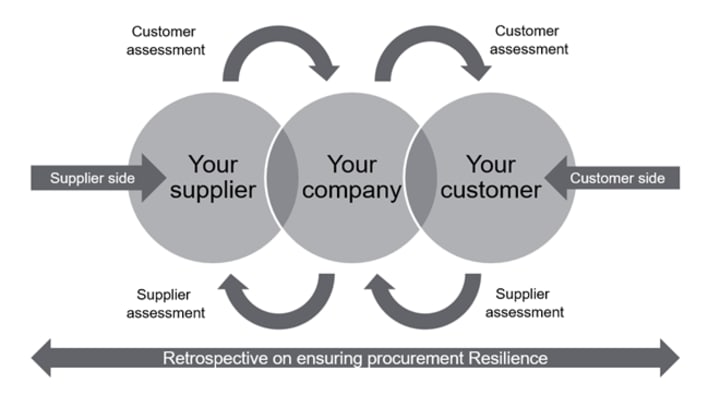
In the world of constant changes with challenges and opportunities, sourcing has become open, accessible to anyone and for any business. A collaborative or furthermore dynamic supplier relationship is highly required to attain our business goals. As always unstated that the performance of our procurement/sourcing team is highly linked and connected with our suppliers’ performance, which means that the magnitude of supplier relationship management is more important. Like any relationship, it helps to gain trust and develops the communication.
Unilateral/Biased approach won’t help to have strong relationship with the suppliers which you intend to work, focusing only on your own benefits. The sourcing process can have real impact on the post–contract relationship that buyer company has with their suppliers.
Only procurement function professionals work hard to build and maintain a strong and vibrant relationships with their preferred/prequalified suppliers.
When procurement function can see evidently that their suppliers are their trustable partners, rest is assured, and company will have robust results.
Even with those suppliers with whom you have an excellent relationship, you must have regular evaluation of cooperation, and should point out things that failed on both sides. When you will evaluate the mistakes of your company, the supplier will appreciate your self-reflection.
It is necessary for any procurement professional to be prepared and play well according to each negotiation with the supplier. If you feel that you are going into a game with low cards, don't just try to bluff, it won't benefit in the long cooperation. You must learn from the game and take more trumps for the next one.
If you have the right cards in your hand, you will not be surprised by the sudden ace of the opponent. Find out in advance how the supplier stands with other departments of your company. Make sure that you are not attacked by arguments or else you will quickly lose your negotiating position.
Obstacles for effective SRM
Today’s business has a lot of critical missions to fulfill such as there are huge pressure on category managers for ensuring quality, sourcing managers for sustainability and CPOs for enhancing top-line value. To meet all those demands, procurement teams requires dynamic work tools.
These tools will develop better insight into their suppliers’ activities and increase intelligence for further analysis to make decisions regarding supplier bases. One way or the other, an SRM solution should be able to provide you with a framework for developing stronger and more collaborative relationships with your suppliers.
The relationship must be trustable and transparent. This includes:
• no alignment with internal stakeholders,
• improperly managed supplier data base,
• unclear supplier classification,
• existence of too many suppliers,
• lack of skilled resources,
• less tools and technology and
• no clear KPI to measure SRM and process in place.
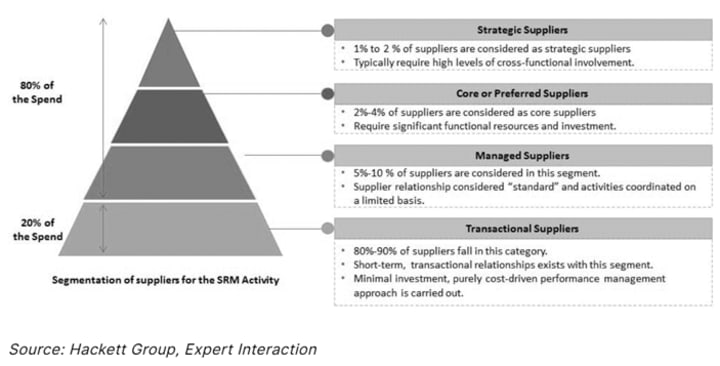
Segmentation of supplier for the SRM activity
This is one example from Hackett Group, I am sure you are already aware of different ways of classifying the suppliers with the application of classic 80:20 rule to support SRM program.
It is important to interact and develop a close contact around the topics in which procurement team or nominated key account manager from the buyer company can interact with their suppliers. To discuss the ongoing challenges, more focus on common project objectives and priorities is needed. Also, understanding the importance of co-design development and innovation possibilities will help to work on mutual benefits.
Regular interactions and frequent communications will help to build trust. Proactive engagement of supplier lays a great foundation to achieve common goals together.
In a challenging business environment, we can experience success simply by joining hands together with our suppliers and not by being alone. We need to develop mutual trust and maintain supplier relationship which leads to a long-lasting journey.
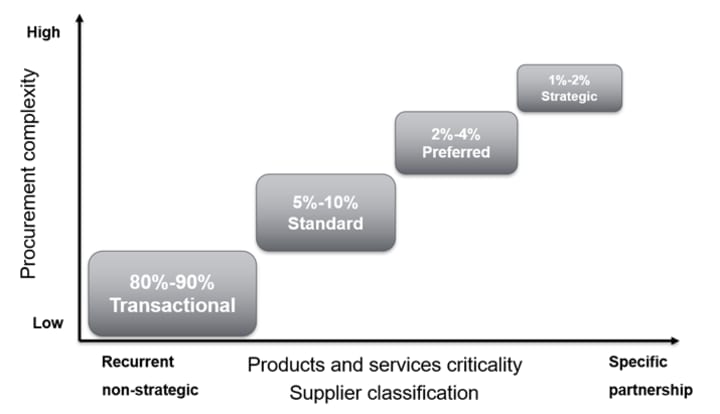
Based on the criticality of product and service, the procurement complexity has been defined. From the following graph, you will get an idea about the idle size of suppliers placed in different classification levels.
Regardless of any size of the companies around 5% of the suppliers classified as Strategic and Preferred suppliers those who needed upmost care, their contribution to your business brings direct impact to your business continuity plans.
Outcome of supplier relationship management
In order to have innovative supplier relationship management program, bringing a significant funnel increase on innovation and brand reputation through constant idea generation. Also, the more proactive and insightful role played by suppliers will support the execution process properly. Looking at innovation from a holistic view, procurement makes it clear that suppliers who support multiple lines of business will see more success than those in standalone relationships.
• Strategic supplier relationships should deliver performance that is “better than market.”
• Cost trends should be challenging level to the market indices. Strategic supplier relationship brings competitiveness in front of end customer.
• It ensures that relationship is mutually beneficial. Also, assures to engage talents and skills of buyer and suppliers to share the knowledge pool.
• It brings maximum value addition to the company and lays a strong base for long-term business relationship.
Concerning quality and performance, a supplier relationship management strategy should enhance the quality and performance of both buyer and seller entities and deliver on business’s critical KPIs.
Upholding the standards of supplier quality and performance, gauged by the members of your internal procurement team, creates a basis for shared responsibility between both entities. Shared obligation aids the production of top-quality products, increasing the brand value, and gives your customers the finest quality they expect and deserve.
Therefore, leveraging supplier relationships to better competitive advantage is crucial for driving collaborative innovation and transcending value from all parties involved.
Summary:
Collaboration across the business shows limited impact or no economies of scale and therefore leverages with suppliers or ability to collaborate and share sourcing/supplier issues internally. Shared objectives and goals lead to effective cross-functional communication, efficient use of procurement resources, economies of scale, leverage with suppliers, lessons learnt contribute to continual improvement. Best-in-class companies consider high-potential suppliers for supplier relationship management programs and invest in them with the expectation that they will come up with innovations that will add value to the organization in the long run.
About the Creator
Sendil Arasu Vijaya Kumar
I attained bachelor degree in mechanical engineering and master degree in marketing management, having 21 Years of professional work experience. International exposure in Supply Chain Procurement domain. Author of "The Procurement Acumen"
Keep reading
More stories from Sendil Arasu Vijaya Kumar and writers in Education and other communities.
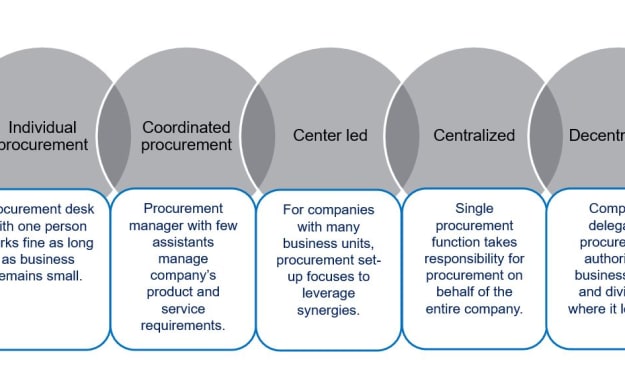
Procurement structure and operating model
When it comes to defining the most efficient and effective operating model for procurement functions, there are hardly any easy answers to be found for that. Procurement operating model needs to be consistent with a company’s overall business strategy and global organization footprint and aligned with its supplier market.
By Sendil Arasu Vijaya Kumar3 years ago in Education
Leading Beyond Limits: The Role of Executive Leadership in Achieving Organizational Excellence
In today’s dynamic and competitive business landscape, organizations are constantly pursuing not just growth but excellence. While growth reflects success in the marketplace, true organizational excellence is measured by sustainability, innovation, culture, and impact. At the core of this transformation is executive leadership—a force that guides businesses beyond short-term wins toward long-term significance.
By Yeasha Sobhan7 days ago in Education
How Business Coaching Helps Founders Scale With Clarity and Control
Business coaching assists founders to scale since hustle and reactivity are substituted with structure, systems and strategic leadership. Strategic coaching provides clarity in the marketing, operations, leadership, and decision-making roles of the business, eliminating the need to use the owner as the bottleneck, instead enabling the business to expand without havoc, burnout, or firefighting.
By Alice Adams4 days ago in Education
Silver Screen Magic with Mae West
American actress and singer Mae West became a popular film actress during the Great Depression. She started entertaining in vaudeville, then performed on Broadway, and finally went to Hollywood. She signed up with Paramount Pictures and made her debut in the 1932 film “Night After Night.” She also starred in musicals, comedies, and crime dramas. The American Film Institute named her one of the best classic Hollywood actresses.
By Rasma Raisters6 days ago in Geeks



Comments
There are no comments for this story
Be the first to respond and start the conversation.