
Outlook 2030: Metastatic Lung Adenocarcinoma Treatment Market Expands Rapidly
Fuelled by increasing incidence, increased biomarker testing, and a slew of new drug approvals, this market is a top area of focus for oncology innovation, drug development, and capital investment.

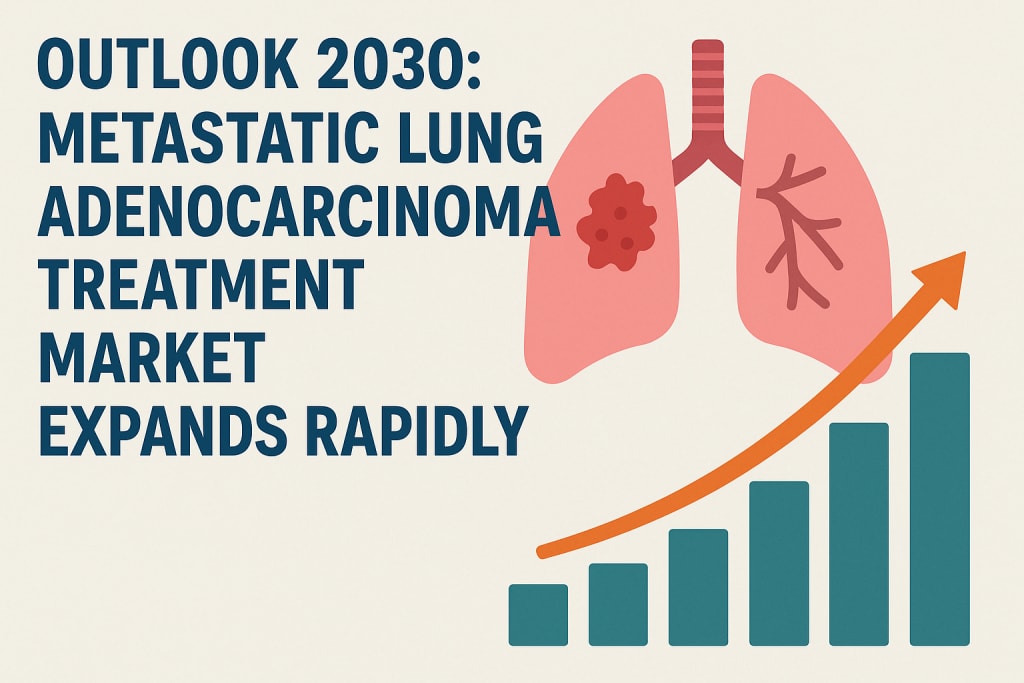
As one of the leading causes of cancer-related deaths, lung cancer remains a major medical and public health challenge — and among the many subtypes of lung cancer, metastatic lung adenocarcinoma is perhaps one of the most difficult to treat. But with the rise of molecular diagnostics, immunotherapies, and targeted therapies, this all-important treatment area is more dynamic than ever, with previously unimaginable treatment options and lifelines offering hope to many patients with this aggressive disease. Consequently, the metastatic lung adenocarcinoma treatment market is expanding rapidly, and is on track to see further high levels of growth through 2030.
A Growing and Deepening Priority
Non-small cell lung adenocarcinoma is the most prevalent histological subtype of NSCLC, making up more than 40% of all lung cancer diagnoses, and is one of the most dangerous when diagnosed at an advanced or metastatic stage, when the cancer has spread beyond the primary site to other parts of the body.
Even with the availability of early screening tools for those at high risk of lung cancer, the majority of patients continue to be diagnosed in the late or metastatic stage, presenting the need for efficient and effective treatment options that can improve survival rates and quality of life for these patients.
Drivers of Market Growth
As mentioned previously, there are several drivers of the metastatic lung adenocarcinoma treatment market, with three of them outlined below.
1. Precision Medicine and Targeted Therapies
The first major shift in this market is the use of targeted therapy. This form of treatment, which now often begins with a genomic profile to identify key driver mutations such as EGFR, ALK, ROS1, BRAF, MET, and others. This leads to targeted therapies such as osimertinib, alectinib, and crizotinib that can “turn off” the mechanism of cancer growth. As these therapies show higher response rates and lower toxicity rates than traditional chemotherapy, targeted therapies are now the gold standard for mutation-positive patients.
2. Immunotherapy
Checkpoint inhibitors such as PD-1/PD-L1 inhibitors like pembrolizumab (Keytruda) and nivolumab (Opdivo) are another key area of the metastatic lung adenocarcinoma treatment market. By supporting the body’s own immune system in identifying and killing cancer cells, these drugs are increasingly being used to treat patients with metastatic adenocarcinoma, in both first-line and combination with other therapies.
Dual immunotherapy regimens and immunotherapy with chemotherapy are currently being explored in clinical trials, so this area is set to see further interest and investment in the years ahead.
3. Rising Incidence and Wider Access to Biomarker Testing
As smoking remains the primary risk factor for lung cancer and adenocarcinoma, incidence in the population as a whole has been relatively stable over the past few years, and the trend is expected to remain stable through 2030. However, non-smokers, particularly women and younger adults, are on the rise when it comes to the development of lung adenocarcinoma, which is often tied to these patients’ genetic driver mutations.
For example, in the US, while smokers made up the majority of new diagnoses in 2023, this trend is set to change with a projected increase in adenocarcinoma in non-smokers of about 40% from 2023 to 2030.
Due to this epidemiological shift, molecular diagnostics are gaining a lot more visibility and awareness, leading to their widespread use not only in high-income countries like North America, Europe, and Japan but also in emerging markets such as the Asia-Pacific and Latin America regions.
Investments in oncology-specific infrastructure, specifically biomarker testing platforms, from both governments and private industry are increasing access to personalized treatment regimens and immunotherapy-based treatment options, which were until recently only available to a small number of patients in select markets and institutions.
Market Challenges and Opportunities
In addition to the drivers of this market mentioned above, there are several key challenges and opportunities in this area, including the following.
Challenges
- High cost of targeted therapies and immunotherapies
- Drug resistance to targeted and immunotherapies over time, which may lead to the need for next-generation therapies
- Testing and treatment access in low-resource settings, where resources for molecular diagnostics are still quite limited
Opportunities
- Liquid biopsy and other non-invasive molecular diagnostic tests
- Biosimilars and generic treatment options to improve affordability
- AI tools to help clinicians make data-driven decisions about treatment selection and patient monitoring
Market Size Forecast to 2030
The metastatic lung adenocarcinoma treatment market is expected to grow at a healthy CAGR through 2030, driven by several factors that will expand both the size and value of this market in the years ahead. Expanding drug pipelines and favorable reimbursement environments, as well as increased survival rates, will continue to drive growth and innovation in this area.
Major pharmaceutical players such as AstraZeneca, Roche, Merck, Novartis, and Takeda are all investing heavily in developing novel therapies and companion diagnostic tests, while biotech startups are focused on nicher targets and novel combination regimens.
Conclusion
As we look to the future of treatment for metastatic lung adenocarcinoma, there are clear obstacles to face as well as opportunities to capitalize on. With the advent of more personalized treatment options and a robust pipeline of immunotherapy-based treatments, the standard of care for this disease is changing rapidly, and patients are starting to have more hope than ever before.
With continued investment in both drug development and targeted therapy research, as well as biomarker testing and precision medicine, the metastatic lung adenocarcinoma treatment market is growing rapidly, and there is much optimism that by 2030, the treatment of this disease will be much more targeted, accessible, and effective — to the point where a diagnosis is no longer a death sentence, but the start of a new long-term disease management journey.
Get Sample Report at https://www.theresearchinsights.com/request_sample?id=154
About the Creator
Silvie Karson
Passionate storyteller exploring the world of trends. With a background in digital marketing, I craft compelling narratives that inform and inspire. Whether diving into deep-dive features, growth analysis, or trend analysis.
Keep reading
More stories from Silvie Karson and writers in Journal and other communities.
What’s Driving the Pharmaceutical Market Forward in 2025 and Beyond?
But neither is it “business as usual” just with more science, disruption, data, or digital health than before. The pharmaceutical market of tomorrow and beyond is in the middle of a radical makeover.
By Silvie Karson7 months ago in Journal
How AI Tools for SEO Changed the Way I Create Content and Rankings
I still remember the first time I heard someone say that artificial intelligence would replace SEO writers. At that time, I was already struggling to balance keyword research, content planning, optimization, and the constant pressure to rank higher on search engines. SEO felt less like creativity and more like a never-ending checklist. That was the moment when I decided to give AI tools for SEO a serious try, not as a shortcut, but as a support system.
By Anthony Rodgers3 days ago in Journal
Silver Screen Magic with Mae West
American actress and singer Mae West became a popular film actress during the Great Depression. She started entertaining in vaudeville, then performed on Broadway, and finally went to Hollywood. She signed up with Paramount Pictures and made her debut in the 1932 film “Night After Night.” She also starred in musicals, comedies, and crime dramas. The American Film Institute named her one of the best classic Hollywood actresses.
By Rasma Raisters5 days ago in Geeks




Comments
There are no comments for this story
Be the first to respond and start the conversation.