
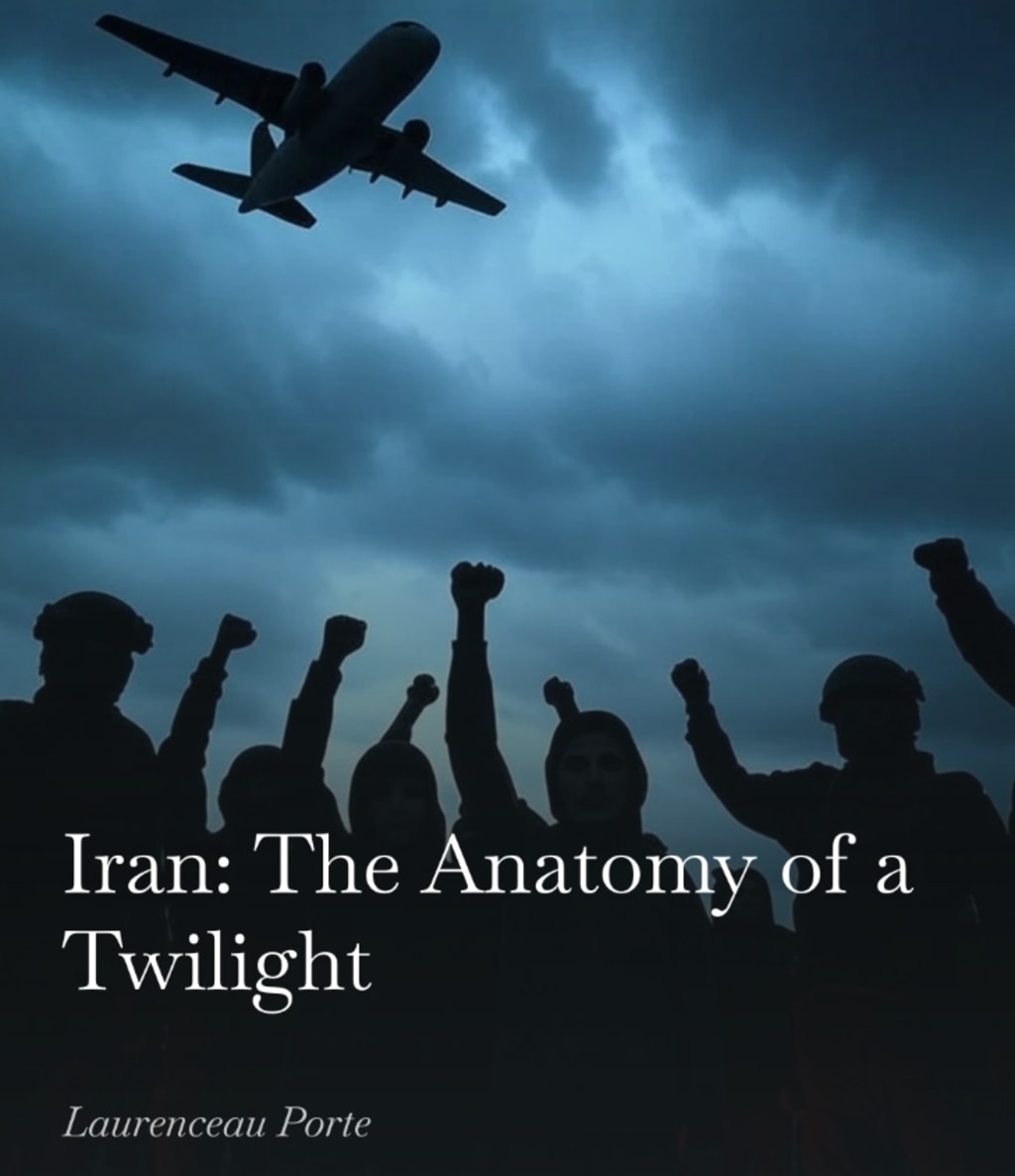
There are images whose power lies not in the brilliance of what they reveal, but in the abyss of what they leave unsaid. A dark silhouette cutting through the leaden skies of Tehran; the heavy silence of departure lounges; and that dry, bureaucratic warning, cold as a judicial sentence: “Leave the country immediately.” When a foreign ministry, usually so adept at hushed euphemisms, exhorts its citizens to flee, it is not merely issuing a cautionary advisory. It is issuing an admission of failure. It is the explicit recognition that the structures of order have become mere theatrical backdrops, that coercion has supplanted law, and that the threshold of radical unpredictability has been crossed. Iran, in this early stretch of 2026, is no longer merely trembling; it has settled into that twilight “in-between” where the crash has not yet occurred, but where the very silence feels like the herald of a seismic shift.
The Mechanics of the Fault Lines
To grasp the weight of this tipping point, one must look past the media froth and accept an uncomfortable truth: the Iranian crisis is neither a historical accident nor the fruit of Western paranoia. It is the product of sedimentation. It is the methodical accumulation of shifting tectonic plates: the crumbling of a bloodless economy, the disillusionment of an educated youth facing an ideological glass ceiling, and the sclerosis of a political apparatus that has mistaken longevity for stability. The regime is not a colossus with feet of clay; it is a concrete cathedral whose internal rebar has been eaten away by rust.
Iran does not offer the spectacle of convulsive chaos. Therein lies its gravity. Systems that collapse loudly are often political corpses that the wind finally carries away. But those that truly haunt the geopolitical analyst are the structures that falter while remaining upright—those edifices whose walls still bear the weight of the roof even as the foundations have already slipped. The Iranian state remains a formidable machine, structured and capable of a projection of force that intimidates its neighbors. Yet, society has begun a movement of mental secession. It no longer merely fights the regime; it ignores it or endures it like hostile weather.
The Belly and the Mind
For several lunar cycles, the Iranian street has no longer been shouting mere slogans; it has been exhaling a metaphysical fatigue. People are no longer protesting solely for abstract concepts of liberal democracy, but for the right to subsist. Inflation—that cold monster that devours wages before they are even earned—has transformed daily life into a series of desperate calculations. The currency liquefies, the stalls empty, and the future becomes a luxury that can no longer be afforded. History—both Persian and global—teaches us that the anger of the belly is of a far more ferocious nature than that of the mind. One can suppress an idea with another idea, or by force. One cannot indefinitely suppress hunger.
The power structure, faithful to its ancestral grammar, has responded with asphyxiation. It severs the nerves of communication—the Internet—it grids the urban space, and it multiplies the faces of intimidation. On the scale of the immediate survival of the clan, this strategy possesses a glacial rationality. It breaks networks; it atrophies coordination. But it generates a toxic residue: the radicalization of perceptions. Every arrest, every black screen, every uniform stationed on a street corner becomes an additional chapter in a grand narrative of rupture. The social contract, already tenuous, is definitively rescinded.
The Foreigner as Currency
Within this climate of encirclement, the figure of the foreigner—and particularly the Westerner—changes in nature. They are no longer a visitor, an expert, or a witness; they become a symbol, a bargaining chip, perhaps even a potential hostage. In the psyche of a regime that views itself as a besieged fortress, the foreign individual is stripped of their singularity to become a pawn on the chessboard of international tensions. Washington, by ordering the departure of its citizens, demonstrates that it has perfectly grasped this logic. The call to leave is not an act of panic, but a strategic withdrawal before the gates swing shut.
This American prudence outlines an alarming landscape: it suggests that analysts anticipate a degradation where standard consular protection will be nothing more than a legal fiction. There is a fear of the fortuitous incident, the security blunder, or the deliberate provocation intended to force a negotiation. Iran, for its part, receives these signals as diplomatic slights, fueling a paranoia that becomes, through a mirror effect, its own prophecy.
The Point of No Return
The question haunting this year is not one of a spectacular collapse—authoritarian regimes possess a resilience that the comfort of democracies often underestimates. The question is the tipping point. To what degree can the metal be twisted before it snaps? History is paved with those derisive sparks that set the powder keg alight: a price that rises too high, an inappropriate gesture by a security guard, a video that escapes the mesh of the digital net.
Iran is a country of millennial nobility, with a youth whose intellectual vitality would make many aging nations blush with envy, yet it finds itself squeezed between a petrified elite and an outside world that hesitates between sanctions and dread. The warning issued by the great powers is a temporal marker. It says: “At this precise moment, the risk has changed category.”
Beneath the polished surface of official statements, an entire people is holding its breath, aware that history has resumed its forced march. And when embassies begin to burn their archives or empty their apartments, it means the time of the diplomats is fading before the time of events. Iran is at the moment of truth: the moment where the status quo becomes more costly than the leap into the unknown.
JLP
About the Creator
Keep reading
More stories from writers in Journal and other communities.
The Quiet Link Between Evening Light and Restless Sleep
For a long time, I believed my restless sleep was caused by what happened in my head. Too much thinking. Too much stress. Too many unfinished thoughts that followed me into the night. I tried calming routines, earlier bedtimes, and stricter boundaries around work. Some nights improved. Many did not.
By illumipure2 days ago in Journal




Comments
There are no comments for this story
Be the first to respond and start the conversation.