

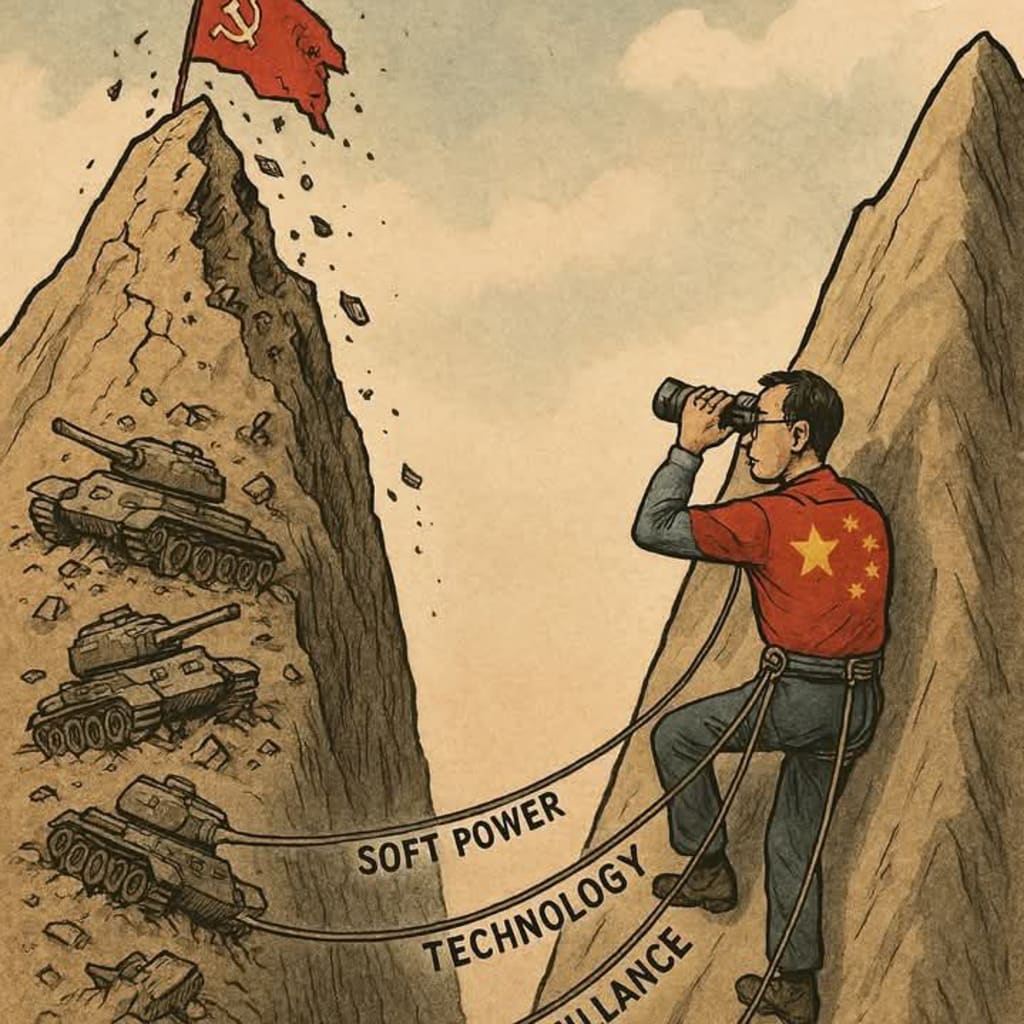
Trade War and China Strategy
The geopolitical competition between China and the United States is a watershed event in contemporary world politics. According to Kishore Mahabubani's analysis, the United States is showing very clear strategic weaknesses in its competition against China, and China is meeting that challenge very systematically, subtly, and pragmatically.
The strategic collapse of the United States
The United States' principal vulnerability is the absence of an articulated strategy against China. This is not only the view of Kishore Mahabubani, but of one of the foremost strategic thinkers in American history, Henry Kissinger. Kissinger makes clear that ''the most profound strategic error that the United States is making in the competition with China is to commence this competition without a strategy.''
It is not clear what the United States' current goals regarding China are:
Stifling the Chinese economy also an impossibility.
Bring down the Chinese Communist Party, that's also impossible.
Containing China cannot be done like the Soviet Union was contained, isolate and contain.
It can also be seen in former President Joe Biden's comment that ''China will not be number one during my term,'' approaches to the issue that differ dramatically from president to president, but that in Biden's case only means that he does not want the Chinese economy to outperform the American economy. If a tariff or chip war or something else is, they are all methods to slow down the speed of Chinese economic growth.
China's systematic strategy
China realizes that it will face a major crisis if it takes action without a clear strategy. So, China have created a very clear and organized strategy. The Three Elements of This are:
1. Strengthen your internal organization
No other country has studied the collapse of the Soviet Union as closely as China, and the US dream is to make China a second ''Soviet Union'' and collapse it. China has done the following to avoid this fate:
China has known that it collapsed not because of pressure from outside, but by its own internal weakness, and has built a strong and successful economy and a strong and successful society.
As the American thinker George Kennan wrote in 1949, ''The eventual outcome of the competition between the United States and the Soviet Union will be not in the final analysis, a matter of weapons and armies, but will depend on which of the two societies has the greater spiritual strength.'' This is a truth that China well understands.
2. Inspirational data for neighbouring States
During this period, the United States pursued a policy of containing the spread of the Soviet Union, which the new neighboring countries of the Soviet Union were able to join in. Many of the countries surrounding the Soviet Union were among them: Western Europe, Japan, South Korea.
China has been learning this lesson and taking intentional measures to prevent this:
The first to propose free trade agreement with ASEAN (2001) No western state (United States, European Union, Australia, and Japan) has proposed free trade agreement to the ASEAN, so China becomes the first state to propose free trade agreement with ASEAN
Transforming economic relations - Economy ASEAN - China trade was $40 billion in 2000, ASEAN - US was $135 billion ASEAN-China trade grew to $975 billion by 2022 (after the FTA), making it the world's largest trading relationship.
Thus, it would make no sense for ASEAN countries to enter into a confrontational stance with China, and to prevent China from growing to other countries going against their largest trading partner is indeed a very high bar of difficulty.
3. The Belt and Road Initiative
China's plan to build infrastructure in every corner of the globe took a strategically significant turn:
New Silk Roads: Meeting Infrastructure Needs Almost all over the world realize that Chinese infrastructure such as high-speed railways and highways are needed.
Make countries dependent on China more. This result makes the countries unwilling to participate in a policy of blocking China from indoctrinating other nations.
By this manoeuvre, virtually the entire world has become reliant on China for its infrastructure development projects.
About the Creator
Keep reading
More stories from Rohitha Lanka and writers in Journal and other communities.
Stripe Provides Update on AI Startup Growth Versus SaaS Growth
AI startups are growing faster than any other company type, says Stripe in an annual letter Stripe, the global payments giant, issued its annual letter Thursday and made a striking observation. AI startups are growing more rapidly than software as a service (SaaS) startups did in years past.
By Rohitha Lanka10 months ago in Journal
I Stopped Chasing Motivation and Focused on Systems.
Motivation feels good. It also fades fast. You wake up inspired one day and stuck the next. I learned this the hard way. I waited for the right mood before I worked. Progress stayed slow. Results stayed random. Everything changed when I stopped chasing motivation and built systems instead.
By Wilson Igbasiabout 12 hours ago in Journal
Miss Persephone's Manual to a Seemingly Ordinary Life
Miss Persephone was found at the dining table, her blue eyes swollen, her tears arriving and retreating like the tides of the ocean. Earlier that day, her family had visited her in the retirement home where she had lived for eight years. It was her eightieth birthday.
By Imola Tótha day ago in Fiction



Comments (2)
A compelling take on how China’s strategic foresight contrasts sharply with the U.S.'s reactive approach in their ongoing geopolitical rivalry.
👌👌