
Bangladesh Satellite-1: Anatomy of a State Project That Hid Losses, Data, and Human Impact
How State Power Framed Triumph While Losses, Opaque Data and Misplaced Priorities Remained Hidden


By Tuhin Sarwar : Bangladesh। 20 | 12। 2025 ।
Bangladesh made global headlines on 12 May 2018 when it launched its first geostationary communications satellite then named Bangabandhu Satellite-1 from Cape Canaveral, USA. The narrative from the government was clear: this was not merely a technical achievement but a bold declaration of national advancement. Ministers and state media broadcast that the satellite would reduce dependence on foreign satellites, save substantial foreign currency by avoiding annual lease fees, and recoup the entire project cost in seven years through domestic and international bandwidth sales.
Far more than a technological milestone, the launch was a political triumph—a high-visibility symbol of progress under the ruling government. But more than six years on, official claims and promotional narratives diverge dramatically from independent financial data, audit findings, and the lived experience of citizens and industry experts. Internal documents, media investigations, and public records suggest that losses were masked as profits, depreciation costs were excluded from official accounting, projected foreign revenues failed to materialize, and ground-level benefits remain limited raising questions about transparency, accountability, and policy priorities.
What follows is a data-driven accounting of how Bangladesh Satellite-1 was marketed, financed, operated, and ultimately evaluated; how key assumptions unraveled; and what it means for a nation investing public funds in space infrastructure amidst pressing development needs
Government Narrative vs. Financial Reality
From the outset, state channels positioned the satellite as a strategic investment with a clear economic rationale: reduce reliance on leased satellite bandwidth, earn foreign currency, and break even within seven years of launch. Officials repeatedly reiterated this timeline in parliamentary speeches and official media documents. This projection was widely circulated and rarely questioned in public discourse.
But when independent audits began to probe the satellite’s finances, they revealed a different story.
A comprehensive audit of Bangladesh Satellite Company Limited (BSCL) and related financial activity shows that depreciation a fundamental accounting expense for capital assets was routinely excluded from profit calculations. Depreciation allocates the cost of long-lived assets over their useful life, and for a satellite with a 15-year design life, straight-line depreciation can be substantial.
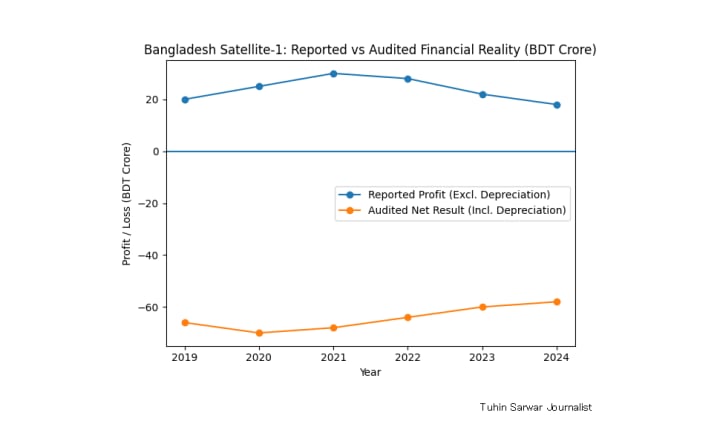
According to investigative reporting based on audit documents and accounting analyses, the annual depreciation on Bangladesh Satellite-1’s asset value estimated at around BDT 1.86 billion (approximately USD 17 million) was not recognized in BSCL’s profit calculations. When depreciation is excluded, the company’s accounts appear profitable on paper; when it is included, the company reports a net annual loss of approximately BDT 660 million in key fiscal years. These discrepancies were highlighted in independent media reporting that scrutinized BSCL’s audit documentation
(see Prothom Alo investigative analysis: https://en.prothomalo.com/bangladesh/cvtckjlo5y
) and editorial commentary calling the project a sheer waste of public money The Daily Star editorial: https://www.thedailystar.net/opinion/editorial/news/sheer-waste-public-money-3703841, Bangabandhu Satellite incurs loss of Tk 600m annually Prothomalo
Where the government presented profit figures to enhance the optics of success, inclusion of depreciation reveals a pattern of systemic loss rather than genuine profitability a serious integrity gap in the financial reporting of a state-owned entity managing a major national project.
Transponder Utilization: A Core Commercial Metric
The commercial viability of any communications satellite hinges on how much of its transponder capacity is leased and utilized. Bangladesh Satellite-1 carries 40 transponders radio frequency channels used to transmit data and broadcast signals. This capacity was expected to underpin both domestic and international revenue streams.
But as industry and media sources report, utilization fell far below expectations: only about 59% of the C-band and roughly 25% of Ku-band capacity has been leased, with the majority of clients being local television stations. International market penetration remained limited, despite early projections of lucrative foreign leases a stark deviation from initial expectations
The Business Standard feature & data: https://www.tbsnews.net/features/panorama/bangabandhu-satellite-1-what-did-white-elephant-really-deliver-985346 The Business Standard
Global industry standards generally consider an 80% transponder utilization rate a benchmark for commercial viability. Bangladesh’s figures, based on public analysis, did not approach this threshold, resulting in underperformance in revenue generation and commercial reach — even as the satellite’s operating costs and loan servicing continued. Observers described this underutilization as evidence that capacity exceeded actual market demand, particularly in international markets where competition from regional and global satellite providers was significant
(International Telecommunication Union utilization norms: https://www.itu.int) Grokipedia
Unrealized Foreign Market Ambitions
One of the most aggressively marketed benefits of Bangladesh Satellite-1 was its potential to generate foreign exchange by selling bandwidth to neighboring regions and beyond. The government claimed that neighboring countries would adopt Bangladesh’s satellite services, fostering a regional footprint.
Yet independent reporting and industry analysis suggest this projection was never grounded in realistic market analysis. According to industry commentary, negotiations with potential foreign clients, such as Nepal or Southeast Asian operators, were marred by pricing misalignment and lack of pre-contracted agreements, leading to limited uptake of services and foreign sales
(Bangladesh Pratidin correspondent report: https://en.bd-pratidin.com/special/2025/05/25/37944 ) en.bd-pratidin.com
One satellite engineer and industry insider told reporters that the promised international market uptake was mostly unrealistic, pointing to insufficient pre-launch market development and stiff competition from established satellite operators who could offer more favorable pricing and broader service coverage realities that were obscured during public promotion of the project’s potential.
Frequency Coordination Challenges: Known but Unshared
Satellite operations, especially in the crowded geostationary belt, require meticulous coordination of orbital slots and frequency allocations, often through the International Telecommunication Union (ITU). This process ensures satellites do not interfere with each other’s signals—a critical factor for commercial agreements across borders.
Multiple sources, including technical insiders and audit-informed reporting, indicate that frequency coordination with neighboring jurisdictions posed challenges before the satellite’s launch and in early operations. These coordination limitations, which affected certain regional leasing opportunities, were not widely disclosed in government-issued communications at the time of contract negotiations or pre-launch briefings. Observers argue that this omission prevented a more realistic public understanding of operational constraints and revenue prospects. The ITU maintains records of orbital coordination dialogues that suggest extended negotiation periods and overlapping claims on adjacent slots
(ITU Orbital Coordination Records: https://www.itu.int/en/ITU-R/space) Bangla Outlook
Opaque Cost Structures and the Missing Comprehensive Analysis
Official documentation places the total cost of Bangladesh Satellite-1 at roughly BDT 27.65–30 billion, including procurement, construction, launch, and ground station infrastructure. Critics, including independent policy analysts, argue that this figure alone requires greater transparency and granular accounting, especially when compared with outcome performance.
Despite public statements about economic benefits, no comprehensive, independently verified cost-benefit analysis has ever been made available to Parliament or the general public. Analysts from Bangladesh’s Centre for Policy Dialogue (CPD) and other research bodies have repeatedly called for such analysis to determine whether alternative investments—such as leasing capacity from existing satellites or investing in terrestrial broadband infrastructure may have delivered greater socio-economic impact at lower cost
(CPD Review of Satellite Investment: https://cpd.org.bd ) Bangla Outlook
This lack of cost-benefit transparency is particularly striking given the satellite’s role as a symbol of national prestige, and fosters suspicion of selective data disclosure for political benefit rather than comprehensive economic evaluation.
Loan Obligations, Debt Servicing, and Long-Term Burden
Bangladesh Satellite-1 was financed in part through significant loans. Records and investigative accounts show that a portion of the project was funded by a term loan facility of €155 million from HSBC Bank, equivalent to roughly BDT 14 billion at prevailing exchange rates, structured over a 12-year tenure a significant fiscal burden for the state.
Sources indicate that the Bangladesh Telecommunication Regulatory Commission (BTRC) remains responsible for servicing this loan, with biannual payments of roughly USD 8.5 million continuing through 2028. As currency depreciation has increased the taka cost of repayments, these annual obligations now place heightened pressure on state finances. Observers describe this ongoing debt service as a long-term fiscal burden that will outlive any residual commercial benefit from the satellite
(The Daily Star report: https://www.thedailystar.net/news/bangladesh/news/bangabandhu-1-satellite-another-white-elephant-3703321) The Daily Star
Independent commentary in national media referred to these dynamics as making the satellite a potential “white elephant,” a costly symbol with limited market return especially when viewed through the lens of broader opportunity costs and competing public spending needs.
Human Impact: Limited Reach, Uneven Benefits
Despite governmental claims of national connectivity gains, the on-the-ground reality for citizens has been more modest and uneven. Most of the satellite’s revenue continues to come from leasing transponder capacity to domestic television channels and a handful of institutional clients. Broadband connectivity improvements in remote islands and high-altitude areas, while real, have been incremental rather than transformational, and nowhere near the expansive economic uplift many critics expected.
Independent reports suggest that private companies and some government agencies use the satellite for specific services, but the high cost of bandwidth and limited international uptake means broader public benefit remains constrained a tension between symbolic technological achievement and substantive impact on daily life.
Political Symbolism vs. Economic Substance
In early 2025, the interim government renamed the satellite Bangladesh Satellite-1 and removed politically affiliated names from several ground stations, framing this as an effort to depoliticize national infrastructure assets. However, while symbolic, this change did not address the deeper financial, strategic, and reporting deficiencies that audits and independent analysis have exposed.
In parallel, a government-appointed committee commenced reviews of BSCL’s past operations, including alleged irregularities and mismanagement, underscoring the degree to which governance concerns now intertwine with fiscal and strategic debates about the project’s legacy and future direction efforts that have been publicly documented by regulatory officials seeking accountability
(The Business Standard report: https://www.tbsnews.net/bangladesh/satellite-companys-previous-activities-under-review-nahid-islam-956621) The Business Standard
Conclusion: A National Milestone, But Which Narrative Prevails ?
Bangladesh Satellite-1 remains an undeniable achievement in science and engineering for Bangladesh. Its launch placed the country among a select group of nations with geostationary satellite capabilities. But whether this milestone translates into sustained economic benefit, sound public spending, and lasting impact on citizens depends on transparent evaluation, independent scrutiny, and rigorous accountability mechanisms.
Symbolic success can be powerful but when it obscures structural losses, paints an incomplete financial picture, and masks decision-making flaws, it risks misleading the very public it was meant to inspire. True progress demands that the story of such investments be told not just through celebratory narratives, but through a faithful accounting of costs, benefits, risks, and outcomes measured in hard data, documented facts, and human impact.
Ref : Tuhin Sarwar Journalist
Author About : Tuhin Sarwar is a Bangladeshi investigative journalist reporting on human rights violations, child labor, and the Rohingya crisis on global platforms
About the Creator
Tuhin Sarwar
Tuhin Sarwar is a Bangladesh-based investigative journalist reporting on human rights, child labor, and the Rohingya refugee crisis through field-based research. Explore his verified portfolio at https://tuhinsarwar.com/
Keep reading
More stories from Tuhin Sarwar and writers in Journal and other communities.
Rohingya Girls Trafficked Inside Cox’s Bazar Refugee Camps
By Tuhin Sarwar : Cox’s Bazar & Dhaka Investigative report exposes transnational exploitation of Rohingya girls and women through false job offers, hotel-based sexual labor, forged documents, and maritime smuggling.
By Tuhin Sarwar3 months ago in Journal
Chad Pratt California: A Life Measured in Meaningful Miles
For some, running is simply exercise. It is a way to stay fit, relieve stress, or compete on weekends. For Chad Pratt California, running has always carried deeper meaning. It has been a discipline, a refuge, a teacher, and a steady companion through every chapter of life. Across decades filled with competition, personal triumphs, heartbreak, faith, and fatherhood, he has returned again and again to the simple rhythm of forward motion.
By Chad Pratt6 days ago in Journal
Trickle Them Down, But Not Out
The thing about smart people is that they should know better, but alas, intelligence is not the same as wisdom. Not only do the mistakes of experts too short on vision—when they are not corrected—have the potential to do great and far-reaching damage, but they also undermine public confidence in the very notion of expertise. This is particularly so when expertise is wielded in defence of the rich and powerful as a cudgel against those laid low. As an academic, this lack of faith in “so-called experts” is painful to see as it plays out in the spread of dis-/misinformation, conspiracy theories, and anti-intellectualism writ large. But it is also an understandable impulse given the catastrophic failure of an economic ideology pushed by certain economic experts. Supply-side economics has shaped a broken system for the last half-century and has arguably done more to undermine the fabric of the American Dream than any policy framework of the past century.
By Cory Wright-Maley3 days ago in Humans


Comments
There are no comments for this story
Be the first to respond and start the conversation.