
When the Toys Remember Us
A Poem of Play, Time, and Tender Silence

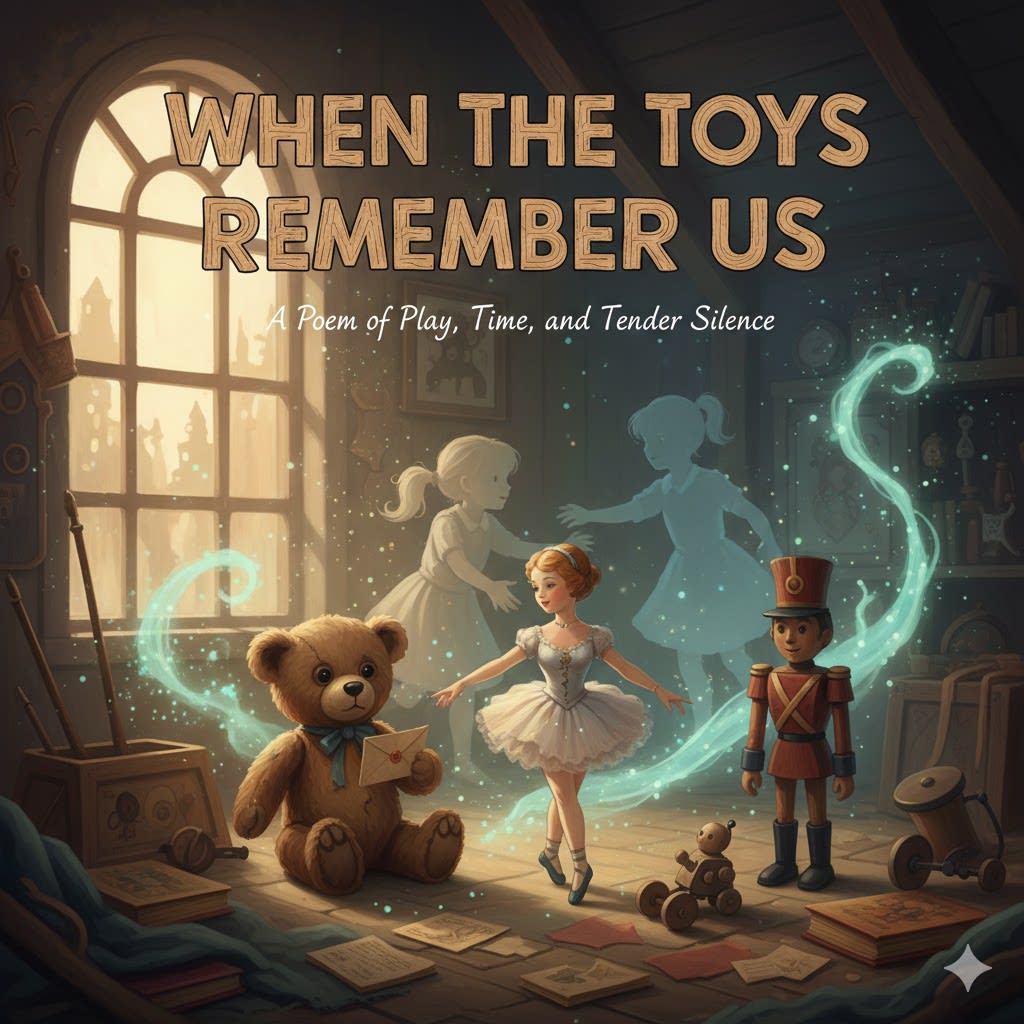
In the corner of the room, where dust learns patience,
they sit—
the toys—
keepers of a language once spoken fluently
by small hands and fearless hearts.
They do not complain about the quiet.
They have survived louder losses.
A wooden train rests mid-journey,
its wheels frozen between destinations
no map remembers anymore.
Once, it carried kingdoms made of carpet,
tunneled beneath chairs,
crossed mountains of folded blankets.
Now it waits,
faithful as memory,
for a whistle that no longer sounds.
The teddy bear leans against the wall,
one eye stitched slightly lower than the other,
giving it a look of eternal understanding.
It knows secrets.
It has absorbed tears without asking questions,
has been hugged through fevers, nightmares,
and the strange loneliness children feel
before they learn the word for it.
Its fur is thin where love was strongest.
A doll lies on her back, staring upward,
her plastic smile unchanged by years.
She once drank invisible tea,
attended weddings of imagination,
listened patiently to stories that had no endings.
She was a doctor one day, a queen the next,
proof that a child’s world
has no ceilings.
Now she listens to silence,
still willing,
still ready.
The puzzle pieces remain half-assembled,
their edges dulled by urgency.
Once, they taught small fingers patience,
taught the joy of fitting,
of belonging.
Now a few pieces are missing,
lost under furniture or time,
just like parts of ourselves
we don’t remember losing.
A ball rests in the corner,
scuffed and quiet.
It once flew like a promise,
chasing laughter across the yard,
rolling into scraped knees and triumph.
It remembers the sun better than we do,
the way afternoons stretched endlessly,
as if tomorrow were a rumor
not yet proven true.
The toys have learned
that children grow upward and outward,
leaving behind entire universes
without realizing it.
They understand abandonment
without bitterness.
They know that love does not always return
in the same shape it left.
At night, when the house exhales,
the toys do not move—
but if memory had footsteps,
this room would echo.
Each toy hums softly
with the ghost of play,
with the warmth of hands
that once believed them alive.
There is a toy car with a missing door,
brave and incomplete.
It survived crashes staged for excitement,
dives off tables meant to test gravity.
It taught a child
that breaking does not always mean ending.
Sometimes it means becoming a story
worth telling longer.
The crayons lie dried and broken,
colors shortened by enthusiasm.
They remember drawing families
bigger than life,
houses with too many windows,
suns that smiled on command.
They remember when art was not judged,
only felt.
A plastic dinosaur stands frozen mid-roar,
guardian of imaginary lands.
Once, it defended the weak,
challenged the impossible,
died heroically only to rise again
five minutes later.
It remembers a time
when fear was thrilling,
not heavy.
The toys do not resent the phone
that replaced them,
the screens that glow brighter than imagination.
They simply wait,
because waiting is what love does
when it understands time.
Sometimes an adult enters the room,
older now, slower.
Their eyes catch on the shelf.
For a moment,
they are not adults at all.
They are eight years old,
kneeling on the floor,
building a world that felt permanent.
That moment is enough.
The toys live for that pause—
that breath where memory touches now,
where responsibility loosens its grip,
and the heart remembers how to play
without apology.
The toys know something
we often forget:
that joy does not need permission,
that imagination is not childish,
only unpracticed.
They know that growing up
does not require leaving everything behind—
only choosing what to carry forward.
Eventually, the toys will be boxed,
donated, passed on.
They will learn new names,
new hands,
new laughter.
And they will love again
without comparison.
Because toys are not owned—
they are borrowed
by moments,
by childhoods,
by hearts not yet guarded.
And when all the rooms change,
when time rearranges the furniture of our lives,
the toys remain what they always were:
quiet witnesses
to who we were
before the world asked us to be more careful.
They wait,
not for us to return,
but for us to remember
that once,
we knew how to be light.
About the Creator
Time to change your life.
Is it even possible for you to change your life? A lot of people, more than there should be, are unhappy with their lives. But what are they doing about it? Usually nothing. People talk about how shitty their lives are and want change, but are they not taking the actions to change?
By Jen Phillipsabout 11 hours ago in Humans



Comments
There are no comments for this story
Be the first to respond and start the conversation.