
The Quiet Power of a Homily
A Story About Words That Heal, Challenge, and Change Lives

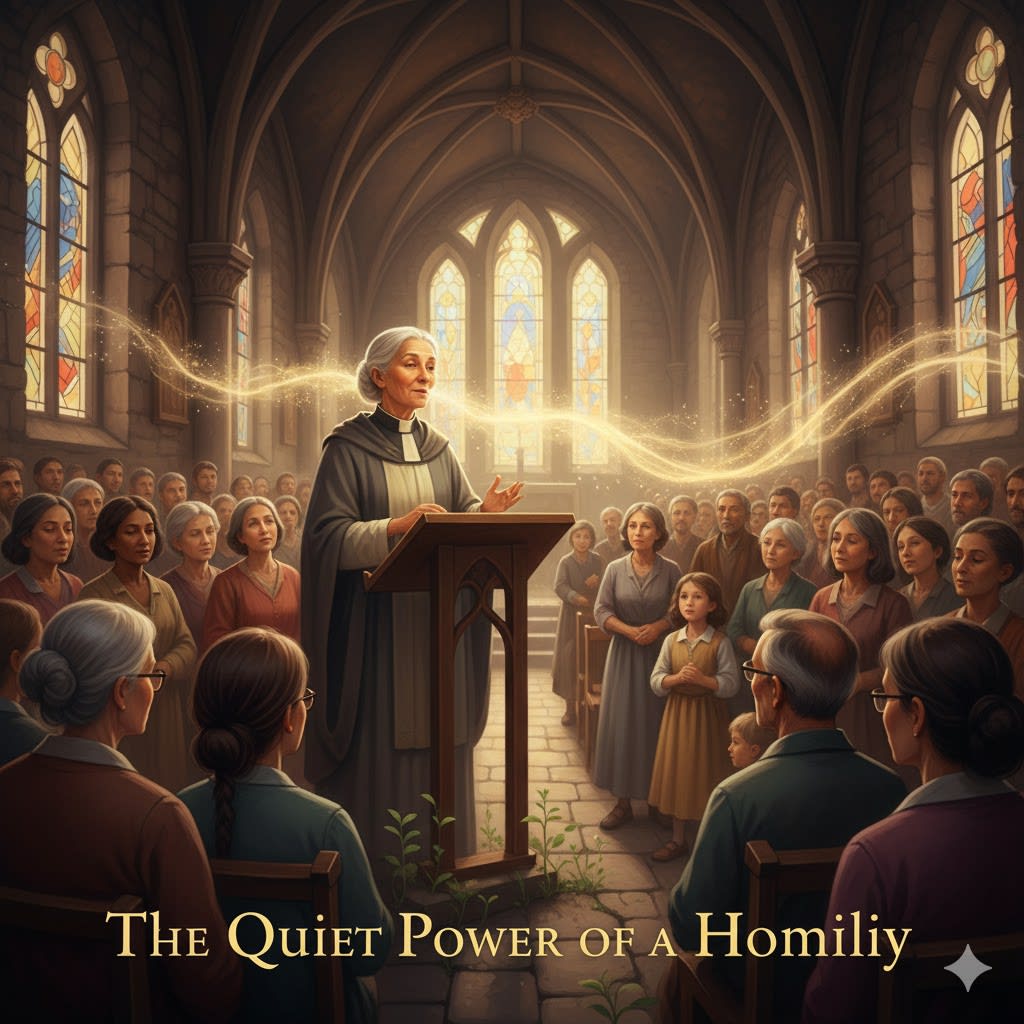
The church bell rang with a sound that seemed older than the town itself—deep, steady, and patient. It echoed through narrow streets, over small houses with worn roofs, and into the hearts of people who had learned to measure their weeks by its call. On this Sunday morning, the bell did not know that something unusual was about to happen. It rang as it always had, faithful and unchanged.
Inside the church, wooden pews creaked softly as people settled into their places. Some came out of habit, some out of faith, some because it was the only quiet space left in their crowded lives. There were tired faces, hopeful faces, distracted faces, and a few that carried grief so carefully it looked like silence.
At the front of the church stood Father Adrian, a man in his late forties with calm eyes and a voice that rarely rose above gentleness. He had served this parish for years, long enough to baptize children he later married, long enough to bury elders who once corrected his early sermons. He was respected, but not considered remarkable. His homilies were thoughtful, yes—but ordinary. Clear. Safe.
Today, however, Father Adrian felt different.
He had spent the entire night awake, sitting at his desk with a blank page before him. The homily he had prepared days earlier lay folded and untouched. It suddenly felt hollow, like words chosen out of duty rather than truth. Something inside him resisted reading it.
The reason sat quietly in his memory.
Two days before, Father Adrian had visited the hospital. Among the many rooms and beeping machines, he had met a young man named Lucas, barely twenty, injured in an accident that had taken his ability to walk. Lucas did not cry. He did not complain. He stared at the ceiling and asked one question over and over, not aloud, but with his eyes: Why?
Father Adrian had no answer. He held Lucas’s hand and said a prayer that felt too small for such pain. When he left the hospital, the city lights seemed colder, and faith—his faith—felt fragile.
Now, standing before the congregation, Father Adrian realized the homily he had written did not include doubt, struggle, or unanswered questions. It spoke of strength and hope as if they were simple choices. It no longer felt honest.
The readings were finished. Silence settled. All eyes turned toward him.
Father Adrian unfolded the paper… then slowly folded it again.
He took a breath.
“My friends,” he began, his voice steady but quieter than usual, “today I was supposed to speak to you about certainty. About knowing the path. But I cannot do that honestly.”
A ripple of surprise moved through the pews.
“Instead,” he continued, “I want to speak about faith when it feels weak. About prayer when words fail. About hope when it does not arrive on time.”
People leaned forward without realizing it.
He spoke of Lucas—not by name, not by detail—but as a symbol of pain that does not resolve neatly. He spoke of standing beside suffering without explanations. He spoke of God not as a distant answer-giver, but as a presence that stays even when answers do not come.
“A homily,” Father Adrian said, “is not meant to impress. It is meant to accompany. Like a hand on your shoulder when the road disappears.”
In the third pew sat Mrs. Helen, a widow who had lost her husband the year before. She had stopped praying because silence felt like rejection. As Father Adrian spoke, something loosened inside her. She realized silence could also be space—space where grief was allowed to breathe.
Near the back sat Daniel, a teenager dragged to church by his parents. He had decided long ago that sermons were just speeches. But today, he heard something unfamiliar: honesty. Not preaching at him, but speaking with him. For the first time, he wondered if faith could include questions without punishment.
Father Adrian continued, not reading, not rushing.
“If you leave here today still confused,” he said, “still hurting, still searching—that does not mean this homily has failed. It may mean it has begun.”
He reminded them that even sacred texts were filled with cries, doubts, and waiting. That belief was not the absence of struggle, but the courage to stay present within it.
When he finished, there was no dramatic ending. No raised voice. Just a soft “Amen.”
The silence that followed was deep—not empty, but full.
After the service, people lingered longer than usual. Conversations were quieter, more thoughtful. Some wiped tears they did not expect. Others simply stood, unsure why their hearts felt heavier and lighter at the same time.
Mrs. Helen approached Father Adrian.
“Thank you,” she said. “Today, I felt… allowed.”
He nodded, understanding more than she said.
That afternoon, Father Adrian returned to the hospital. He sat beside Lucas again, not with prepared prayers, but with presence. He told him about the homily, about a room full of people learning that faith did not require pretending.
Lucas listened. For the first time, he spoke.
“I don’t need answers,” he said slowly. “I just don’t want to be alone in this.”
“You’re not,” Father Adrian replied.
Weeks passed. Word spread—not dramatically, but gently. People spoke of that homily not as a great sermon, but as a turning point. Attendance did not surge. Miracles did not explode. But something shifted.
People listened differently. They prayed more honestly. They allowed cracks in their faith without shame.
Father Adrian continued to prepare homilies, but now he left space for silence, for humility, for humanity. He understood that a homily was not about standing above others—it was about standing among them.
Years later, when asked which sermon he was most proud of, Father Adrian never mentioned scripture references or eloquent phrasing. He spoke instead of the day he set aside his prepared words and chose truth.
Because that homily did not solve problems.
It did something quieter.
It reminded people that faith is not a polished speech—it is a shared journey, spoken one honest word at a time.
About the Creator
Thief In The Night
To the thief in the night that took and replicated what once was mine: Honestly, I feel kind of bad for you. It’s funny, because we hardly know each other. I only know of you through the magazines you’ve written and the broadcasts you have televised in the past — as well as through the public mentions of you from your show business connections there.
By Snarky Lisa6 days ago in Humans
The Voice in the Dark
In the history of big cities there are moments when everything turns into chaos and people don't know where to go in those moments only the people with real character and tarbiyat can lead others to safety this is the true story of Rick Rescorla who was born in a small town in England and later moved to America he was a man who had seen many wars and he knew that safety is not something you get by luck it is something you prepare for every single day
By Hazrat Umer5 days ago in Humans



Comments
There are no comments for this story
Be the first to respond and start the conversation.