
The space in-between
An observation from a Starbucks


What do you call the place in between work and home life? Perhaps every Sunday you take a walk to a local café or enjoy a walk in the park after work. What do you call this place in your mind? Is it simply a part of your monotonous everyday routine, or is it something more?
Ray Oldenburg, sociologist, wrote about this middle place in his 1989 book titled "The Great Good Place". He called this space the third place (Steelcase).
We as humans have always been aware subconsciously of the third place phenomena. For some, a third place might be the local library, for others it might be a favorite store. The point of a third place is to establish yourself as a person outside of home life and work life. It exists to help us make connections with people in between the long work days and harsh realities at home. I consider the concept of a third place to be absolutely essential for our development and evolution as people (I never took a psychology class, but I just feel strongly about this concept).
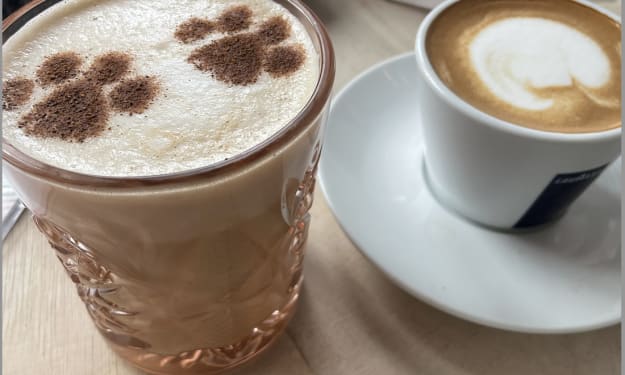
So why am I writing about this? Well, I'm currently sitting in a Starbucks surrounded by high school aged children. They are loud, don't fully grasp boundaries or acceptable talk volumes, and seem to be everywhere. However, while others might find them to be annoying, I see something different: I see these kids finding their third place and embracing the important steps of their development.
However, according to Rao (2024), third places are disappearing in America due to social media overconsumption and residuals leftover from the pandemic (social distancing). According to this article, the pandemic banned our favorite places that we once went to to escape and we just got used to spending time indoors (Rao, 2024). I also want to mention that remote jobs, while great, also contribute to the decline of third places by cutting out the work space completely. Instead of experiencing an office life with likewise coworkers, now that space is your spare-room. With the invention of grocery apps like Instacart and convenient food delivery apps like Doordash, why bother leaving your house anymore? And while you're at it, why bother finding a third place?
Rao's (2024) article also mentions that social media and online video game spaces have become third place alternatives for growing teenagers. This, however, is not true communication. True communication involves tone and eye contact and touch, and I don't mean to be that guy, but how is online messaging through Instagram comparable? Sending a message with your thumbs, in my opinion, isn't the same as having a meaningful vocal conversation.
Another reason why third places are disappearing has to do with economic issues (Rao, 2024). Individuals who live in so-called wealthy areas have access to community pools, safe sidewalks, enriching community programs, and private sport areas like parks or golf courses (Rao, 2024). Individuals who are considered lower income simply can't afford to spend time in their third places because other things take priority (Rao, 2024). These individuals are most likely working long hours and can't justify using the community pool because, A. sleep and getting dinner ready for the kids is more important, and B. it doesn't exist.
So back to my afternoon in this crowded Starbucks. An hour later, there are still teenagers here. A group of girls in uniform from a private school sat near me, and while their phones are still visible, they are talking to each other. It's silly, but empowering in ways that I can't quite articulate. Where I live, in the past certain places have created curfews for teenagers to reduce petty crime, and while I do agree that some teens are troublesome on purpose, is it right to restrict all of them?
Another issue is transportation. It's hard to get around in America without a car. This forces teenagers to ask their parents to pick them up and drop them off. In other countries like Japan and Denmark, children regularly venture outside on their own and take public transportation and maneuver the world without parental influence. In other countries, it's much harder to do this. In America, there are real consequences for allowing children to be alone in public. In multiple articles I've found, there are reports of parents facing legal prosecution for allowing their kids to take the train alone and even walk to a park alone. How are these kids supposed to find their third space if the public makes it actively clear that they're unwelcome? Thankfully, these teenagers I'm observing in this Starbucks appear to have been walking home from school together and seem to have establish this chain café as their third space.
In my undergrad years, I took some art classes. I had one professor who made us go outside and sketch trees. I would set my bulky canvas down on the grass, study a tree, and let my pencil takeover. I would study the branches and each leaf and the trunk, but the actual tree was only half of the sketch. My professor wanted us to meticulous learn the structure and shape of each tree: how each branch curved and how it was all significant for each tree to be considered a tree. However, he also wanted us to study the gaps of each branch and leaf that revealed sunlight. The sunlight spaces also made up the tree. My professor called these spaces the space in-between, and in a way, this concept is the same as a third place concept. Both spaces are always there and are essential for growth and development. These spaces in-between shouldn't be ignored, and should instead be embraced and acknowledged.
About the Creator
Jenuine Travel
Hello there! In the past I've written about different graphic books that I enjoyed, but now I'm moving in the direction of writing about my travel experiences! Enjoy!
Keep reading
More stories from Jenuine Travel and writers in Humans and other communities.
Cafés of Reykjavik
I recently had the wonderful opportunity to travel to Iceland on an EF Ultimate Break tour. I chose this tour company because I like the fact that it's exclusive to people in my age group (young adults). Iceland, the land of ice and fire, is a beautiful country inhabited by friendly and caring people. I can't wait to go back one day! In this article, I talk about some of my favorite cafés in Reykjavik!
By Jenuine Travelabout a year ago in Wander
Marc Guéhi
Marc Guéhi is a professional football player who is known for his calm defending, strong leadership, and smart decision-making on the field. He plays as a central defender and represents both club football and the England national team. Over the years, Marc Guéhi has become one of the most trusted young defenders in modern football.
By Farhan Sayed3 days ago in Humans
Silver Screen Magic with Mae West
American actress and singer Mae West became a popular film actress during the Great Depression. She started entertaining in vaudeville, then performed on Broadway, and finally went to Hollywood. She signed up with Paramount Pictures and made her debut in the 1932 film “Night After Night.” She also starred in musicals, comedies, and crime dramas. The American Film Institute named her one of the best classic Hollywood actresses.
By Rasma Raisters6 days ago in Geeks


Comments
There are no comments for this story
Be the first to respond and start the conversation.